Former Duke coach Bucky Waters is back on his feet. ‘I’m a grateful 84. And frisky!’
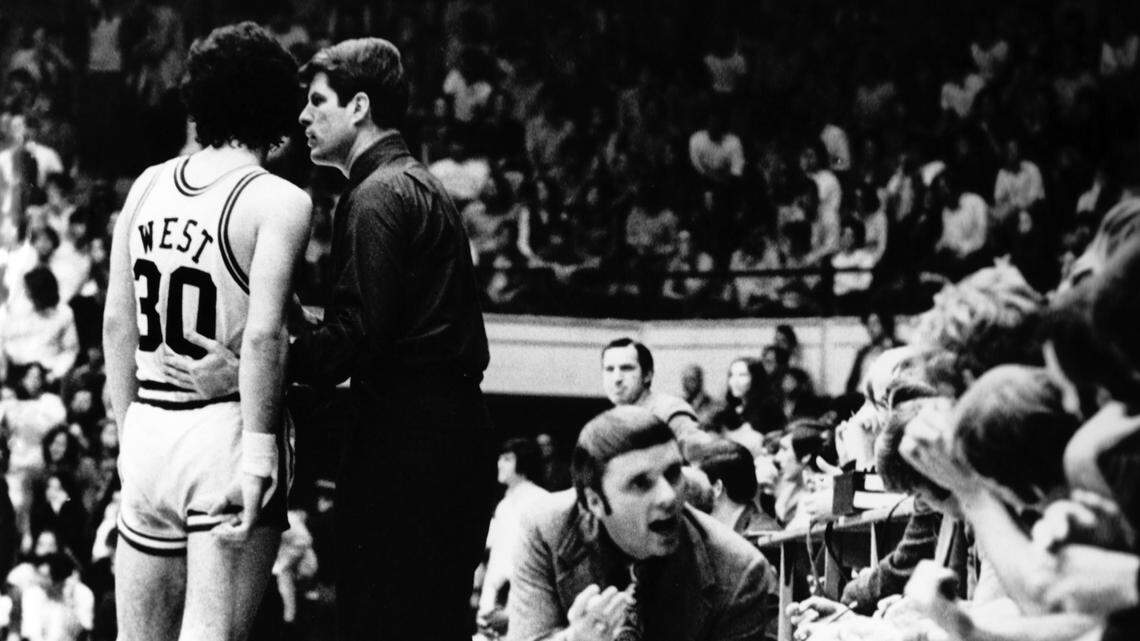
Bucky Waters’ aortic valve went into the transfer portal last week, which sent the Where’s Waldo of the ACC into the hospital at an inauspicious time to be in the hospital. After a new minimally invasive replacement procedure to replace the valve and implant what Waters calls a “shot clock” — a pacemaker — the former N.C. State player, Duke coach and ESPN broadcaster is back on his feet.
“I’m a grateful 84,” Waters said. “And frisky! I told them if I get off the redshirt list and back in action, I’ll make commercials for them.”
Waters rarely misses a Duke game at Cameron, but for now his recovery walks are confined to the Durham senior-living facility where he lives with his wife Dottie. They’re still an active couple but still sequestered on campus for their own safety and that of their fellow residents amid the COVID-19 pandemic.
The circumstances remind Waters of a different medical emergency from his youth.
“My age group, we went through polio,” Waters said. “It was the same fear, the isolation, the iron lung. I don’t remember it being global, but in our country, President Roosevelt had it. Famous people were paralyzed for life. It made you focus on some important things. I didn’t have dreams of grandeur. I wanted to wake up and be active and physical the rest of my life.
“So I had a little taste of it, but this is overwhelming in so many areas. The polio thing wasn’t of this magnitude. This really makes you pull back the covers and look at what you’re doing and how you’re doing it, how you’re making the most of your time. I’m retired, so it’s a different animal, but for people in the workforce losing their jobs, it brings tears to your eyes. We’ll come through this stronger. That’s my hope.”
These are also days of basketball reminiscence for Waters, who continues to work on a book about his journey from South Jersey to N.C. State, where he played for Everett Case (and future Duke coach Vic Bubas), arriving on campus as a freshman in the first year of the ACC.
As a 29-year-old rookie head coach at West Virginia in 1965, Waters brought his team back to the Triangle to play State and North Carolina at Reynolds Coliseum in a four-team event that was an attempt to reboot the ill-fated Dixie Classic, which had imploded in a gambling scandal a few years earlier.
Case, stricken with cancer, had stepped down the previous spring and been replaced by Press Maravich. (Later, after leaving for LSU, Maravich would beat Waters in a key recruiting battle for a star player: His son, Pistol Pete.) The night before opening against the Wolfpack, Waters went to visit the dying Case at his home in Cameron Village.
“He was really weak, lying on the bed,” Waters said. “I got down on my knees and said, ‘Coach, how you doing,’ or whatever, a courtesy kind of a thing. He almost never called out anybody by their first name. ‘Play defense, boy.’ ‘Rebound, boy.’ Everybody was ‘boy.’ He rolled his head back a little bit and looked up and said, ‘Boy, if I feel better tomorrow, I want to come see your team play.’ My eyes leaked right on him. I said, ‘You get better coach, I’ll come back after the game.’”
The next night, just before the State-West Virginia game was about to start, Reynolds erupted with noise. Case, frail and in a wheelchair, had made good on his promise to Waters with his first public appearance in months. Inspired, the Wolfpack romped. Later that night, Waters went back to Case’s house expecting the old coach to be asleep. Case was awake, waiting for him.
“I don’t think I helped you, boy,” Case told Waters. He died four months later.
Waters, who walked into the beginning of the ACC, has spent his entire life in it. From Case to Dean Smith to Mike Krzyzewski, there’s rarely a name that pops up that Waters doesn’t have an anecdote ready.
Even in this case, he can jump right to Smith. West Virginia beat North Carolina the next night, Smith put his arm around Waters’ shoulder.
“He had that smirk he always had, you never knew what he was thinking,” Waters said. “He said, ‘Please don’t think this is a welcome home present.’”
But Waters has been home ever since.
This story was originally published April 21, 2020 at 10:44 AM with the headline "Former Duke coach Bucky Waters is back on his feet. ‘I’m a grateful 84. And frisky!’."