Cut, dig, slide, glide: The Hurricanes MVPs might be the men who sharpen their skates
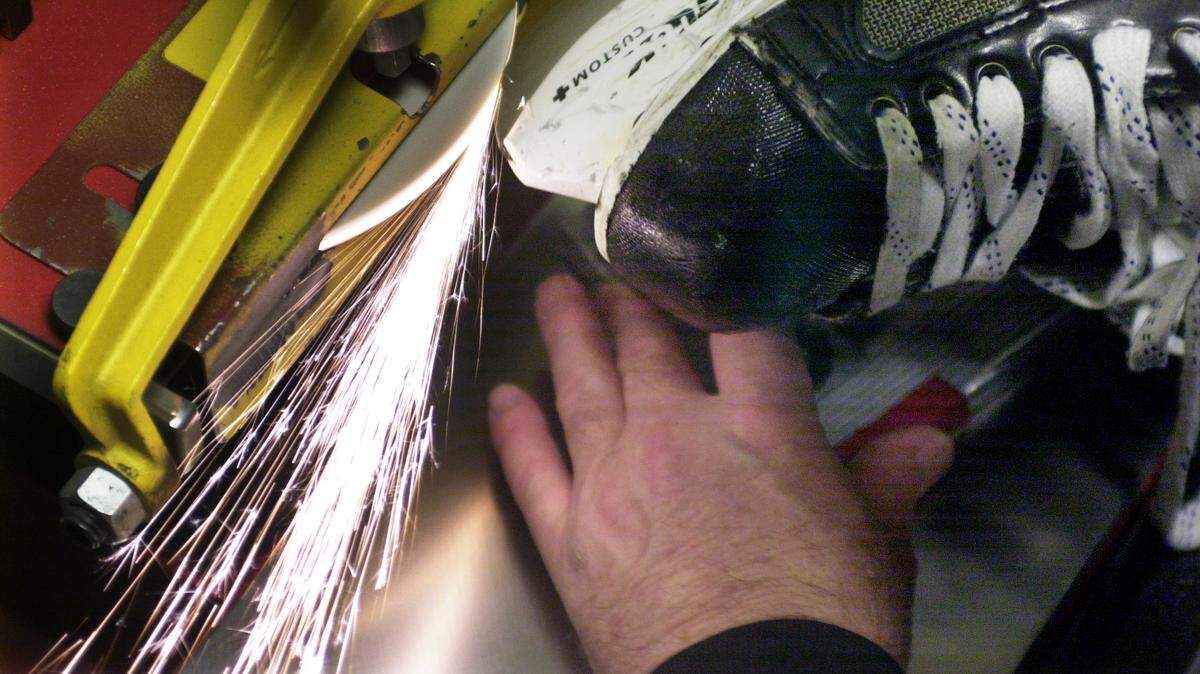
How many times did Wally Tatomir try to talk Rod Brind’Amour into putting a little less edge on his skates? Too many to count. Over and over again. Brind’Amour would never budge.
In his playing days, Brind’Amour liked his skates sharpened with a half-inch radius hollow, a relatively deep gap between the two edges of each blade. Tatomir, who was for many years the Carolina Hurricanes’ equipment manager and skate-sharpener in chief, wanted Brind’Amour to switch to a shallower hollow, one that would dig in less and allow Brind’Amour to glide more on the ice. But Brind’Amour always fought back.
“From my standpoint, I always loved to be able to feel the ice and cut and not slide on it,” the current Hurricanes head coach said. “I always liked my skates sharp.”
The relationship between NHL players and their blades is a delicate one, as sensitive and vital as the interface between the blades and the ice itself. A hockey skate doesn’t have a single edge, like a knife. It’s a 3-millimeter-wide piece of steel hollowed out down the middle in an inverted U to create two edges. An NHL player uses both edges on both skates, like a skier shifting weight from side to side during turns.
Most recreational players just want their skates sharpened. OK, fine. An NHL player knows exactly how deep his hollow is. Players measure it in fractions of inches, shorthand for the geometry of how the middle of the blade is cut away, but it is counter-intuitive to how it works: A larger hollow, like one inch, leaves a shallow arc between the two edges, slick and almost flat, better for gliding and expending less effort. A smaller radius, a half-inch or smaller, cuts a deep, more rounded furrow with sharp edges that dig into the ice for tighter turns and more agility, at the cost of more friction.
Then there’s balance, also known as rocker. That’s how much of the skate blade actually sits on the ice at any time. Most blades come from the factory with a broad natural curve from toe to heel. The Hurricanes — and most other NHL teams — grind a flat edge onto them that controls not only how much steel is in contact with the ice at any time but where on the blade the contact is, another matter of player preference. Some like more blade on the ice, some like less and some like to be pitched forward on their toes or sit back on their heels.
“I think everybody’s pretty particular with their skates and blades,” Hurricanes forward Vincent Trochek said. “I get mine cut at a half (inch) most times, unless the ice is a little dull. I have my rocker set a little bit forward, leaning forward.”
Factor in the wide variety of ice temperatures and consistencies players encounter from building to building and even period to period in the NHL, and equipment managers spend more hours working on the little pieces of steel at the bottom of the skate than just about anything else. Some players notice every little adjustment. Maybe most players.
Like a golfer tinkering with swing weight or shaft flex or grip size, or a race-car driver being able to feel a tire that’s slightly out of balance or flat, the connection between skate and ice is fundamental to a hockey player’s ability to perform, down to the most minute detail.
“If you can think of the brain not only attaching to the end of the stick that’s attached to your hands, but also that 50 millimeters that’s on the ice, this is a connected circuit between your brain and the feeling that’s created within your feet and your hands,” said former Hurricanes defenseman Bret Hedican, one of the NHL’s smoothest skaters in his day.
“That circuit, when things aren’t right, doesn’t feel good. ... But when I had the power under me, when I could feel every stride I took, I had power, and it was right where I needed it to be, I was like, ‘I dare you. I dare you to try me one-on-one. Give me everything you got. Test me.’ That’s how you get to that point where you’re that confident.”
Staying sharp
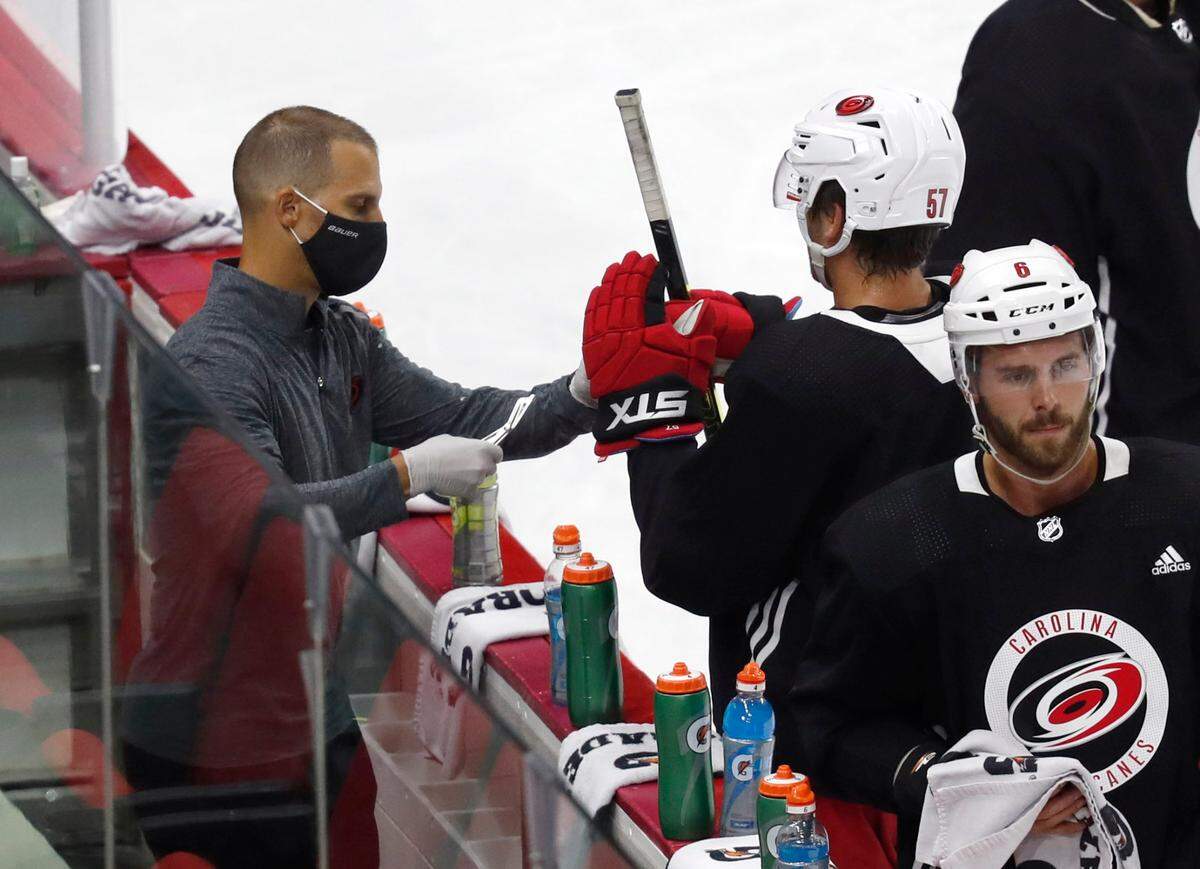
On any given day, Hurricanes equipment managers Bob Gorman and Jorge Alves split the sharpening. Gorman, who along with Skip Cunningham has been on the equipment staff since the team moved to North Carolina, handles all the players at five-eighths, about half the team. Alves, the team’s longtime practice goalie, took over the other half when Tatomir retired in 2012.
They sharpen every skate in the afternoon before every game, a process that takes them about an hour, each manager with their own sharpening machine. The machines aren’t complicated — there’s a grinding wheel set horizontally and the equipment manager moves the skate, on its side, along it by hand — but there’s an art to doing it right. The Hurricanes lug two sharpening machines along with them on the road.
Bigger, heavier players typically like less hollow, because they dig into the ice enough already. Smaller, lighter players like more, for more grip. But there are always exceptions, whether Brind’Amour’s half-inch or skinny Martin Necas’ one inch. Hedican started his career at three-eighths but found his “legs were fried” and spent most of his career at five-eighths. He wanted to go deeper, like many other superlative skaters, but never felt comfortable.
“I could never do that because I was more of a stop-and-start guy, particularly in the defensive zone,” Hedican said. “If you’re taking a second or two to stop because your skate blades are 1 1/4, now you’re sliding to a stop instead of digging in the ice.”
Goalies are, as usual, their own operation. When Martin Brodeur starred in the league, most goalies had a very shallow hollow, for shuffling from side to side. Brodeur had a very deep hollow, for digging in and pushing off and getting up from his knees. Now, that’s the standard.
Petr Mrazek has the deepest hollow on the team at a quarter inch and wants Alves to hand-hone even that to a finer edge. James Reimer is second at three-eighths.
“It’s funny,” Alves said. “When I came up it was one era and one style of play and I literally never liked to get my skates sharpened. They were always too sharp, no matter what it was. That’s how I felt. Then I went in the Marine Corps and didn’t play for four years and a lot had changed, with goaltending styles and everything else. I ended up going deeper, too. It’s changed a lot over the years, and it could probably change again.”
The equipment managers will sometimes change hollows without telling players, especially in warmer buildings where the ice is softer. A five-eighths player may get his skates sharpened to three-quarters before a game in Tampa, whether he asks for it or not. A few Hurricanes players have already backed off in Toronto, where the ice has been soft from playoff-bubble overuse, in hopes their blades dig in a little less.
Others are less concerned about their blades, under any circumstance.
“I don’t really think about that stuff at all,” Hurricanes defenseman Joel Edmundson said. “I’m at five-eighths, every time.”
Blade runners
The reason for all that tinkering, even by such tiny fractions of an inch: It matters.
“It’s hard to understand how much of a difference it makes,” former Hurricanes center Matt Cullen said. “It’s more than what kind of a shoe you’re wearing. You can change your posture on the ice. You can change how well you glide on the ice. You can change how well you turn. It makes an incredible difference as you adjust this.”
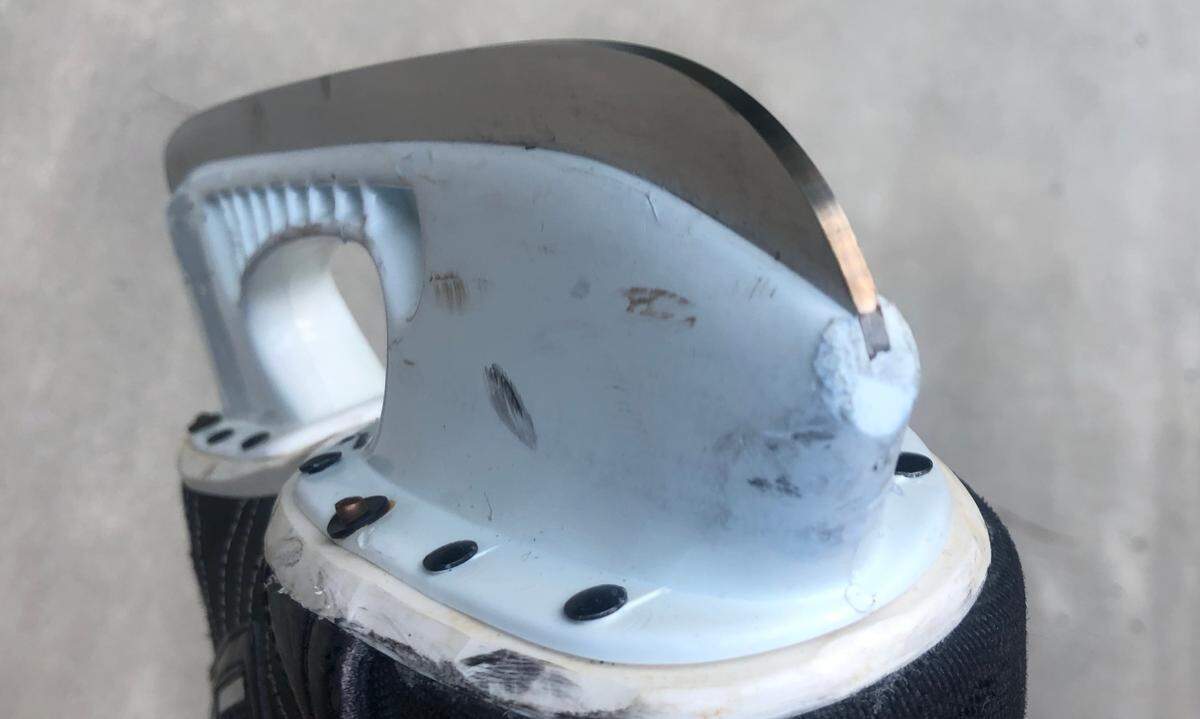
Once skates are sharpened, they’re not done. They need to be balanced, something that’s only become standard in the past 20 years or so. Tatomir holds the patent on the Pro Skate Balance machine the Hurricanes and several other NHL teams use. Others use one of its competitors, like Maximum Edge or Prosharp or CAG One. While the radius of a hollow is measured in inches, balance is measured in millimeters — two numbers, measuring how many millimeters forward of center the blade starts to curve toward the toe and how many millimeters of blade in total are on the ice. In equipment manager speak, former Hurricanes center Kevyn Adams was a 35/65 with a half-inch cut.
“If you put more millimeters on your blade, now you can back off on the hollow,” Tatomir said. “You can put less hollow on there now and you don’t have to work as hard. We proved that with different players.”
A blade comes from the factory curved on a 10-foot radius, with a gentle curve but still a curve. The PSB machine mills it down to a flat edge to a player’s precise specifications. The hollow and balance numbers — and the date of the last sharpening — are written in black Sharpie marker on the blade-holder of every Hurricanes skate.
It’s not something to which much attention is paid at the lower levels of hockey. When Alves was a minor-league goalie — he’s famous for appearing, briefly, in a game for the Hurricanes on New Year’s Eve 2016, back when teams were allowed to dress their own emergency goalies — his teammates would come to him with questions about their equipment.
Most didn’t know what their hollow was, let alone what it should have been. Alves ended up surreptitiously sharpening a few of his teammates’ skates. Now, there’s always a bit of an awakening when recent draft picks arrive for prospect camps and get their blades balanced for the first time.
“Some of these young kids come up and they don’t really know what’s going on with their steel,” Alves said. “They’ve never asked anybody. They don’t really know. You kind of sit down with the player, you analyze the way they skate, you analyze their stride, you kind of look and make suggestions.”
When Cullen was a rookie with the Anaheim Ducks in 1997, teammate Teemu Selanne pulled him aside after practice one day and asked him if he knew what his hollow was. Cullen, two years removed from high school, had no idea. Selanne told him it looked way too sharp to him, walked Cullen to the equipment room and asked the manager to put a seven-eighths hollow on them. (Cullen hadn’t considered until now, more than two decades later, how bad his skating must have looked to the Hall of Famer.) Cullen played on seven-eighths for the rest of his career.
“He said, ‘Cully, do you like to glide?’ and walked me through it,” Cullen said. “With a flatter hollow, you glide better, fatigue less, it’s easier on your body, your joints, your hips, your knees. I tried it, and it was an eye-opening experience. You feel so much better on the ice. Then I left it alone until I got to Carolina, and Wally was on another world as far as how advanced he was on the cutting of the steel.”
Cullen arrived in Carolina in 2005 to find a franchise on the cutting edge of this technology. Tatomir was able to move the center of his blades back and tip him forward a bit, which Cullen felt drastically improved his agility ahead of what turned out to be the best season of his career. Just about everyone in the NHL does it now — Tatomir’s machines are in almost every equipment room — but Tatomir swears balancing played a huge role in the team’s success in 2002, when the Hurricanes were ahead of the curve, no pun intended.
Hedican arrived in January of that season and, for the first time, could count on his skates feeling right. Over the course of his career, he had struggled to get his blades exactly the way he wanted them. It was almost like he lacked the words to express what he needed. Tatomir had the vernacular.
“With Wally, I finally had somebody that understood my language,” Hedican said. “I could tell him, ‘I feel like I’m in a perfect scenario right now with my hollow. Every time I push off, I’m exactly over the middle of my skate where I can garner the most power, right to the last little snap of the ankle where the point of the blade digs in.’ When I could feel that last little snap and push, I knew my skates were just right. And Wally could replicate what that felt like and make sure it felt like that every day. I wanted to kiss him on the forehead.”
In those old days, when the Hurricanes were one of very few teams actually doing it, players would arrive in a trade, put on their newly sharpened skates and suddenly feel faster. When Ron Francis came to the Hurricanes in 1998, Tatomir balanced his skates to 35/65, giving him more blade on the ice with Francis’ usual three-quarter inch cut. Francis went out for a spin and said it felt great, and he could do with less hollow.
By the time they were done tweaking, Francis’ blades were almost flat, with a very shallow 1 ½-inch hollow, like an old-time goalie.
“I only wanted to go to an inch,” Tatomir said, but with Francis approaching 40, the glide mattered more than the grip.
Sami Kapanen showed up with a standard curve on his blade and started at 25/50. Then 30/60. Then ended up at 40/80, a ton of blade in constant contact with the ice, more than three inches of it.
“I’ll never forget, one time he said, ‘Wally, can you tip me forward a little more?’ ” Tatomir said. “I put five more millimeters on the front. He did one circle two times around, nodded his head and was the fastest skater in the league that year.”
Living on the edge
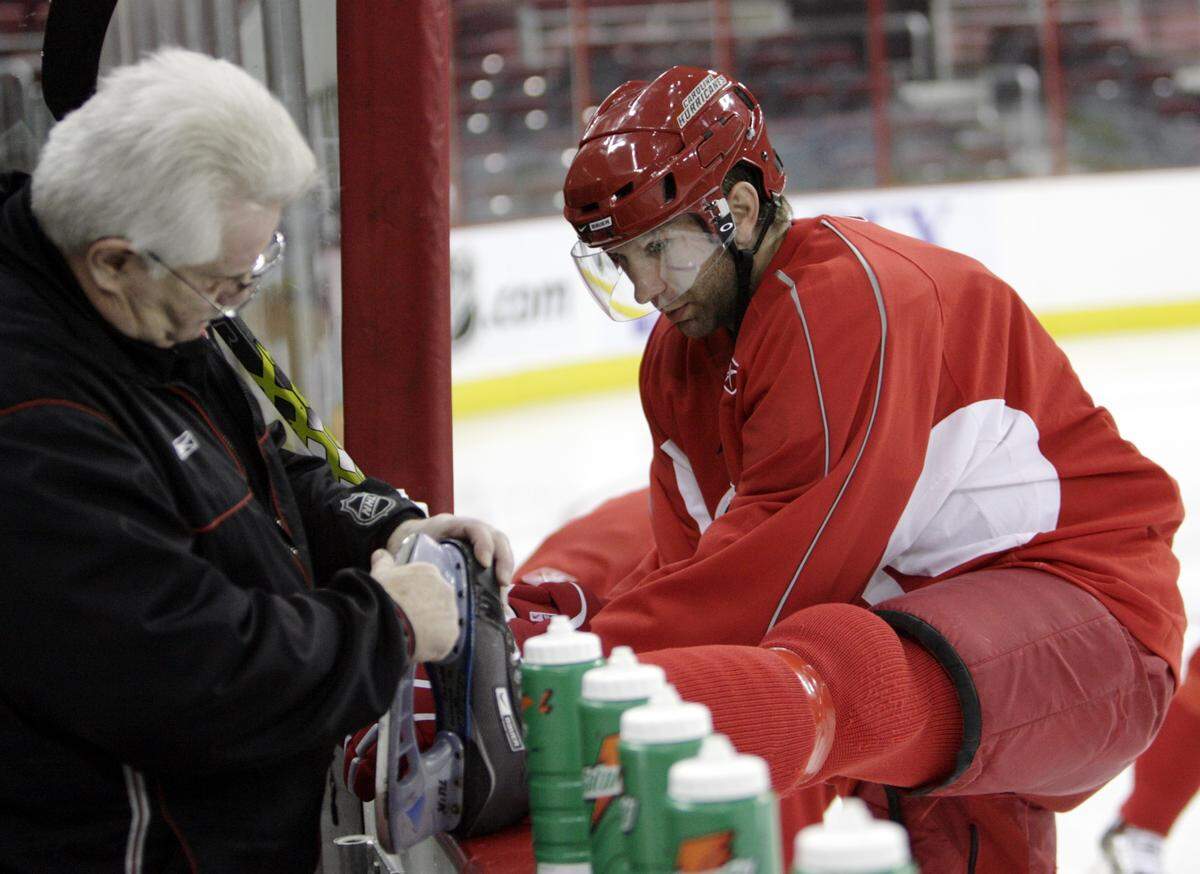
Keeping blades properly sharpened is an all-the-time thing for Gorman and Alves. Players frequently bump skates during games and lose their edge. Some players want their skates sharpened between periods, or in some cases even between shifts. Typically, Alves is the one who handles in-game sharpening while Gorman continues to man the stick rack.
“Last time we were here in Toronto, I probably sharpened throughout the game, and with it being the whole (emergency goalie) David Ayres thing, I was running around back there like crazy getting him set up,” Alves said. “It was just nonstop, four or five pair a period I was sharpening. Obviously, playoff hockey gets like that, too. They’re grinding in the corners with blades hitting each other. That’s how they lose edges. You go blade-to-blade with somebody else chasing the puck and the guy’s right next to you making the same stride, and when those skate blades touch each other you can lose an entire edge.”
That used to be a big deal when the blade was fixed to the skate; a player would have to walk off the bench, take off his skate and wait for it to be sharpened. Now, the blades themselves swap out. All a player has to do is stand up facing the ice, put his foot on the bench behind him and wait for Alves or Gorman to swap in a new one. The Hurricanes travel with a complete set of properly sharpened and balanced replacement blades for every player, each in its own pocket in a case that goes on the bench during games.
That doesn’t just save time. It saves money. In equipment manager math, a player making $8 million a season gets about $2,500 a shift. Not having to leave the bench and miss a shift saves thousands. But even with the quick-change blades, it’s not immediate.
“It does happen where a guy comes off and says, “I need new steel,” and then it’s a power play and he pulls his skate out of your hand,” Alves said.
Some players are more particular than others. Dougie Hamilton doesn’t just tweak his hollow and balance; he’ll actually ask Alves to make minute adjustments to how the blade is angled relative to his skate boot. Hedican could sense even the most minute deviations in his balance and still sends his skates to Tatomir for sharpening (five-eighths, 25/50), even just for his own recreational use.
It isn’t uncommon for Jordan Staal to have his skates sharpened multiple times during a game. Other players can play several shifts on dull, mangled blades without complaint. That latter group isn’t necessarily who you might think, grinders plodding away: It often includes some of the better skaters, who have an innate sense of how to avoid a dull edge without sacrificing performance.
“A good example of a guy who would wait for the next period is Jaccob Slavin,” Alves said. “Slavin’s a guy who would just wait it out. Brett Pesce, he would skate on crap the whole game and not realize it. ‘Pesh,’ his steel takes a beating and he just skates right through it.”
As for Brind’Amour today, he’s not even sure what his hollow is these days, for the little bit of skating he does in practice or with his kids.
“I don’t remember the last time I had my skates sharpened,” he said. “It doesn’t matter how I’m doing it now.”
But Cullen knows. All three of his sons play hockey in Minnesota. Cullen bought one of Tatomir’s balancing machines, and he sharpens and balances his sons’ skates himself. He has to do it often. They’re 13, 11 and 10, and they’re growing so fast they rarely stay in the same skates for long.
“I’ve turned into a skate guy,” Cullen said. “It makes such a difference. I’ve seen it with young kids, with my own kids. It makes such a difference.”
Cullen’s eldest, Brooks, just got new skates. Cullen put them on the machine immediately. Brooks is a 30/55 with a seven-eighths cut, balanced back of center so he tips forward a little. Just like his father.
This story was originally published August 7, 2020 at 8:52 AM with the headline "Cut, dig, slide, glide: The Hurricanes MVPs might be the men who sharpen their skates."