PNC Arena architects offer first look at how $300 million renovation could refresh arena
In the year since the historic agreement to renovate PNC Arena and develop its surroundings was reached, discussion of what the updated arena might actually look like has been mostly theoretical.
The Centennial Authority, which oversees the arena, spent that time working through its budget, changing architects and finalizing the myriad legal documents that extended the Carolina Hurricanes’ lease through 2044, secured $300 million in tourism tax money and will allow Hurricanes owner Tom Dundon to turn 80 acres of parking lots around the building into a mixed-use development.
Thursday, finally, it started to get real.
Deep inside PNC Arena, authority members and the general public got their first look at what Gensler Sports and Raleigh-based LS3P — the new architecture firms it hired in February — have cooked up to refresh the 25-year-old arena.
Demetra Thornton, the co-managing director of Gensler’s Raleigh office, led the authority through a presentation of more than 80 slides that showed the various concepts Gensler developed for the arena over the past five months,
The architects identified 10 projects in all, from behind-the-scenes infrastructure few fans will ever see to a new, modern facade that will change the face of the building.
“Something for everyone,” Thornton said. “That’s kind of the theme of what we’re talking about today.”
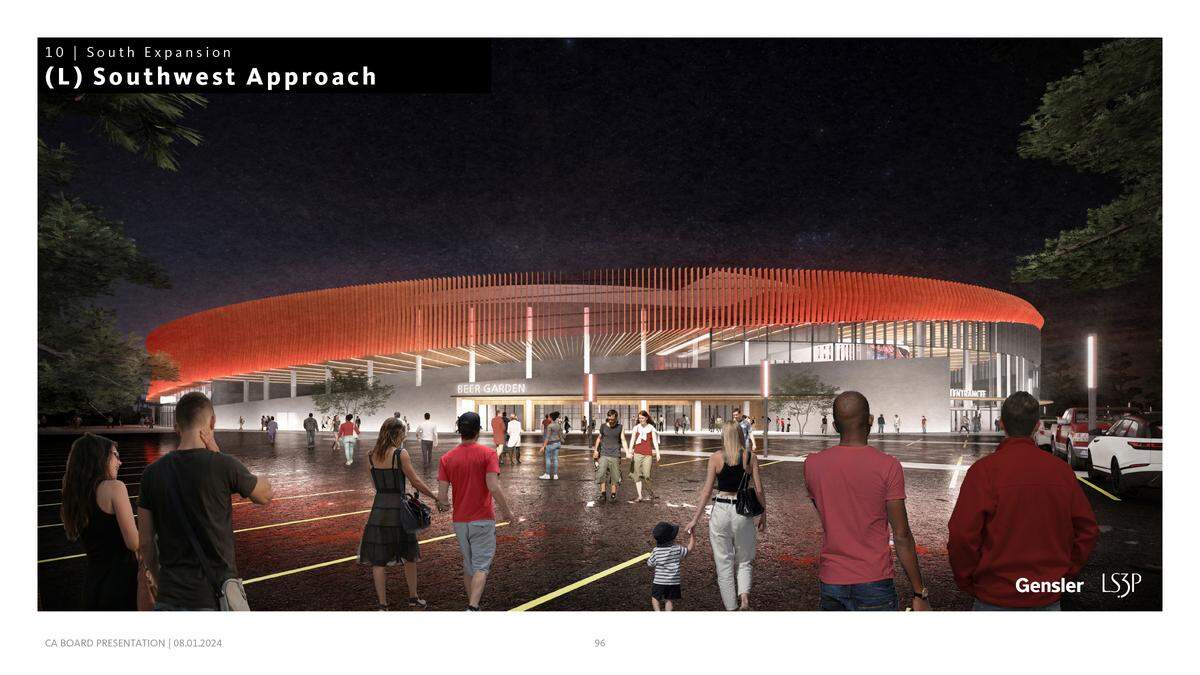
The projects included an overdue expansion to the loading-dock area on the north side of the building — that infrastructure will likely be in the first phase of construction, in the summer of 2025 — reimagined main and upper concourses and a potentially massive expansion of the south side of the building, facing Carter-Finley Stadium, that could include an exterior re-skin of the 25-year-old arena. The authority saw three scaled options for that expansion, with the largest creating a new, multi-story lobby.
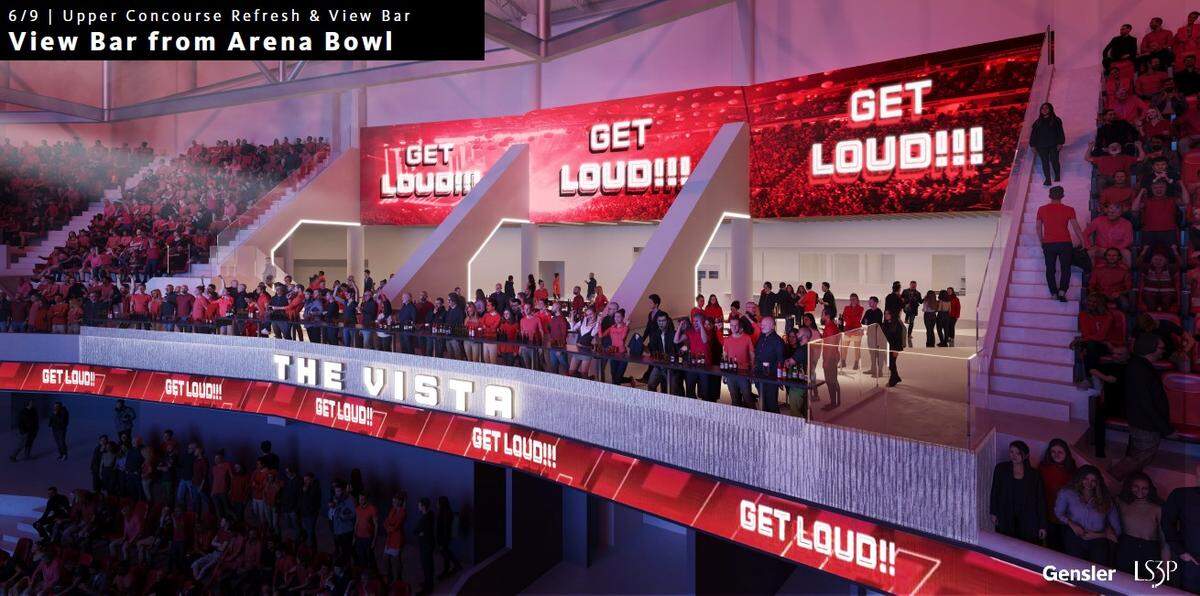
There are also designs for four new suites and a club/meeting area under the stands opposite the Zamboni entrance, a 7,600-square-foot external storage building to save space inside the arena and a 300-level bar overlooking the arena bowl, while a considerable amount of concession space and additional restrooms can be created on concourses by the removal of stairways that are no longer required by code. Many existing concession stands could be converted into grab-and-go markets while the also tripling the size of the existing The Eye team store.
“It’s extraordinarily exciting to see the ideas that Gensler has proposed to us,” authority chairman Philip Isley said. “It makes our next several years feel like it’s going to happen in a really good way.”
Not included from earlier imaginings were suites under the lower bowl accessed directly from the seats above, additional office space on the north end of the building or a rooftop bar overlooking the football stadium, although there are options for a ground-level beer garden in that area that could be open on non-event days.
It was a wide-ranging menu of potential choices, and the authority now has to work with its construction consultants to price out Gensler’s concepts so it can decide what it wants to do and what it can do within its budget before the first phase of construction begins next summer.
“What you’re seeing is possible from a construction point of view,” authority member Doyle Parrish said. “We just have to figure out a way to pay for it and construct it in an arena that’s in active use. ... It’s going to be a little bit of art and a lot of magic.”
The authority has been working on these renovations for a decade, delayed first by the 2018 sale of the team by Peter Karmanos to Dundon and then by the pandemic. There have been countless visits to other buildings — last week, an authority group toured Los Angeles’ SoFi Stadium and the Clippers’ new, $2 billion Intuit Dome — to gather ideas, but now, difficult choices lie ahead.
In the world of arena renovations, let alone construction, $300 million doesn’t get you as far as it once did. But Gensler also went into the project knowing what the authority’s budget was, and all of the concepts were developed with that in mind.
“The ideas are there and we have to do what we can with the money we have,” Isley said.
The renovations to the building are separate from Dundon’s plans for its surroundings, which are being overseen by Dallas investor Jonas Woods and Dundon through their Pacific Elm Properties development arm. The agreements call for a minimum of $800 million in development but new Hurricanes CEO Brian Fork reaffirmed Wednesday that Dundon envisions likely approaching or exceeding $1 billion.
The first phase is slated for $200 million in investment on a 20-acre plot that includes 100,000 square feet of retail and restaurant space, 150,000 square feet of office space, a 150-room hotel and 200 residential units, 10 percent of that classified as affordable housing. One other early priority is a $40 million, 4,300-seat live music venue managed by national promoter Live Nation.
Never miss a Luke DeCock column. Sign up at www.newsobserver.com/newsletters to have them delivered directly to your email inbox as soon as they post.
Luke DeCock’s Latest: Never miss a column on the Canes, ACC or other Triangle sports
This story was originally published August 1, 2024 at 2:00 PM with the headline "PNC Arena architects offer first look at how $300 million renovation could refresh arena."