How the Hurricanes’ would-be rebuilding year became another year as a contender
Andrei Svechnikov scoffed at the question, a reasonable one given the Carolina Hurricanes’ considerable offseason — and midseason — turnover. Had this team, in the Eastern Conference Final for the second time in three years, overachieved in what was expected to be a rebuilding year?
“Maybe some people were talking about that but we as a group, we never thought it was a rebuilding year,” Svechnikov said earlier this week. “We’ve got so many good players here. We just know we’ve got a new team. Especially in playoffs, it’s a different animal. We got so much experience the last six years.”
Both the question and the answer were fair. Long before they ended up here, this was supposed to be at least a little of a retooling for the Hurricanes. The departures of trade-deadline rental Jake Guentzel and stalwarts like Brett Pesce and Brady Skjei and Teuvo Teravainen over the summer prompted a regrouping and retrenching with limited cap space.
That all presaged what figured to be a bigger splash in 2025-26, when hotshot rookie defenseman Alexander Nikishin would claim a spot on the blue line as big-money contracts for players like Brent Burns and Dmitry Orlov fell off the books.
The best laid plans, etc. etc. — but in a good way.
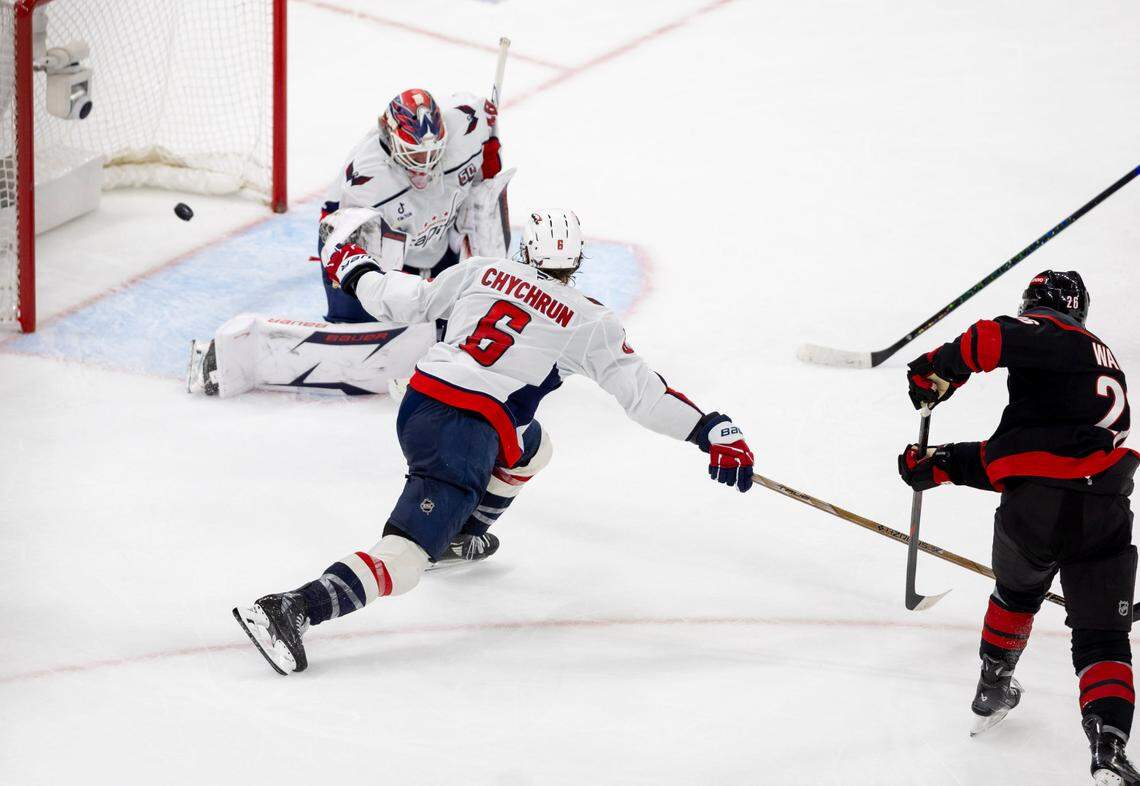
First, even working with limited resources, the Hurricanes seemed to find all the right players at all the right prices during the offseason. Sean Walker, a quietly efficient and reliable defenseman, not the skater Bret Hedican was or as big, but very much in the same mold. The return of Shane Gostisbehere to run the power play, empowered as The Guy this time. Big, hard-skating forwards William Carrier and Eric Robinson to bang around the opposition’s defensemen. Jack Roslovic, a 22-goal scorer who showed he could finish some of the chances the Hurricanes always create that too often went lacking.
No big names, only good deals. That’s about as far as anyone could ever stretch $12 million in cap space.
“We had a phenomenal hit rate this year, and that’s a huge credit to our scouting staff,” first-year Hurricanes general manager Eric Tulsky said. “It’s a credit to our coaches working with us on understanding what they’re looking for and what a fit would look like. It’s probably not sustainable.
“When you bring in seven or 10 new players, I don’t think you can bet on every single one of them fitting in the way you hope they all will. We’ve been lucky that this year, it’s gone that way, and it’s a testament to the players who came in and their ability to adapt. It’s a testament to the coaching staff and their ability to help them get acclimated.”
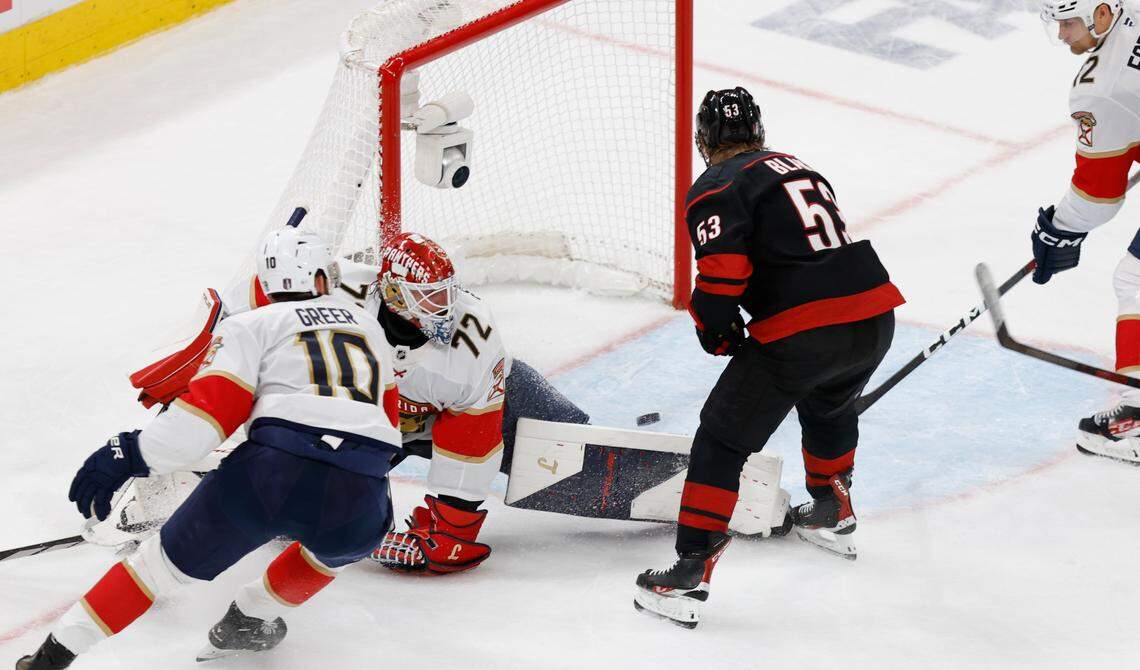
The group — along with rookie forward Jackson Blake, another pleasant surprise — meshed so quickly that what might have been a rebuilding year became just another contending season, comfortably cruising toward the playoffs for a seventh straight time despite the now-routine rash of midseason goalie injuries.
Things were going so well, the Hurricanes decided to make the kind of big swing they had been saving for this summer and pulled the trigger on the now-infamous Mikko Rantanen trade in January.
There’s obviously going to be revisionist history given the way things turned out, but the deal made sense at the time, just as flipping him to the Dallas Stars for Logan Stankoven and a pair of first-round picks made sense 42 days later when it was clear Rantanen would not or could not give his full effort here. (He has shown, in these playoffs, just how potent that full effort can be, which only highlights what a low percentage the Hurricanes were actually getting from him.)
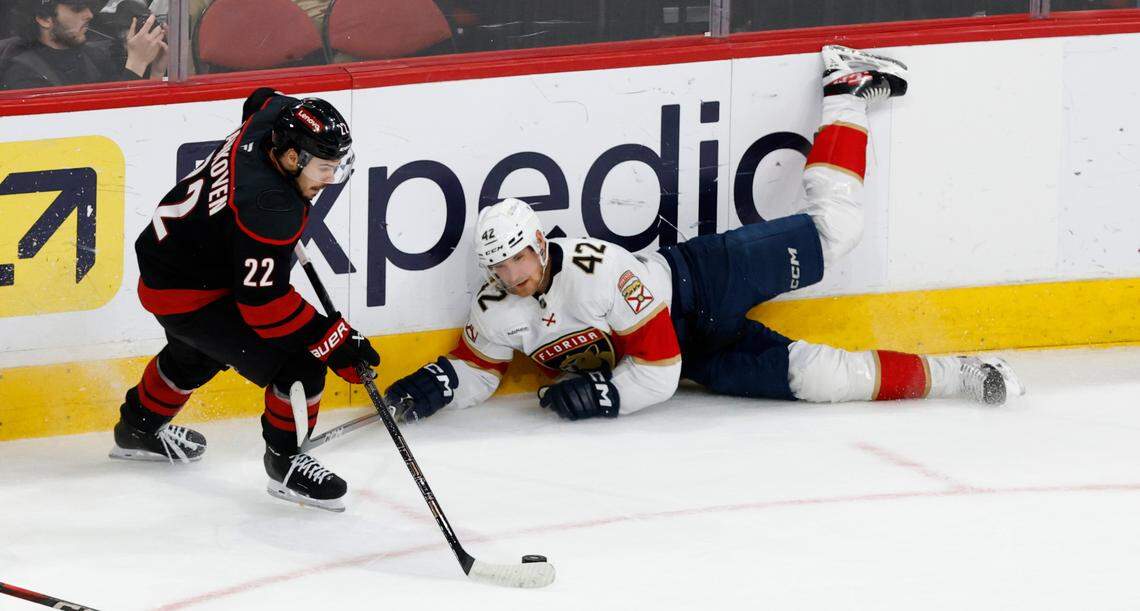
Stankoven, Mark Jankowski and Taylor Hall may not have Rantanen’s star power, but like their summer predecessors, the new arrivals fit quickly into their roles among their new teammates, adapting quickly to the Hurricanes’ style of play in a way Rantanen never did.
“I love the group we ended up with at the end of all that,” Tulsky said. “I don’t know that in my 10 years here we’ve had a team that’s been the way this one is in terms of every single player being a fit for the way we want to play, being bought in, competing as hard as they can. This group is made to play Carolina Hurricanes hockey. That puts us in a good situation, a good position to win.”
And that’s how a rebuilding season becomes something else entirely. Svechnikov isn’t wrong. No player wants to be told his group isn’t as competitive as it thinks it should be. But that group also had everything to do with changing what would have been the narrative. Despite the doom of July, it is still playing in May, in the conference finals for the third time in seven years. Maybe expecting less is one reason it has delivered more.
Setting the record straight
It has now been more than seven years since Ron Francis was fired as Hurricanes general manager, but he is still often credited on national broadcasts for “building the foundation” of this Hurricanes team.
The reality is that time has diluted Francis’ influence, to the point where his predecessor, Jim Rutherford, may have more fingerprints on this group than Francis — and both have long since been exponentially eclipsed by the work of first Don Waddell and then Eric Tulsky since Tom Dundon purchased the team in 2018.
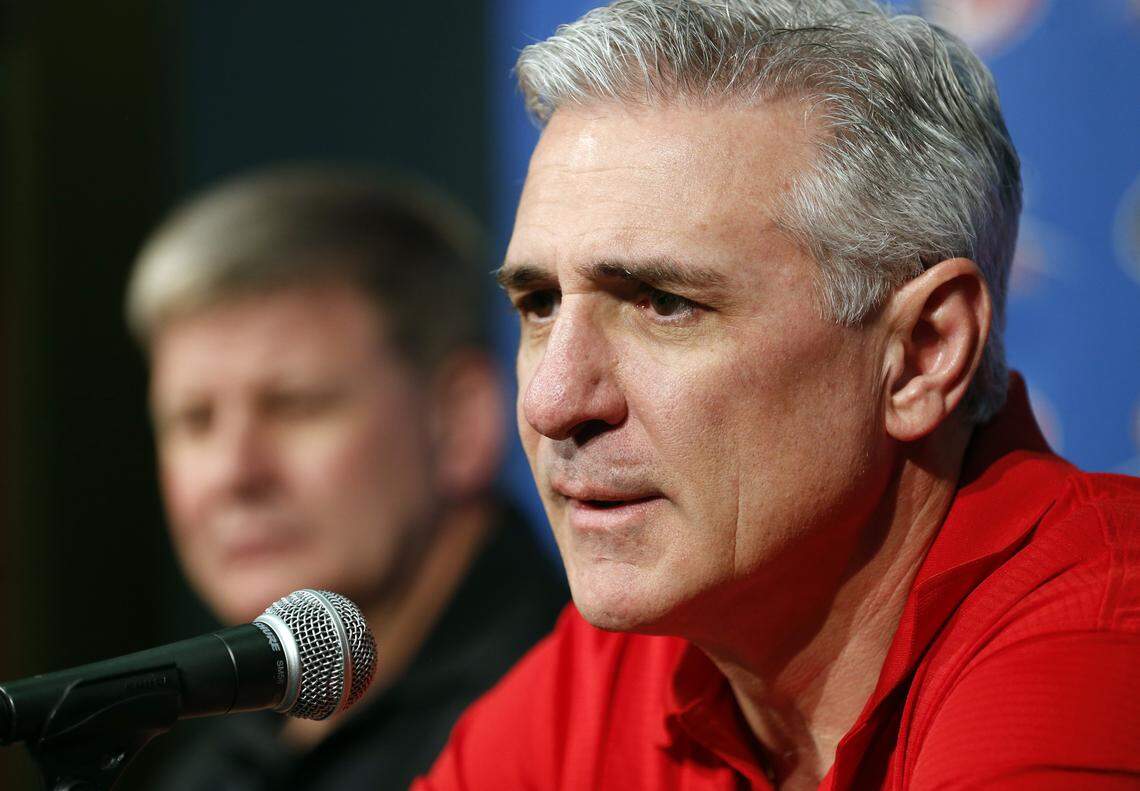
Francis’ direct impact on the current roster:
Drafted Sebastian Aho
Indirect:
Drafted Martin Necas who was traded for Taylor Hall
Drafted Eetu Makiniemi and Stephen Lorentz who were traded for Brent Burns
Traded for Marcus Kruger who was traded for Jordan Martinook
(If prospects Aleksi Helmosalmi or Jakob Vondras ever pan out, they were drafted with picks obtained for Francis-drafted players Jake Bean and Hadyn Fleury.)
Never miss a Luke DeCock column. Sign up at www.newsobserver.com/newsletters to have them delivered directly to your email inbox as soon as they post.
Luke DeCock’s Latest: Never miss a column on the Canes, ACC or other Triangle sports
This story was originally published May 22, 2025 at 5:30 AM with the headline "How the Hurricanes’ would-be rebuilding year became another year as a contender."