Panthers knew they had a problem, but do they have enough to defend NFC South elite?
The first step in solving a problem is admitting you have a problem.
The Carolina Panthers have at least done that much in terms of their defense, which was so awful in 2019 that it set multiple franchise records for ineffectiveness.
To start solving it, the Panthers used their first three picks on defensive players over the NFL draft’s first two rounds. Penn State defensive end Yetur Gross-Matos and Southern Illinois safety Jeremy Chinn on Friday — both second-round picks — joined first-rounder Derrick Brown, the Auburn defensive tackle.
That was a good start for a draft that for the Panthers — after an offense-first free agency period — had to be all about the D up top.
But Carolina still had a gaping hole at cornerback when the third round concluded Friday night, which meant no one was quite sure yet who is going to cover Michael Thomas, Julio Jones or Tampa Bay’s fearsome twosome at wide receiver.
Chinn is probably versatile enough to play nickel corner and guard the Rob Gronkowskis of the world, at least at this late stage of Gronk’s career. But you’re not going to put an FCS safety on an island and tell him to go stick with Thomas.
The Panthers then tried to partially solve their cornerback problem early in the fourth round on Saturday, taking Notre Dame cornerback Troy Pride Jr. with the 113th overall pick. Pride is the pride of Greer, S.C., where he grew up only 90 miles from Charlotte. And then with their fifth-round pick they took their fifth straight defensive player -- West Virginia safety Kenny Robinson.
The Panthers are undoubtedly putting themselves in position to play better defense. A front four of Brown, Gross-Matos, Brian Burns and Kawann Short — the “KK and the Kids” lineup — sounds pretty strong.
San Francisco won the NFC in 2019 partly because it threw so many high draft picks at the defensive line over the years, and in that Panthers foursome you have two first- and two second-round selections, as well as three guys who are only 22 years old.
“We’re trying to build a defensive line you have to be prepared for,” Panthers coach Matt Rhule said Friday night.
That part I like. As with Brown, Gross-Matos looks and sounds like a player who is going to get better.
On the other hand, I don’t like the Panthers giving up a fifth-round choice to Seattle (the one they recently acquired in the Kyle Allen trade to Washington) just to move up five spots, from 69 to 64, so they could draft Chinn.
The Panthers didn’t think Chinn would last until 69, and it’s quite likely he wouldn’t have given the New York Jets chose another safety at No. 68.
But Carolina fans understandably always get nervous when general manager Marty Hurney starts trading up on a draft day, having been burned several times before by the “We Just Couldn’t Wait For Him To Fall For Us” card.
It was that sort of thinking from Hurney that gave the Panthers Jeff Otah, Everette Brown and Armanti Edwards — draft busts, all of them. Hurney, who has now supervised more than half of Carolina’s drafts in his two-stint tenure, has been much more successful in the draft when trading back, not forward. Of the Chinn deal, Hurney said: “We just thought he was too good to take a chance of getting through six more picks to get to us …. I don’t think he would have gotten to us.”
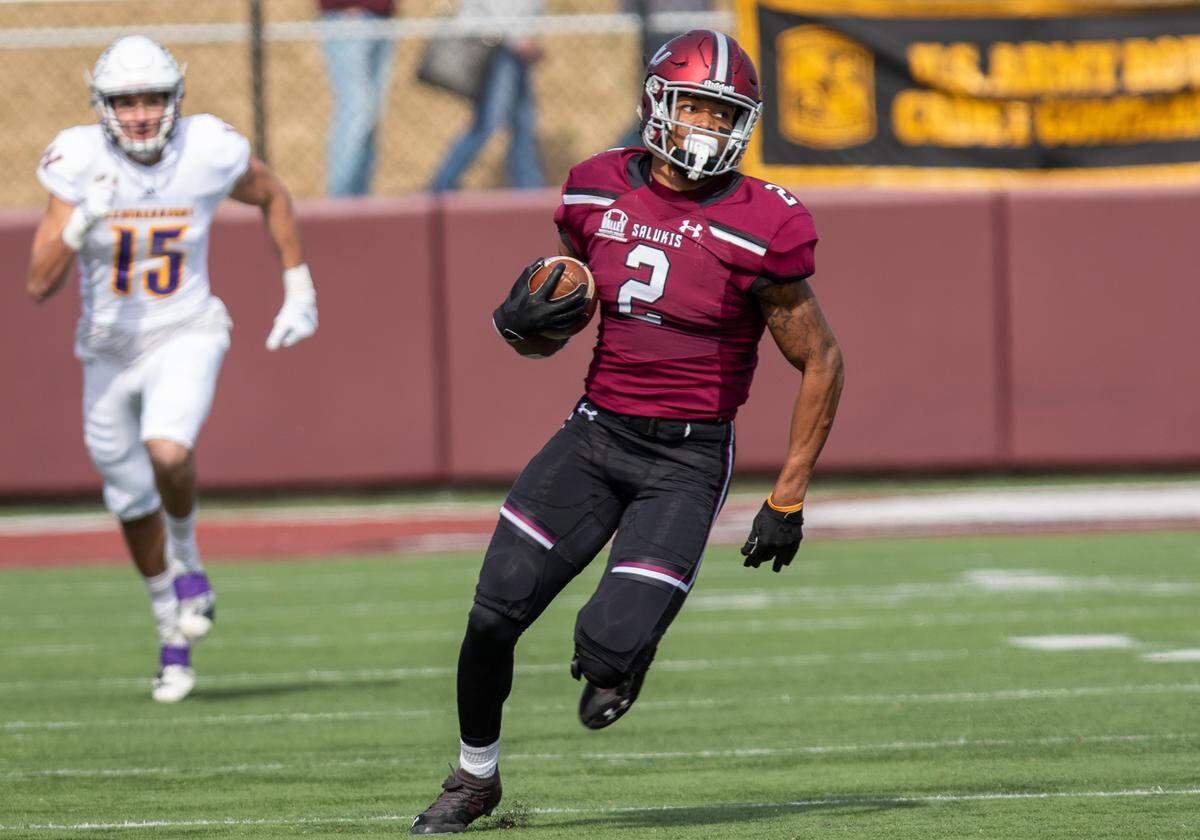
That doesn’t mean Chinn is going to be a bust. Rhule said Chinn had “rare-rare-rare” measurables — height, weight and speed — and could be used as a quasi-linebacker in some passing situations. The Panthers did a similar thing with the now-departed Eric Reid this year. “You don’t find guys that big that can run that fast,” Rhule said.
Chinn will also play some safety and, maybe, at nickel cornerback. What he may not do is start in 2020, as the Panthers have veterans Tre Boston and Juston Burris as likely starters at safety right now. Gross-Matos may not either, but the Panthers will rotate defensive linemen so much that some substantial playing time may be easier to come by. Pride, from Greer, S.C., will also have a chance to start at cornerback because Carolina lost James Bradberry in free agency. Robinson, the fifth-round pick, played well in the XFL after West Virginia kicked him out of school due to academic fraud. He projects as a special-teamer at first.
“Coming into this draft, if you had told us we could have gotten these three guys, we would have been really ecstatic,” Hurney said Friday night, before the draft’s final day began and the Panthers just kept picking more defensive players. “We’ve got three guys who are going to grow in our defense and really help us out.”
Of course, on draft night, everybody talks like that. Everyone is happy. Give the Panthers this, though: They are throwing a lot of resources toward their biggest problem areas.
The first few rounds were far from a slam-dunk. But it’s a start.
This story was originally published April 25, 2020 at 6:00 AM.