Jeff Gordon talks NASCAR, COVID-19 and why Wednesday night races should be permanent
As a NASCAR Hall of Fame driver who now serves as Fox Sports’ primary race-day analyst, Jeff Gordon commands attention like few others in his sport.
So who better to opine on NASCAR during this unprecedented time?
Gordon talked about all sorts of subjects in our phone interview Thursday, from how he’s calling races remotely in Fox’s Charlotte studio to why Chase Elliott now has “the upper hand” on Kyle Busch.
Gordon also said he liked Wednesday night’s race in Darlington so much that he’s ready for midweek races to continue for the long term — and for NASCAR’s grueling schedule to eventually get compressed by two full months.
“There’s been some discussion about, ‘How do you end on Labor Day?’ ” Gordon said about NASCAR’s schedule, which currently runs into early November. “I think that would be the ultimate goal.”
Gordon is about to call two NASCAR Cup races at Charlotte Motor Speedway in a four-day span: the Coca-Cola 600 Sunday night (Fox, 6 p.m.), as well as the Alsco Uniforms 500km Wednesday (FS1, 8 p.m.) Our conversation is lightly edited for clarity and brevity.
Scott Fowler: Wednesday night’s Cup race in Darlington ended in controversy when Kyle Busch spun out Chase Elliott late, drawing a very public middle finger from Elliott and a lot of postrace talk. What sort of repercussions will there be from that incident?
Jeff Gordon: I never felt like it was anything intentional that Kyle did. We haven’t heard from Chase Elliott yet, but I think his gesture spoke volumes.
In this situation, what that does is put Chase Elliott in a position to have a bit of the upper hand on Kyle. You’ve got Kyle wondering, thinking: ‘Is it now? Is it going to happen later? Is he going to forgive me? What’s going to happen?’
I do think for Chase Elliott, though, he and his team need to go out and focus on performing on the racetrack over 600 miles. They’ve got a fast race car, but they haven’t won a race yet this year. You’ve got to be more focused on execution then you need to be focused on repercussions.
SF: How does broadcasting a race remotely from a studio in Charlotte differ from being at the racetrack?
JG: I know me and Mike (Joy, Fox’s play-by-play announcer for NASCAR) would love to be there at the track. But the Fox folks have done an amazing job. We’re fortunate to have a great studio where we can do this, and it’s gone pretty seamlessly so far.
Mike and I are probably 8-9 feet away from one another in the studio. We have several monitors, including some that give us a full panoramic view of the track. The monitors are arranged so that his eyes are toward me and mine are toward him, so when you have a conversation, you can look at one another.
SF: Certainly everybody misses having fans at races, but maybe there are other parts of racing in these viral times that maybe can be adopted. Less practice? No qualifying? What do you think the sport should keep?
JG: Wednesday night was a great example of some conversations that have been going on for years about our schedule getting compressed. We’re at a 38-week schedule with 36 points races. That’s long. It runs into all these different sports along the way — entire seasons come and go — or maybe like football, they just start.
I think that’s probably one of the priorities that’s already being looked at for the future of the sport: How you can do all of these races, but do them in a shorter period of time? One of the biggest challenges is, well, if you have a Wednesday night race, you’re not going to have as many fans. Well that may be the case, and it may not. Look at “Monday Night Football.” They do a nice job getting fans into those stadiums.
I loved that race this week. A Wednesday night race. A shorter race. An incredibly exciting race.
SF: So when would you end the season if you could?
JG: There’s been some discussion about, ‘How do you end on Labor Day?’ I think that would be the ultimate goal.
I don’t know if we’re close to getting there. I know it’s hard work on everybody. There are so many logistics that would need to be worked out. But we’re showing that it is possible.
SF: You were once known as ‘Wonder Boy’ on the track. Now you and Matt Kenseth are both 48 years old, and Kenseth is back driving again. Do you miss it?
JG: I don’t miss it — until I get behind the wheel of a car. Every once in a while I go out to a track and do some stuff and when you get in there, you realize how much fun it is to push a car to its limits.
But trust me — coming back (as a substitute driver) for Dale Earnhardt Jr. in 2016 was a great reminder to me that the competitive side of me in a race car? That’s behind me. I’m loving this next stage in life. All the challenges that come along with it are plenty for me.
SF: The thrill of winning or losing in the final seconds, though? It seems hard to replace.
JG: Every once in awhile would I love to be in the shoes of these drivers, battling it out on the final lap or the final restart for a win at a big race? Heck yeah! You’ll never replace that. But I was fortunate to experience that more than most.
SF: Describe the personal significance of the Coca-Cola 600 to you.
JG: It obviously means a lot. That 600 trophy from 1994 (for Gordon’s first-ever Cup win) is still front and center in my office. Charlotte Motor Speedway, personally it means a lot to me, and I think that connects with everybody in the sport. Whether it’s race teams like Hendrick Motorsports that call the area home, or the long history of the race, or honoring our troops on Memorial Day — it’s such a special day.
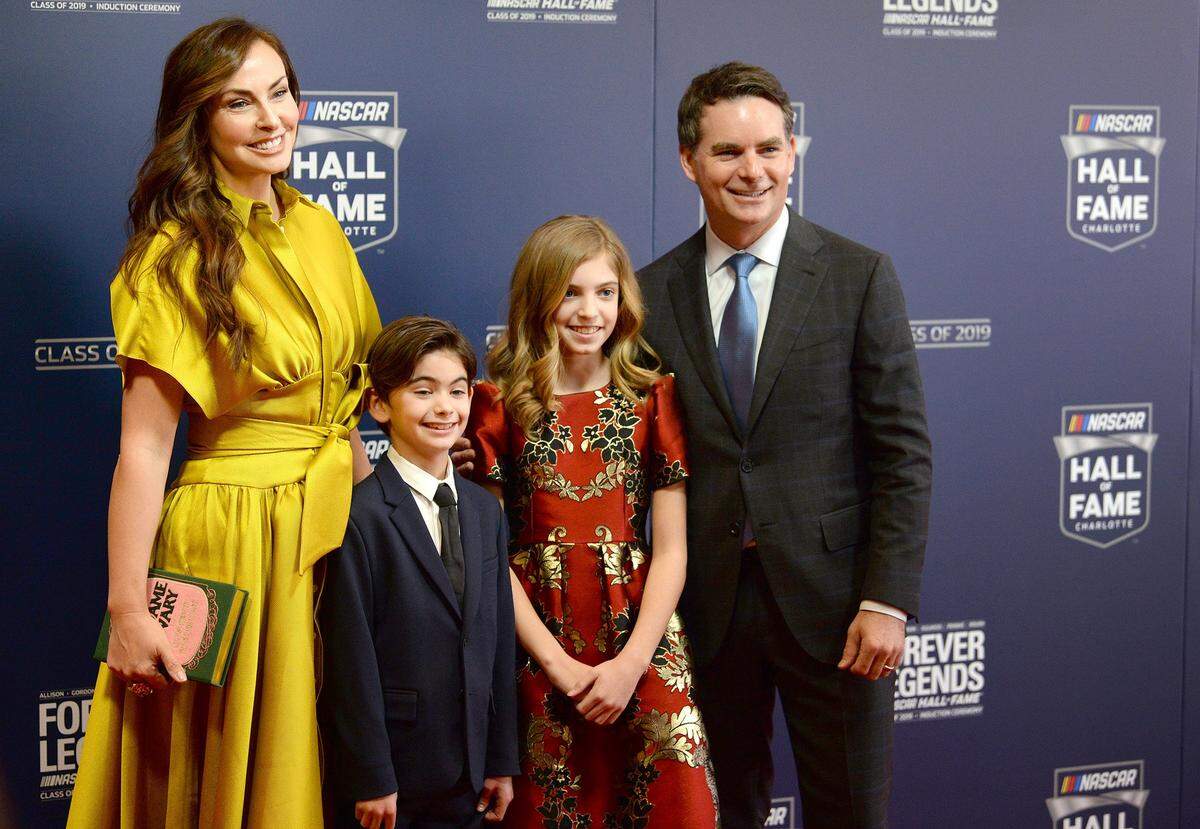
SF: You and your wife Ingrid Vandebosch-Gordon have two young children, Ella and Leo. How has the stay-at-home order changed your family’s life?
JG: We’ve been here in Charlotte the whole time. It’s close to my work. The most important part is the kids and their at-home schooling, and we feel like we have the best setup to do that here. We’re a family that travels a lot. If there was a break in school or time off from racing, then we’re going to be on a plane somewhere traveling, trying to experience the world.
And certainly that’s not happening. But at the same time, the most important thing is putting things in perspective and prioritizing what’s important: Our health and the health of front-line healthcare workers and other essential workers.
The first week was really tough: It was like, ‘Wow, is this what life is going to be like? And for how long?’ It was a huge adjustment for us. But now, this far into it, we’ve adjusted well. My wife has been a great third-grade teacher, and I’ve turned into a pretty good at-home chef on the grill.
SF: Do you know anyone who has been sick with COVID-19?
JG: I have one friend in New York who had it very early on and is doing fine now. Most of my family now lives in Concord. One of the toughest parts was Mother’s Day — not being able to hug and kiss your Mom on Mother’s Day. That was strange. We spent a little bit of time together, but we did it while social distancing. You have to be so cautious.
.JPG "JEFF_GORDON_12 (1).JPG")
SF: What have you learned about yourself in the last 10 weeks?
JG: You can get down to the bare knuckles of what you need pretty fast, as opposed to luxuries. You get back to the basics of what’s most important. That’s family, of course. But it also makes me realize how passionate I am about racing. I’ve learned that more since I’ve gone to the booth.
As a competitor, when you’re driving week in and week out, you lose sight of how much it means to you. You can’t reflect on it, because you’re in the grind. But as I’ve stepped away and looked at the sport through a different lens — in the broadcast booth as well as my partnership with Rick Hendrick — it turns out I really love racing.
This story was originally published May 22, 2020 at 2:00 AM.