Sports, interrupted: UNC’s Charlie “Choo Choo” Justice did it better than anyone
For many athletes in 2020, the games have been interrupted.
Spring sports stopped in March due to COVID-19. North Carolina high school football won’t start until February 2021. Close to half of the FBS college football programs around the country won’t play in the fall.
But sports aren’t always played in a straight line, and sometimes, it still works out OK. Witness the career of Charlie “Choo Choo” Justice.
One of the most famous football players ever at the University of North Carolina, Justice was a two-time runner-up for the Heisman Trophy, in 1948 and ‘49. He made the cover of Life, with the national magazine rhapsodizing that Justice looked like the actor Rudolph Valentino “made up as Superman.” Fan mail addressed only “Choo Choo, North Carolina” found its way to him.
It wasn’t until a skinny freshman from Wilmington — who at the time went by the name Mike Jordan — showed up in Chapel Hill in 1981 that an athlete captured UNC’s imagination as completely as Choo Choo did.
Justice’s own football career was severely delayed — not by a pandemic, but by World War II. He spent three years in the Navy, which was ironic since he never learned to swim.
In 2003, at age 79, Justice died due to dementia and complications from earlier heart issues.
But his only surviving child, a feisty grandmother named Barbara Justice Crews, emailed me recently from her home in Cherryville. She was concerned about the high school and college athletes whose lives are being adversely affected by the coronavirus and wanted to offer some encouragement to them.
“If you research my Dad’s fairy-tale life story,” she wrote, “you will see that he hit a wall like this at the end of his unbelievable high school career. Instead of his entire high school team heading off to Duke, where they all had been recruited to play football, they all marched off to war. Dad thought his dream was over.”
Wait a minute.
Charlie Justice nearly went to Duke, along with his whole high school football team from Asheville? Surely that wasn’t true.
I decided it was time for a drive to Cherryville, where Barbara Justice Crews keeps a storehouse of her late father’s memorabilia and memories.
‘He only had one gift’
The trip to Cherryville wasn’t my first to see the Justice clan, but it had been 20 years since I made the trip to the small town 40 miles west of Charlotte.
While Justice grew up in Asheville, he lived most of the final decades of his life in Cherryville because he and his son-in-law, Billy Crews, had established a successful insurance business there.
Business success eluded Justice for years after college. He went bankrupt twice. In general, his life after UNC was far more jagged than the one he lived while at Chapel Hill. “He only had one gift and that’s the gospel truth,” Barbara Crews said. “He was a football player. He wasn’t a business person.”
Sarah Justice, Charlie’s wife for 59 years, knew him better than anyone. They were married in 1943, while Charlie was on leave from the Navy and before he ever got to Chapel Hill. Sarah died 16 weeks after her husband, in early 2004, having declared to her family she could now be at peace because she had helped nurse Charlie through his final days.
Sarah would sometimes tell their daughter, Barbara, that Charlie’s life was never quite the same after he stopped playing football at age 30 following his final year with Washington’s NFL team. Her husband without football, she felt, was often “a ship lost at sea.”
Back in 2000, I went to visit the man everyone called Choo Choo. I was struck by how happy he seemed that day. His memory of the years between 1951-2000 was iffy by then, but it was amazing how good his recall was of his early life. His family said, then and now, his memory of the time prior to 1950 stuck around much longer than his memories of everything since.
That day Justice was in fine form as we conducted one of the last interviews he ever did. As Sarah patted his shoulder, I asked him why his college career had seemed to resonate with so many. Even now, both 22-yard lines at Kenan Stadium in Chapel Hill are painted Carolina blue in honor of the No. 22 Justice wore, and there’s a statue of Justice standing in front of the Kenan Football Center.
“It was the perfect time,” Justice said then. “Carolina needed a star. Everyone had been through a war. Confined. There had been gas rations. The war was over, and people wanted to turn it loose a little. You couldn’t get ‘em out of the stadium when we played at home.”
Justice as a Blue Devil
Justice finished high school in Asheville in 1942. He was a 5-foot-10, 165-pound running back who played for an Asheville High team that could still make an argument today as one of the best prep teams ever in N.C. In his senior year, the team outscored its opponents 441-6, winning one game 94-0. Justice’s average per rush that year will look like a typo to you — 18.6 yards a carry.
Recruiting was different then. College football scholarships were unlimited and a school could give as many as it could afford. And the “nearly went to Duke” story? It’s family lore, and apparently true.
Said Choo Choo’s daughter: “I jokingly say that if it had not been for the war, I would have had to be a Duke fan ... How awful is that thought?”
Justice was quoted as saying in the 1996 book “All the Way Choo Choo,” by Bob Terrell, that the entire starting 11 for Asheville High (players played both ways back then) were offered scholarships to Duke. The team decided to attend en masse.
“We voted to take the offer,” Justice said. “We wanted to see what we could do against the best college competition, and I’ll tell you right now I think we would have done all right. ... The only thing that prevented us from doing it was the war.”
Why they called him ‘Choo Choo’
Yes, the war. World War II scuttled Justice’s plans to become a Blue Devil as well as many more important ones, much like COVID-19 has done over the past five months. He finished high school in 1943, got drafted by the military and took a bus to Charlotte to be inducted into one of the service branches.
Justice’s war experience was far different than most. Although he didn’t want to join the Navy — and never did learn to swim — that’s where he was placed. He left for Bainbridge Naval Training Station in Maryland. After making it through boot camp, he stayed on in Bainbridge as an exercise specialist.
Bainbridge also had a football team that played football squads from other service branches. With so many college and professional football players also drafted into the service — men from the ages of 18 to 37 were required to register for the draft at that time — the Bainbridge team was well-stocked and not looking for anyone straight out of high school to join the team.
When Justice went out for the squad anyway and said he wanted to play running back, the coaches sent him instead to shag punts. On impulse, Justice kicked one back, well over the punter’s head.
They first made him a punter (Justice would eventually lead the nation one year in punting at UNC). Then they tried him at running back. Before long, Justice, the young man from the N.C. mountains, became the team’s shining star. After a scrimmage with Washington’s NFL franchise, Bainbridge’s head coach allowed that Justice could play for a pro team “right now.”
It was at Bainbridge that Justice acquired his nickname from a naval officer who was watching him play.
As Justice described it to me in 2000: “This naval officer said, ‘Look at that fool run!’ He’d had too much to drink, of course. Then he said, ‘He looks like a runaway freight train. I’m going to call him ‘Choo Choo.’ “
A writer heard the comment and put it in print. Justice remained eternally grateful for the naval officer’s sobriquet.
“Hell, he made me,” Justice said. “That guy did me a favor. All you need is a good nickname and to be able to go out there and play a little.”
A wife on football scholarship
Justice stayed in the Navy three years, based mostly in Maryland and playing a lot of football. The delay actually helped his future collegiate career. He was a 22-year-old freshman, more mature and already married to Sarah by the time he picked North Carolina.
The Tar Heels became his first choice only after an older brother convinced him that a man who was going to live in North Carolina after college should go to an N.C. college, too. Duke was out of the picture by then, but Justice was close to picking South Carolina.
It helped turn the tide that UNC would accept Justice’s terms for coming. He wasn’t paid anything to go, he always swore — although pro teams were also bidding for his services at the time. However, since he could already go for free on the G.I. Bill, he wanted Sarah to be able to use his football scholarship.
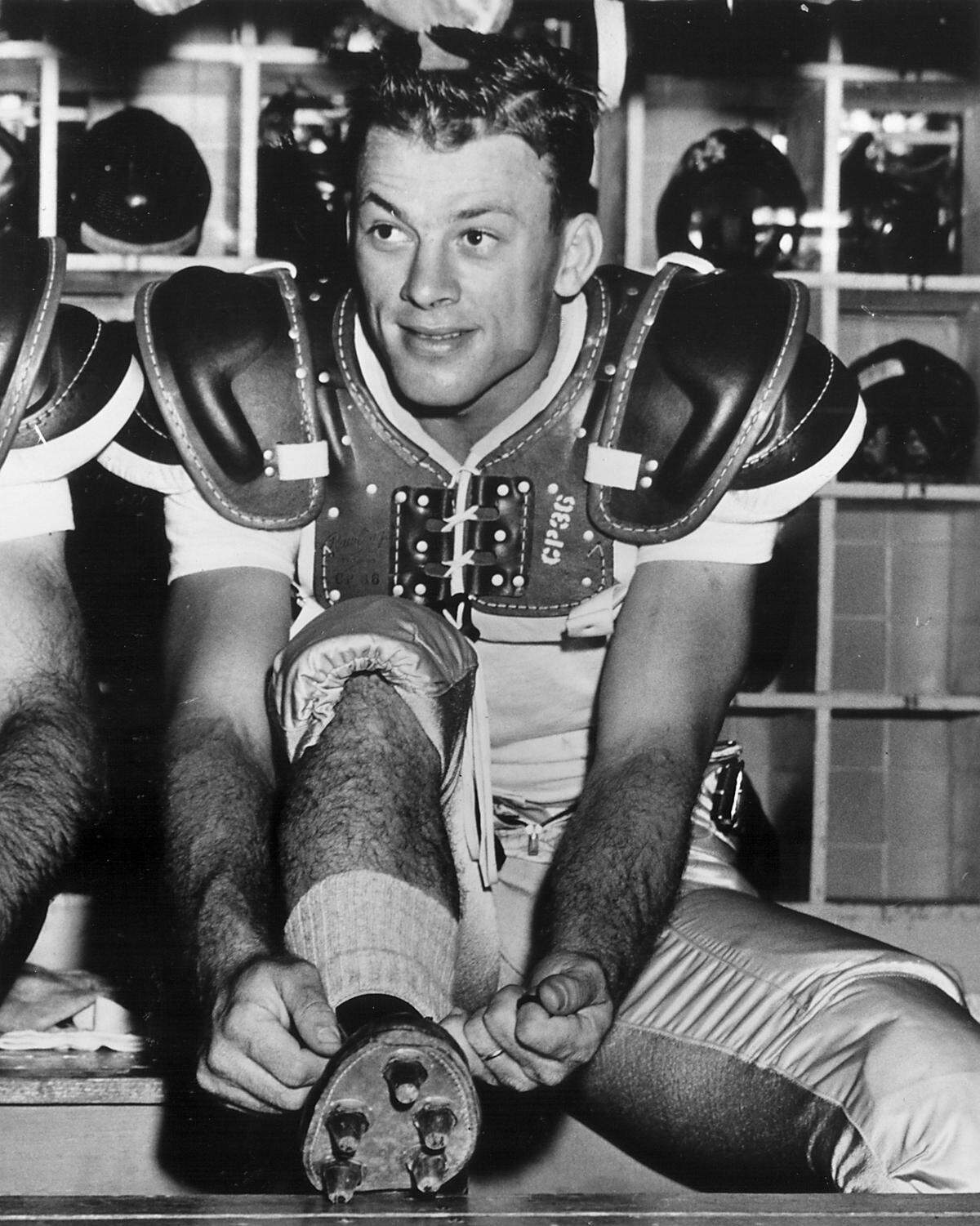
UNC agreed — yes, a lot of rules were different back then — and Sarah enrolled at Chapel Hill as well on football’s dime. She wouldn’t use the scholarship for all four years, it turned out, because she and Charlie had a baby. Sarah dropped out to care for their son while Charlie was in school.
The next four years served as Justice’s glory days. It should be noted that Justice played before college football was integrated in the South. Every photo of his games features all white faces. Justice also only weighed 165 pounds — small even at the time for a college player, and tiny nowadays.
“I wouldn’t want to play today,” Justice told me in 2000, “as little a man as I was.”
But for his time, he was extraordinary. Justice ran the ball, threw it, punted, returned kicks and occasionally played safety on defense. The Tar Heels went 32-7-2 in his four seasons. Songs were written about him.
You couldn’t see Justice play on TV — this was part of his “you had to be there” appeal. He wasn’t the fastest player ever, but his elusiveness was legendary. Justice was a three-time All-American, leading the Tar Heels to the Sugar Bowl twice and the Cotton Bowl once.
At one of those Sugar Bowls in New Orleans, a trombone player named Andy Griffith played in UNC’s marching band, according to the 1958 book “Choo Choo: The Charlie Justice Story.” Griffith later became a famous actor, but at the time was just part of the background music in Justice’s symphony.
Four years in the NFL
Justice’s press clippings still fill countless scrapbooks in his daughter’s home in Cherryville. He won just about everything there was to win except a national championship and the Heisman Trophy — finishing second to Southern Methodist’s Doak Walker in 1948 and second to Notre Dame’s Leon Hart in 1949.
“That bothered him,” his daughter said. “That was the one trophy he wished for that he didn’t get.”
Justice’s life from 1950 onward was more complicated. He and Sarah’s first child and their only son, Ronnie, had special needs. Barbara, born two years after Ronnie, believes that her brother may have had autism.
Ronnie almost always lived at home and died in 1993, at age 44. “He had mental issues — anger issues,” Barbara Crews said. “It was never clearly diagnosed what was wrong. He was loved. But it was difficult for everyone, including Ronnie.”
Justice told NFL teams who were thinking about drafting him in 1950 that he was done with football. NFL players were fortunate if they made $12,000 a season at the time and the pro game wasn’t the draw to all top collegians as it is now. Washington drafted him in the 16th round anyway, but Justice instead took a job as a fundraiser for UNC’s medical system.
It turned out he couldn’t stand asking people for money, though, and he left the job within a few months. He decided to try football after all and joined Washington for a little more than half a season, getting paid $1,000 a game. Train cars full of fans would make the journey to Washington to see him.
Still, he was ambivalent about the pro game — the defenses were bigger, his impact on games was smaller and Washington wasn’t good. Justice sat out the 1951 season, instead returning to Chapel Hill and taking an assistant coaching position with UNC.
Coaching wasn’t all Justice hoped for, either — like many of the best athletes, he was better at playing his game than telling someone else how to play it. He returned to Washington for the 1952-54 seasons. He played decently for some very poor Washington teams. The four NFL teams he played on won a combined 34 percent of their games, but Justice was named one of the 70 greatest Washington players ever when the team celebrated its 70th anniversary in 2002.
‘I’ve had quite a life’
At the end of the 1954 NFL season, Justice was 30 years old, beaten up and ready to retire. Yet he also couldn’t stand the idea of leaving football behind. Before his final game, at the family’s apartment in Washington, he told Sarah something.
“It was one of the saddest stories my Mama ever told, and it brought tears to her eyes every time,” Barbara Crews said. “It was 1954. He had gotten his things together and walked to the door before his last ballgame. He put his hand on the doorknob. She said he turned and looked at her and said, ‘I hope I die out there today.’
“And she said he was serious,” Crews continued. “Football meant that much to him. He felt like that was what he was here for. That was his purpose. But for a wife with two children? You don’t want to hear that. And she carried that with her the rest of her days.”
In 1981, Sports Illustrated’s Frank Deford published a novel called “Everybody’s All-American,” about a football star who played at Chapel Hill (but in the 1950s); made the cover of “Life” magazine; had a catchy nickname (The Grey Ghost); had a mediocre career for Washington’s NFL team in the pros; and then had a difficult time in his post-athletic life.
Deford said in numerous interviews before his death in 2017 that his protagonist’s resemblance to Choo Choo Justice was purely coincidental and the character wasn’t based on anyone in particular. The Justice family was never too sure about that. (In the 1988 movie version, Dennis Quaid played the aging football star, and the setting was moved to Louisiana).
Still, even though his post-college life veered more toward the mundane, Justice knew he had been lucky to have the golden years that he did. As he told me in 2000: “I’ve had quite a life, I guess.”
And he did. But in 1942, when he was headed to boot camp instead of college, he only knew that his sports life was being postponed.
Nearly 80 years later, high school and college athletes around the country are in the same predicament.
“Maybe just maybe there’s a way to make these kids understand that this doesn’t have to be the end of the world,” Barbara Crews said. “It could be devastating, I know. But for some, it’s going to work out. I hope, for many of them it works out like the way it worked out for Daddy.”
This story was originally published August 23, 2020 at 6:00 AM.