Once an orphan from Ukraine, Charlotte teenager is now a star in wheelchair tennis
The forehand sailed over the net with heavy topspin, bouncing high and back into the fence on the other side of the court.
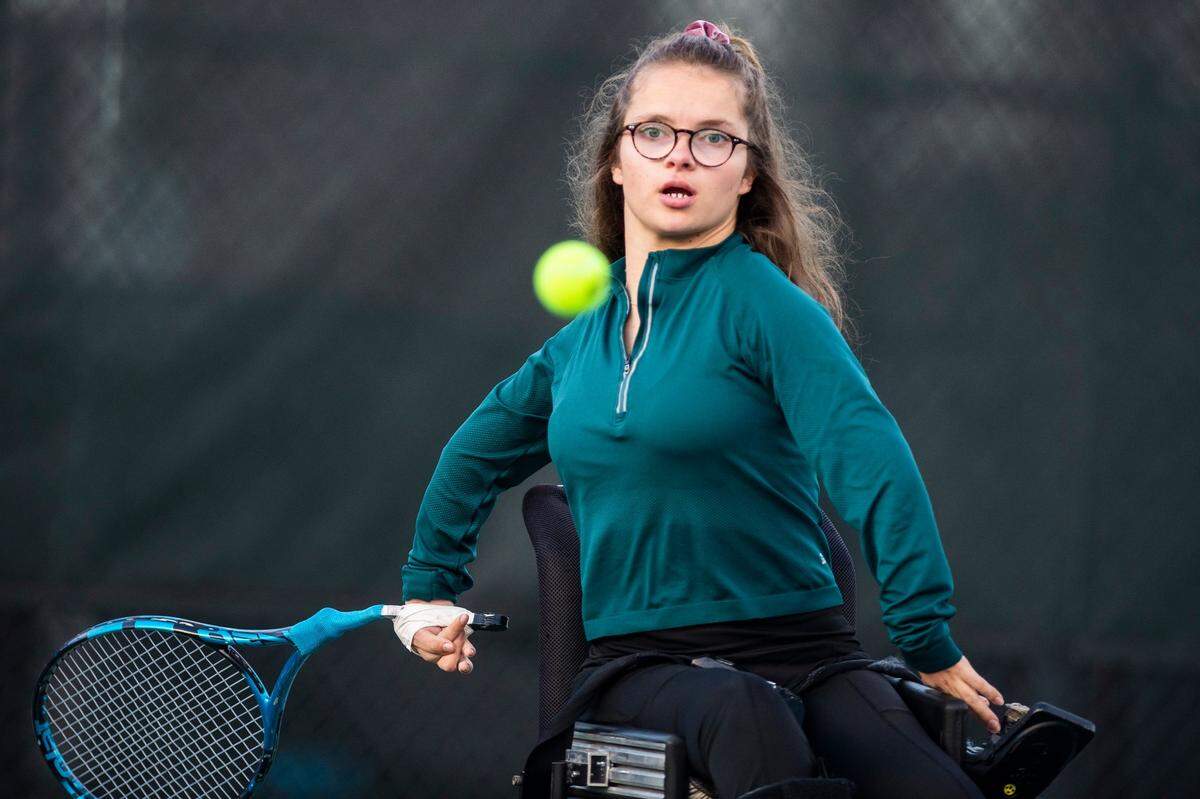
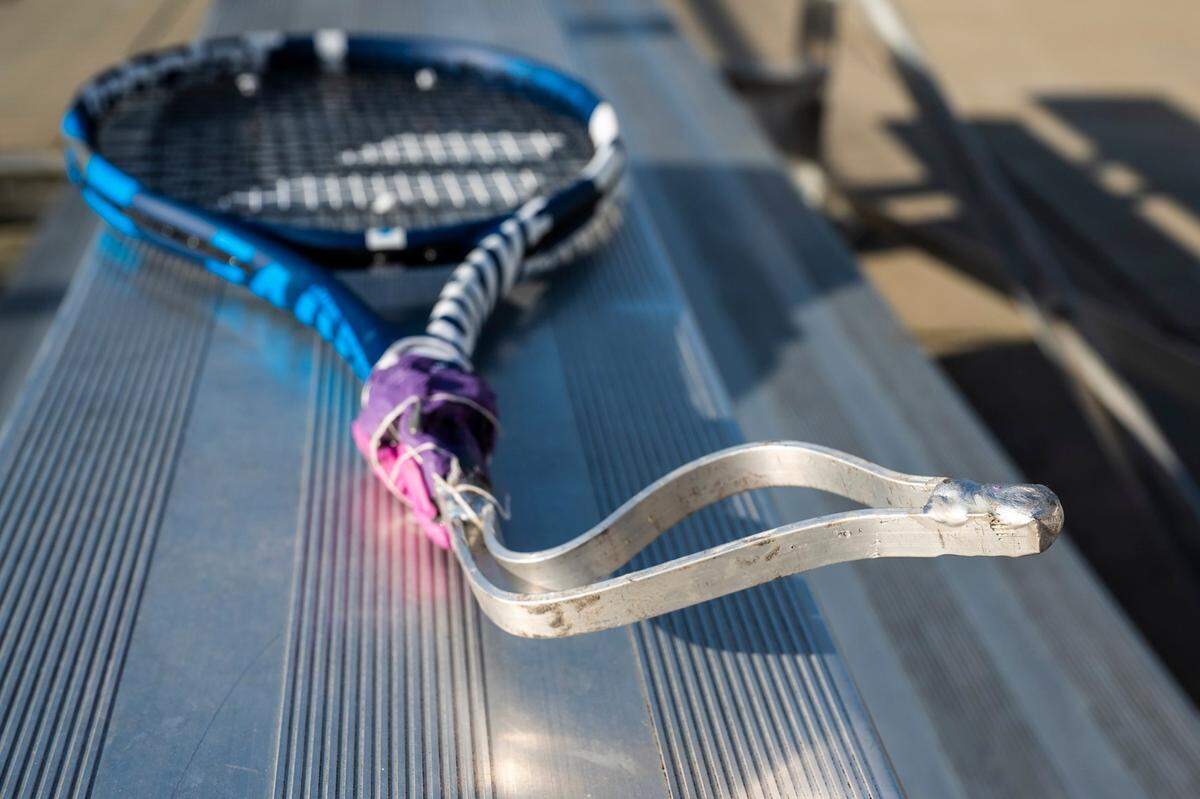
It was the sort of shot any tennis player would be proud of, and one that 18-year-old Gaila Fosbinder hits with regularity. The fact that she hit it with a modified tennis racket that she can’t grip but that is taped to her wrist, from a wheelchair that she drove slightly forward at the exact moment of impact to generate more speed on the ball, made it remarkable.
“How’d you like that one?” Fosbinder said, smiling.
Fosbinder, a native of Ukraine, was adopted out of a Ukrainian orphanage at age 4 by Julie Fosbinder, a Charlotte resident. Julie picked Ukraine in part because she had visited the area while in college and been struck by its beauty.
Now a senior at Myers Park High, Gaila ranks as one of the best junior wheelchair tennis players in the world. She’s also a young woman who worries that Russia’s invasion of Ukraine will deny her the opportunity to track down her birth mother, whom she knows little about except her name and that she was 16 years old when she gave birth to Gaila, then gave her up.
That’s one of many things on Gaila Fosbinder’s active mind. Also bouncing around in there like a tennis ball: Schoolwork, college choices and the endless machinations of “The Bachelor” and the Taco Bell menu.
When asked about her favorite Taco Bell order, Fosbinder rattled off several beans-and-rice combinations, paused for a moment and then said: “Oh, there’s more.”
And that might be a good theme for Gaila Fosbinder herself:
Oh, there’s more.
Fosbinder was named the female wheelchair tennis junior of the year by the International Tennis Federation in December, an honor earned with both her on-court results and her fine sportsmanship at an international tournament. But while her power wheelchair is part of her life, it certainly doesn’t define it.
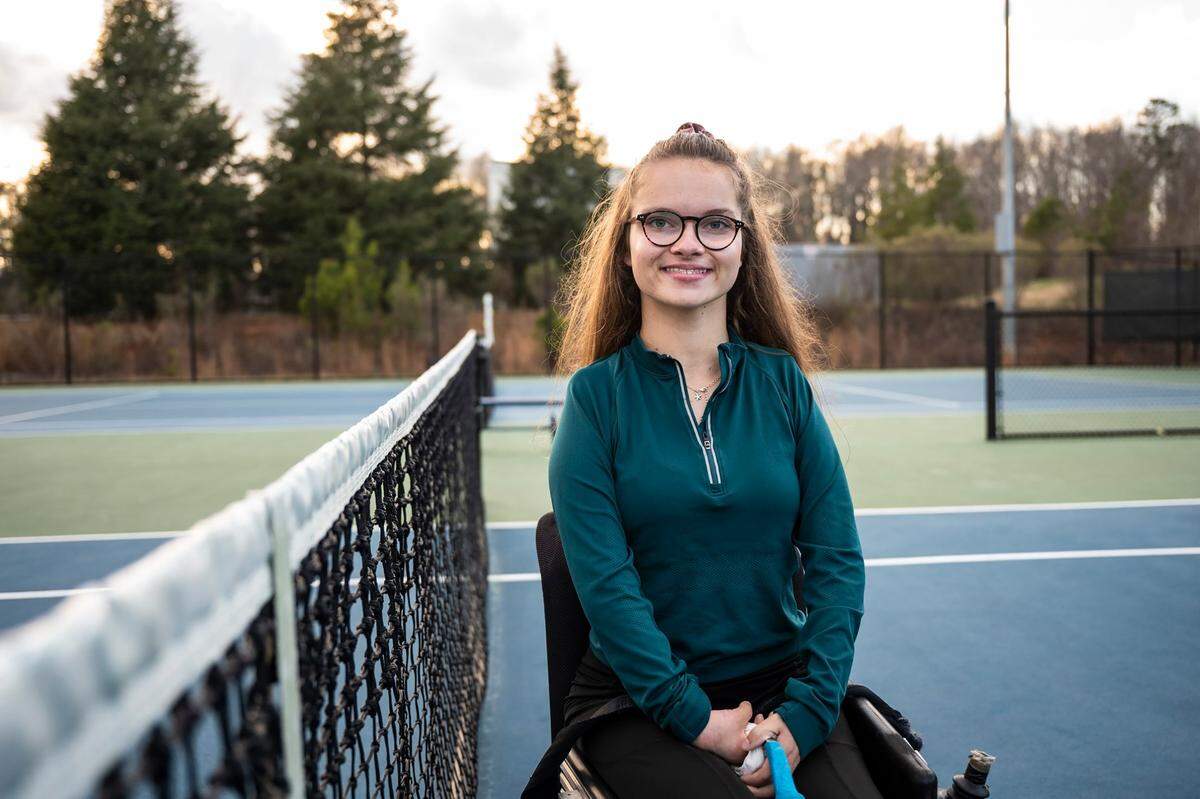
Fosbinder was born with arthrogryposis, a rare condition in which the range of motion in your joints is very limited. Sometimes your arms or feet are stuck permanently in odd positions. As she and her mother explain it:
“So when I was in the womb, it was too tight,” Gaila Fosbinder said. “When my joints were forming, there were only certain areas that they could form. That explains more like why my wrists are really bent. There’s also an inability to really build up muscle mass.”
Said Julie Fosbinder, Gaila’s mother and a longtime employment attorney in Charlotte: “The main thing is that for almost all kids that have it, they have at least one joint on an extremity that is either stuck in flexion or stuck in extension. So for Gaila, when she was born, she had to have four surgeries on her feet because they didn’t bend. And then both of her elbows were stuck straight (in extension).”
In Gaila’s case, there are no mental disabilities associated with her medical condition. She has a weighted 4.0 GPA in high school.
Julie adopted Gaila, on her own, from a Ukrainian orphanage when Gaila was four years old. It took about 2 ½ years of paperwork beforehand, and then two more months in Ukraine, Julie said, before she came home with her daughter to Charlotte in 2007. Julie knew she would be trying to juggle single motherhood with her career, and that caring for Gaila would be a challenge in many ways.
“I met with her surgeon in Ukraine, just because I knew nothing about this medical condition,” Julie said. “Just to make sure I could handle it. And then I fell in love with Gaila, so none of that really mattered. I was going to handle it.”
Gaila had two more surgeries in Charlotte, each designed to improve her range of motion. With her leg braces, she can now stand and walk for short distances. She has enough function in her right arm to feed herself and to hold a paintbrush, although she can’t raise the arm above her chest. She painted a self-portrait in school — a fine likeness that is all the more extraordinary given how she did it.
“When my arm got tired of painting,” she said, “I just put the paintbrush in my mouth and kept going.”
Learning to play tennis
For wheelchair tennis, Gaila uses a powered chair because her arms aren’t strong enough to make a manual chair move. Playing in the “quad” division, against opponents who also have different limitations in all four extremities, she zips around the court with her left hand on the joystick and her right taped to her tennis racket, only hitting forehands because the setup doesn’t allow for a backhand. So there’s a lot of backing up the wheelchair involved. For serves, she drops the ball to the ground, then hits it on the bounce. (In wheelchair tennis, the rules are basically the same except players get two bounces to hit the ball instead of one.)
Fosbinder got into the sport due to her mother, Julie, an avid tennis player.
“I’ve been a bad player for a long time,” Julie said. At age 8, Gaila sometimes watched Julie play doubles in a local tennis group in the Dilworth area.
“I thought to myself, ‘I want to play tennis and be better than her,’ ” Gaila said.
“Which wasn’t a very high bar to set,” Julie added.
After eclipsing her mother, Gaila went in search of better competition and coaching. She found that in her tennis coach Taylor Wingate, an accomplished national-level wheelchair player himself who lives in Rock Hill.
“It’s eye-opening to watch Gaila play,” Wingate said. “Her strength is the deep topspin strokes that she can generate. Her shots are so hard and so deep. She has three different serves — a drop-shot serve, a body serve and a topspin serve. And she’s very competitive.”
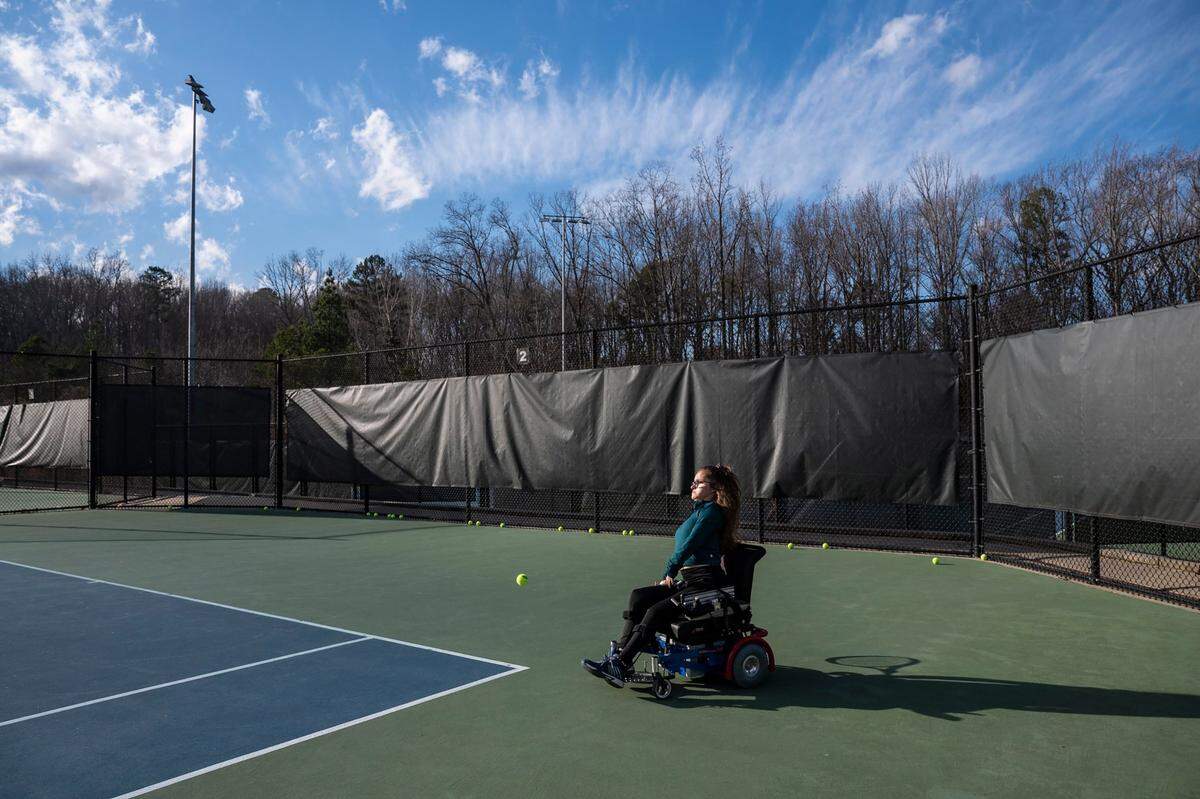
Fosbinder also likes to laugh, and her practice sessions with Wingate are full of wisecracks and gentle trash talk. “She’s always trying to keep people laughing,” Wingate said. “She likes to keep the mood light. And she’s supportive of other players, even her opponents.”
Not that she doesn’t want to win. Of a frequent opponent on the wheelchair tennis circuit, Fosbinder said with a smile: “I finally cracked him.”
Fosbinder has been helped by the fact there are two established wheelchair programs in Charlotte: Wheel Serve NC and ASAP, the adaptive sports and adventures program run by Atrium Health Foundation. She believes both are excellent and encouraged others with disabilities to give them a try.
College and beyond
What’s next for Gaila Fosbinder? As with nearly all 18-year-olds, that’s an open question.
She will graduate from Myers Park High in May, and most of the colleges that have wheelchair tennis programs are lining up to talk to her. She has been to Arizona and Michigan on recruiting trips, and there’s potential that she will start a new program entirely at Virginia Tech. She’s well-known enough in the tennis world that she was named one of the U.S. Tennis Association’s Net Generation Aces, which allowed her to meet a number of current and former tennis stars like Billie Jean King and Venus Williams and to attend the 2019 U.S. Open.
One day, Fosbinder hopes to get a racket handle that can be duplicated more easily. She has drawn up the specs she would like, and a class at Vanderbilt University is working on a model. Eventually, Fosbinder said, she’d like to make it to the Paralympics.
As for life: Oh, there’s more.
When things get back somewhere close to normalcy in her home country — she and her mother have been somberly monitoring the Russian invasion of Ukraine on the news each day — she would like to hire a Ukrainian private detective to find her mother.
“I’m fascinated to know where I come from, and who I come from,” Fosbinder said.
When she gets to college, she plans to study something STEM-related.
“I want to probably get a biomedical engineering degree,” Fosbinder said. “Education will always be at the forefront.”
But she will always play tennis.
“I’m not usually a mad person,” Fosbinder said. “But if a biology test didn’t go great, I can always go out and just smash the ball. On a good week, I’m playing 3-4 times. I really love the atmosphere, and it’s a lifetime sport. Even when I’m 90, I can play. And more than half of tennis is mental. So physically, it maybe doesn’t seem like I should even be able to do tennis. But with a good mental game, you can be tricky, and make up for what you lack physically.”
It’s a full life, one that is going to change again with her college decision. For now, though, there’s another hopper full of tennis balls to hit.
This story was originally published March 3, 2022 at 10:36 AM.