
NFL draft will give fans their much-needed fix. I like 1 of these 3 to the Panthers
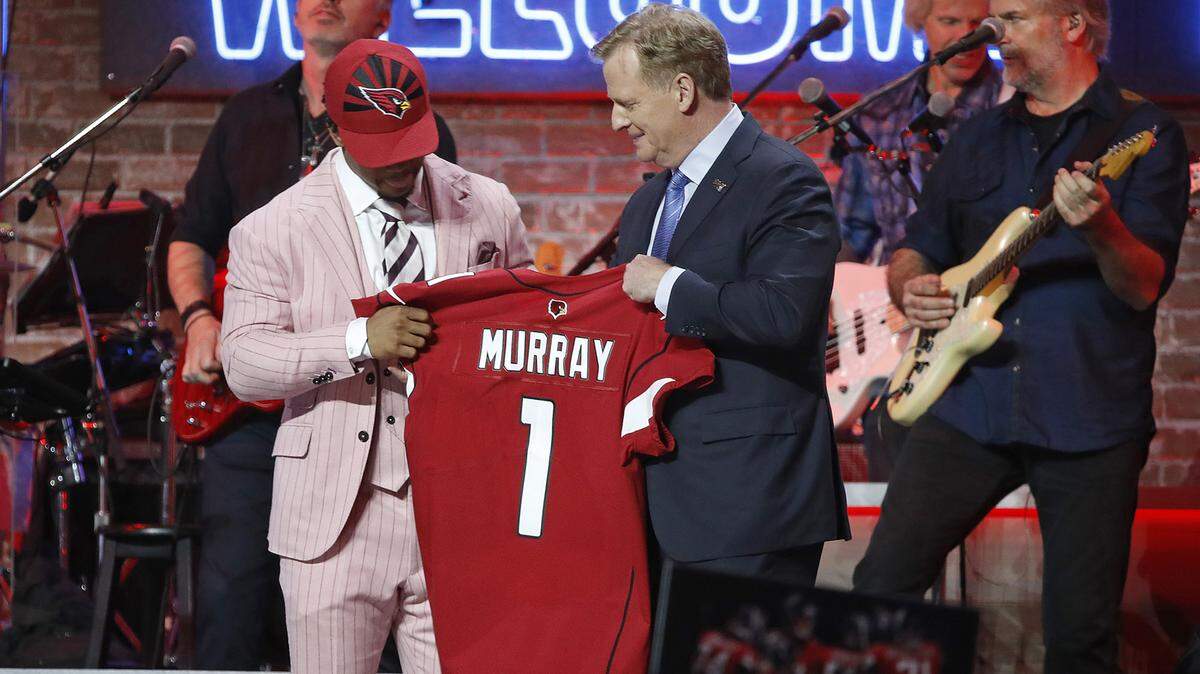
The NFL draft, which begins April 23, in a mere three weeks, will be among the strangest sporting events we have ever seen. But we’ll watch. Of course, we’ll watch. We are desperate for something live. An iDraft won’t cut it.
As a necessary concession to COVID-19, the draft, in Paradise, Nev., a neighborhood in Las Vegas, will be devoid of all but a few people. The draft’s attendant festivities, designed for fans, have been canceled. Thousands of fans will not be on the street to watch the draft on a large screen.
Fans won’t be inside, either. Their absence will create a major change. When the New York Giants make their pick, the fourth overall, nobody will boo.
Dave Gettleman, the former general manager of the Carolina Panthers, is the Giants’ GM. When he selected Duke quarterback Daniel Jones with the sixth pick last year, fans flipped. They wanted Anybody But Jones. They wanted Ohio State quarterback Dwayne Haskins, who would go 15th to Washington. Jones is the better prospect. It’s not close.
The three-day draft will be like a party in which the only people who attend are the people who throw it. Plenty of good seats are available.
Because the draft will be the only live sporting event since the early rounds of the conference basketball tournaments, we’ll be transfixed.
The Panthers will draft seventh. If Ohio State cornerback Jeff Okudah is available, I jump. If Clemson linebacker Isaiah Simmons is available, I jump. I doubt either will be. If they aren’t, I take Auburn defensive lineman Derrick Brown.
Okudah is the best cornerback in the draft, Simmons the best linebacker and Brown the best interior defensive lineman.
Aside from signing receivers who played at Temple, we don’t really know what new coach Matt Rhule, who coached at Temple before coaching at Baylor, after which he came to Carolina, is doing. We’ll know a little more after the three-day draft.
But we really won’t know until we see the new players on the field, at mini-camp, and especially at training camp. And we don’t know when that will be. An iCamp will not be held.
Nothing wrong with expanding NFL playoffs
The problem with expanding playoffs usually is that too many teams get in. We look at the team that under the old rules wouldn’t have qualified and, unless it’s our team, think: They have no right to be here.
But in a year, at most two, we forget the playoffs were ever any other way – unless an 8-8 team wins the Super Bowl.
The NFL announced the inevitable Tuesday. As per the new collective bargaining agreement between owners and players, the league will expand the playoffs this season from 12 teams to 14. The NFL last expanded the playoffs in 1990, when they moved from 10 teams to 12.
Is 14 too many?
The NBA is a 30-team league, and more than half of those teams, 16, advance to the playoffs. Make it 20 to 24, and perhaps the Charlotte Hornets get in. Since the NBA returned to Charlotte for the 2004-05 season, the Hornets have three times made the playoffs, and are 3-12. They last made the postseason in 2015-16.
The role of the eighth seed is to provide fodder for the one seed, but the coach of an eighth-place team can put playoffs on his resume, and hope he saves his job. And once their team is in, fans get to dream.
Major League Baseball has 30 teams, and 10 make the playoffs.
The NHL has 31 teams, and 16 make the playoffs.
The NFL will add one wild card team in each conference and take away the bye from the second-place team. So, the No. 2-seed will open against the No. 7-seed.
Last season, the lowest seed in each conference won its opening playoff game. Tennessee, the AFC’s sixth seed, upset New England and then Baltimore. Minnesota, the sixth seed in the NFL, upset New Orleans but lost to San Francisco.
The teams that would have advanced had there been a seventh seed were the Pittsburgh Steelers (who finished 8-8), and the Los Angeles Rams (who finished 9-7).
Playoffs expand all the time. Watch. Baseball and the NHL will soon expand theirs.
In the NFL, come one, come all. We’ll get triple-headers on wild card weekend.
Best games I’ve seen: Hornets-Celtics, Panthers-Rams
I turned on ESPN one morning and Muhammad Ali was fighting Joe Frazier. Ali is my favorite athlete of all time, and I would have paid to watch him shadow box. Frazier was a testament to grit, will and a devastating left hook.
Our televisions are full of former NFL, college football, NBA and college basketball, Major League Baseball and NHL games, and boxing and wrestling, too.
So, in that spirit, here’s a look back.
The best game I ever saw live? There are two.
The first is the Charlotte Hornets 104-103 playoff victory against the Boston Celtics. That game, the game that ended the series, was May 5, 1993, at the Charlotte Coliseum.
The season was the fifth for the Hornets, and their first foray into the playoffs. I remember walking into Boston Garden behind some Hornets officials, and we had entered through an unapproved door.
A man in a suit, who at least looked dignified, and was walking past said, “That’s the wrong door.”
Then he saw team colors, and stopped walking.
“You’re from Charlotte,” said the man, who only looked dignified. “Of course you went into the wrong door.”
The man stood there several seconds to let the group know that he was serious, and perhaps expected us to take a knee.
The Charlotte-Boston first round series was as tense as any I’ve covered. I remember Charlotte’s Larry Johnson, talking in the locker room about Boston’s Kevin McHale, who was playing his final season. Johnson and his friends would watch McHale on TV and say that those moves would never work against them. In the locker room, Johnson shook his head. The moves still worked.
The series was best of five; if the Hornets did not win Game 4 in Charlotte, they’d return to Boston for the final game.
The Hornets appeared unbeatable early. This was their night. And then it wasn’t. Late in the fourth quarter they went 3 minutes and 22 seconds without scoring, and the Celtics took a one-point lead.
Working against Xavier McDaniel, Johnson missed what could have been the game-winning shot, and the ball went off the Celtics out of bounds. Dell Curry threw the inbounds pass to center Alonzo Mourning, and Mourning hit from 17-feet with 0.4 seconds remaining and the Hornets won 104-103.
So many Hornets piled on Mourning that you no longer could see him, and 23,698 fans celebrated as if they were atop Mourning, too.
The playoff door closed on the Celtics.
The second game was Jan. 10, 2004, when the Carolina Panthers upset the St. Louis Rams 29-23 in double overtime on the road in the NFL’s divisional playoffs. The Rams led the league in scoring, and had won 14 straight at home.
On third and 7, on the game’s final play, the Panthers ran a play offensive coordinator Dan Henning pushed for – X-Clown. Jake Delhomme hit Steve Smith Sr. after Smith cut hard on a disguised post route, for a touchdown of 69 yards. Smith held his arms in the air before he crossed the goal line. Nobody was going to catch him.
The play was startling and stunning, and the great St. Louis fans – St. Louis should have an NFL team – were too numb to react.
Smith wasn’t. I asked him what he was thinking when he crossed the goal line.
“I can tell you what Angie (his wife) was thinking,” said Smith, “Cha-ching.”
Everybody who saw that game remembers. When it comes up, former players always smile. Whenever I run into ex-Hornets, and the playoff clinching Boston game comes up, and it often does, they, too smile.
I’m not going to pick between those games. It’s my column. I don’t have to.
The best series I saw live: Davidson’s 2008 Stephen Curry-led run through the NCAA tournament.
Remember? The Wildcats upset Gonzaga and Georgetown in Raleigh, and Wisconsin in Detroit. They then played Kansas; winner would go to the Final Four. The Jayhawks, the eventual NCAA champions, won by two.
I watched Davidson’s Gonzaga victory on TV because I was in Washington with Duke. But after Duke’s second-round loss to West Virginia, I sped back to Raleigh to catch the second half of Davidson’s Georgetown upset. I was in Detroit when the Wildcats handled big but plodding Wisconsin and came so, so close to beating Kansas.
Davidson’s tournament run felt like a cause. Basketball insiders knew how good a coach Davidson’s Bob McKillop was. Now everybody else did.
Everybody now knew about Curry, a sophomore. He scored 40 against Gonzaga, and 30 against Georgetown, leading comebacks in both. Wisconsin led the NCAA in defense, giving up only 53 points a game. Curry score 33.
Curry scored 25 against Kansas, but needed 25 shots to get them. The Jayhawks were really good.
By then, everybody knew about Davidson. The one detail almost every story included: students didn’t have to pay to get their laundry done. The school took care of it.
The true Davidson story was a story about an engaging underdog that handled its success with style and grace.
Maybe another underdog would have emerged this season. We’ll never know.