
The art of capturing Charlotte
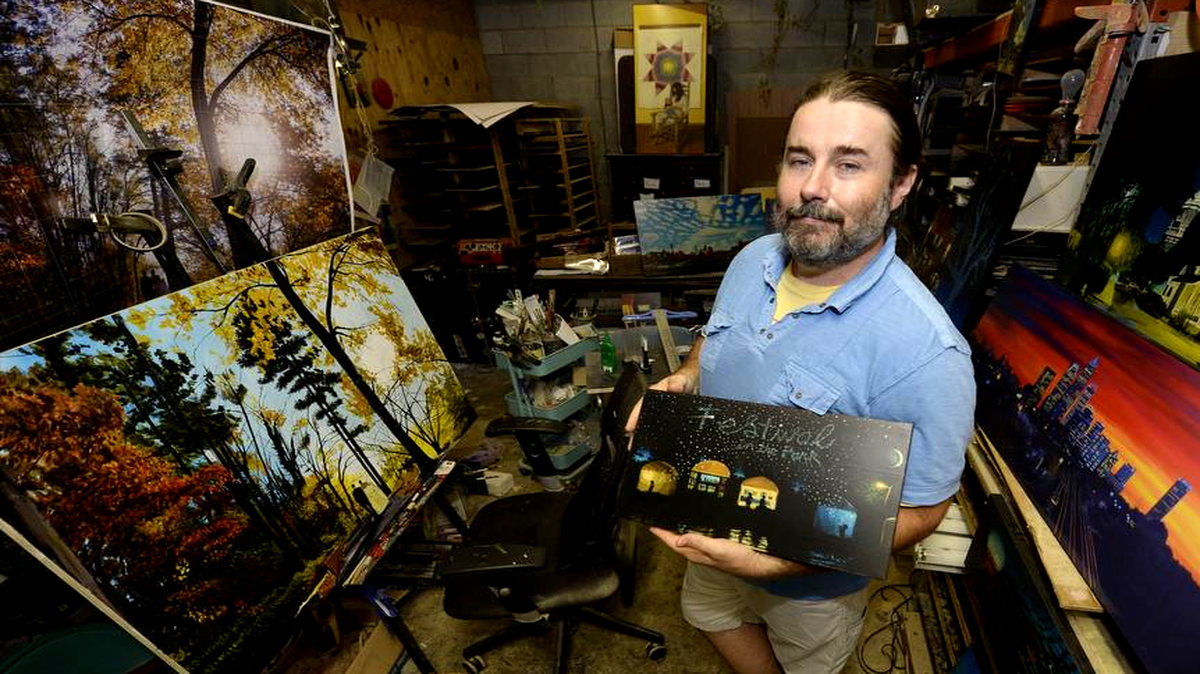
David French estimates his artwork is in close to 30,000 homes. The number sounds outlandish until you discover that in the seven years he’s been a professional artist, he’s sold nearly 50,000 prints.
You could easily have a David French print and not know you have one. (Believe me. My parents gave me a mounted print of the Manor Theatre, and I didn’t realize it was by David French until I began writing this story.)
French, 39, a West Virginia native who has called Charlotte home since 1994, paints local landmarks – mostly the quirky places people love. The Coffee Cup, Anderson’s, The Athens – French memorialized all those mom-and-pop restaurants before their demise.
The artist formerly known by his childhood nickname – Wheetie – will paint bigger landmarks, too. But what he’s really drawn to are the funky, independent places that give Charlotte a soul.
He’s mostly self-taught. (Or he sought out his own teachers.) He studied at UNC Charlotte and CPCC but left shy of earning a degree. He didn’t think what was being taught in his art classes would help him make a living as an artist.
Right place, right time
At the time French was thinking he’d like real-world experience instead of classroom experience, he met Starr Davis, an artist looking for an intern. He worked for Davis for a year while working 40 hours a week for an electroplating company.
Davis, who now lives in Coburg, Germany, said via email that French was a “charming welcome” to her NoDa studio. He “oozed talent and energy,” she said.
During Davis’ time in Charlotte, she painted murals as large as 12 by 18 feet for restaurants including Lone Star Steakhouse and The Atlanta Bread Co. French assisted her.
“I remember how I first taught him to paint realistically the folds in a lady’s gown,” she recalled. “He … listened well to my instructions (and) held an intense desire to learn to paint and was curious about what it was like to be a working artist.”
In 1999, Davis introduced the aspiring artist to Paul Sires, the sculptor and founder, along with his wife, artist Ruth Ava Lyons, of NoDa. It was another lucky break.
Sires needed a tenant for a small house he and Lyons owned behind NoDa’s Smelly Cat Coffeehouse. French and a roommate moved in and turned the place into their home and an anti-establishment art gallery they called Two 7s Gallery. “Seven is a magic, spiritual number,” French explained. “And it was I-77 that brought me to Charlotte.”
The tiny gallery in the nearly hidden house was open only on Gallery Crawl nights. “Hundreds of people funneled through that yard,” he recalled.
With that makeshift gallery, French became immersed in the city’s alternative arts scene. “This, to me, was more valuable than school,” he said. “This was a real education.”
Becoming a full-time artist was nearly a decade away for French, who waited tables for seven years. But even that experience served his artistic progression. It was during his restaurant career that he met his first big patron.
Financial adviser Frank Bragg came to the now-closed Monticello restaurant for dinner and asked French about himself. French said he was an artist; Bragg asked to see his work and bought an original painting. Then he bought two more.
“David’s an entrepreneur,” said Bragg, who’s purchased five paintings total. “He’s very good at promoting himself, which is what you have to do, I reckon.”
The net result, he quips: “I lost a great waiter.”
Big as barbecue
French knows where to reach people. He’s exhibited at Festival in the Park every year since 2007. “They tell me that, outside of the barbecue stand, my booth is the busiest,” he said.
Also in 2007, he began selling his work in galleries and retail shops – first at Green Rice Gallery in NoDa and next at City Supply Co. in Plaza Midwood.
He makes smart use of social media. He’ll post photos of works in progress and ask for help from his nearly 1,200 Facebook friends/followers in naming a new work. Followers are happy to offer suggestions; the winner gets a free print of the work. (One winning suggestion: “Midsummer Knights Dream” for a painting of Knights stadium.)
People really respond to his work. People tell us (of a particular scene), ‘That’s where my husband and I had our first date’ or ‘This is where I proposed.’
a
Paper Skyscraper has carried French’s prints since 2010. Co-owner Ron Wootten said the store sells something of French’s every day. The artist has to restock at least once a week and daily during the holiday season.
“People really respond to his work,” Wootten said. “People tell us (of a particular scene), ‘That’s where my husband and I had our first date’ or ‘This is where I proposed.’”
Besides, it’s just plain fun. “David will sometimes paint himself into his art,” Wootten said. “In his Cabo Fish Taco painting, he and his wife (Molly) and son are there.” Even if French doesn’t make a cameo appearance, his truck might. Or a friend of his.
And the color? It’s boisterous. French spent a number of years working almost exclusively in charcoal and thinks his affinity for vivid color is a reaction to his previously monochromatic palette.
Art as social commentary
You can look at French’s works as slice-of-life depictions of little pockets of the Queen City. But when viewed another way, the work is a commentary on what the city has lost.
Sires especially appreciates what he calls the documentary aspect of French’s work. “David is painting Charlotte scenes that are disappearing,” he said. “That aspect of his work, for me, is the most interesting.”
“(The work) is socially relevant, but in a subtle way.”
But “subtle” isn’t a word you’d use to describe the gentle, but outspoken, French.
Talk to him for a few minutes, and he’ll tell you that city leaders don’t appreciate – or support – the spontaneous arts areas that have popped up organically. He’ll also tell you the taxpayer money being spent uptown is a waste.
“Most people I talk to aren’t interested in uptown,” he said. “And my job is to know what people love about Charlotte.”
He criticizes city leaders for pouring money into uptown development when artists are creating their own little worlds elsewhere in the city that, he said, deserve support.
He has an especially critical view of the city’s 2003 takeover, by eminent domain, of uptown’s boundary-pushing arts incubator Hart-Witzen Gallery (where French and about a dozen other artists were working and living) and turning it into – wait for it – a gravel parking lot.
Emboldened by a tragedy
Losing his artistic (and literal) home was devastating. But not as devastating as the 2008 plane crash that killed Bryan Quan, French’s friend, fellow artist and housemate.
In 2005, the pair bought what French described as “the worst house in NoDa.”
“We had more time than money,” he said. The house had asbestos siding, rotting wood and a tree growing out of the porch. What it didn’t have were interior walls and plumbing.
“Bryan’s passing gave me fire in my belly,” he said. “With great tragedy can come a greater beating of your heart.”
French still lives in that fixer-upper – which he’s turned into a whimsical, bohemian compound where he lives with wife Molly, a yoga disciple and practitioner, and their 3-year-old son, Thayer.
He and Quan bought the house “mostly for the garage,” which today serves as his art studio. An untamed space, it lacks air conditioning or heat. But it has plenty of crazy charm.
His work has taken on a dreamier quality in the past three years. Stars, van Gogh-like swirling clouds and a certain playfulness suggest, he said, the influence of young Thayer.
French’s artistic output is huge. But he’s making, he says, “art for the people.” And the people continue to respond.
He said, “If you believe what you’re doing is good, why not make it accessible to everyone?”
Pieces of Charlotte
David French has painted about 240 Charlotte vignettes, and 100 of those have been made into prints. Ten of those are skyline views, which are among his best sellers.
It can take from 10 hours to 100 hours to complete a painting, French said. After years of using oil paints, he now uses acrylic.
Looking ahead: “There will be a day I paint abstracts,” he said. “I inch toward it slowly ... maybe.”
His work is sold at Paper Skyscraper in Dilworth, Green with Envy and City Supply Co. in Plaza Midwood, Ruby’s Gift in NoDa and The Beehive uptown, as well as from his NoDa studio. Prints on paper sell for $15 to $25. Mounted prints are generally $75 to $150. A commissioned work might run $500 to $5,000, with $1,000 being average. davidfrenchoriginals.com.
This story was originally published August 15, 2015 at 2:00 AM with the headline "The art of capturing Charlotte."