
Cardiologist follows his heart and a trend
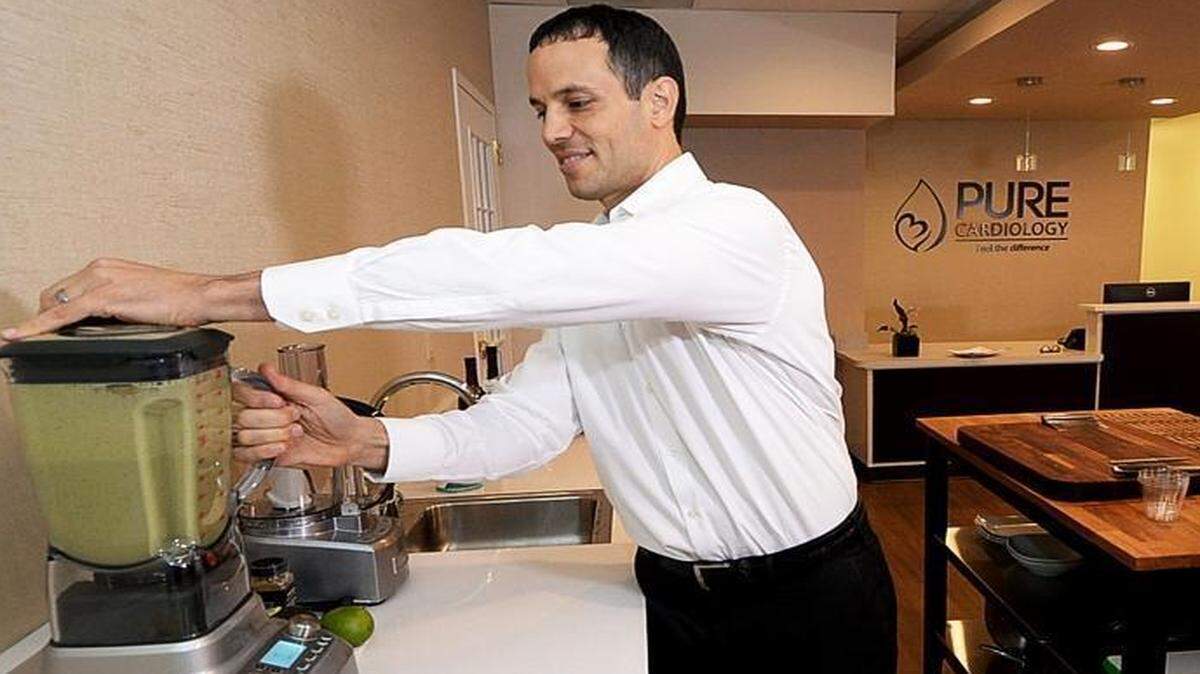
Walk into the waiting room at Pure Cardiology in Ballantyne, and you’ll be surprised by the lack of chairs, coffee tables and magazines.
Instead, there’s a pub table and two bar stools where patients can sit and watch as Dr. Christopher Stephenson demonstrates how to prepare plant-based meals that can help them lose weight and prevent or combat heart disease.
It’s just one of the ways in which Stephenson’s 7-week-old venture purposely veers from the traditional way of practicing cardiology.
After 12 years at Carolinas HealthCare System and Novant Health, Stephenson said he was tired of feeling pressured to order more tests and procedures and see more patients each day instead of taking time to counsel them about heart-healthy lifestyles.
In July, Stephenson became the first cardiologist in Charlotte to start a “concierge” practice, in which patients are asked to pay monthly or annual retainers. Since 2003, about a dozen Charlotte doctors have switched to similar practices, but most are primary care physicians. Of the 6,000 or so concierge doctors in the country, about 25 are cardiologists, according to the American Academy of Private Physicians, a trade group.
For a monthly fee, patients at Pure Cardiology get unlimited visits, sometimes same-day appointments, with Stephenson, as well as other services such as cooking and yoga classes. He doesn’t bill commercial insurance but will accept Medicare. And he plans to limit the number of patients to 300, instead of more than 2,000 he had in his previous practice.
The idea of charging patients a retainer to be part of a smaller, concierge practice – also called private or boutique medicine and direct primary care – got traction in the 1990s as doctors became frustrated with managed care and financial pressures to see more patients. That frustration has only grown as hospital chains have purchased physician practices and, with eyes on the bottom line, pushed doctors to become even more productive.
“We really need a revolution in health care, and the solution is not going to be offered by politicians. It has to come from the grass roots,” Stephenson said. “I started to realize there is a better way.”
There’s no possible way you can attend to people’s needs in 10 to 15 minutes.
Dr. Christopher Stephenson
founder of Pure CardiologyCritics continue to question the ethics of creating a separate system of care for the elite. But the traditional U.S. health care system is already stratified. Despite passage of the Affordable Care Act, which expanded access to health insurance, millions of citizens still are uninsured or underinsured, with limited access to care.
Longtime patients of doctors who switch to concierge medicine may feel abandoned if they can’t afford the new fees, some critics say. But Stephenson counters that patients from his previous practice, part of a large hospital-owned group, can continue to receive care from its other cardiologists. “That happens all the time, when doctors move or leave the state,” he said.
Concierge doctors make up a small percentage of the total – about 900,000 in the country, including about 33,000 in North Carolina. But after more than 20 years on the scene, the concept appears to be here to stay. The American Academy of Private Physicians says the number has been growing by 25 percent annually in recent years.
More time with patients
Stephenson, 45, who is married with two young children, is one of about a dozen Charlotte-area doctors who have studied with Dr. Andrew Weil, the world-renowned guru of “integrative medicine” at the University of Arizona. He’s also studied culinary arts through the online Rouxbe cooking school.
He was drawn to the idea of “using food as medicine” after resolving medical problems of his own. In 2009, after years of migraine headaches and gastroesophageal reflux disease, he adopted a plant-based diet. “Within a week or two, I stopped having acid reflux. And the migraines didn’t come back,” Stephenson said.
At the same time, he was frustrated by expectations on his time. His four-hour morning schedule included 17 patients with “very complicated” health problems. “There’s no possible way you can attend to people’s needs in 10 to 15 minutes,” he said.
Most of those patients were overweight with chronic conditions, such as diabetes, high blood pressure, cholesterol disorders, joint pain, sleep disturbances, and depression or anxiety, he said. It’s common for doctors to “match a pill to your symptom” without discussing the root of the problems, he said.
Doctors aren’t necessarily to blame, he said. “Perverse incentives” push doctors to perform procedures and tests for which they get paid, because insurance typically doesn’t reimburse for time spent talking with patients.
At Pure Cardiology, Stephenson spends one to three hours with each patient, helping them understand how they might avoid invasive procedures or surgery that cardiologists often recommend. He said his focus is “on health rather than disease” and “getting away from reliance on pharmaceutical drugs.”
In conversations and cooking demonstrations, Stephenson talks about the dangers of processed food and the benefits of a plant-based diet, which has been proven to reverse heart disease. He recommends books by nationally respected specialists, including Weil, Dr. Dean Ornish, Dr. Caldwell Esselstyn and Dr. Joel Fuhrman. He also talks about the benefits of exercise and how today’s adults don’t move enough.
For this extra time and access, patients are asked to pay $135 a month if they’re 65 and older. The monthly fee for other adults is $185. So far, Stephenson has signed 25 members to his practice.
Cardiology-based practice
Dr. Jordan Lipton, a founder of Signature Healthcare, Charlotte’s first concierge practice, said he’s glad to see more doctors “jumping on our bandwagon,” but he has doubts about the viability of a cardiology-based practice.
“I just think it’s going to be tough for him to make a go of it,” Lipton said. “Everybody should have a primary care doctor, but not everybody needs a cardiologist.”
Those who do need a cardiologist may require one who is affiliated with a hospital and can perform procedures, such as cardiac catheterization and stent placements, Lipton said.
Stephenson is no longer performing invasive procedures, such as cardiac caths, but if any of his patients needs to go to the hospital, he said he will make the referrals and “coordinate care.” Those services will be billed to insurance, as always, by the hospital and the treating physician.
But Stephenson said patients who join Pure Cardiology don’t have to have heart disease. They can simply be interested in preventing it.
Indeed, Tom Blue, chief strategy officer for the private physician trade group, said he encouraged Stephenson to try the concierge concept, especially because of his interest in nutrition and integrative medicine. By helping people prevent heart disease, Stephenson can also help prevent diabetes, obesity and other health problems, Blue said.
In the United States, heart disease is the leading cause of death for both men and women. Someone has a heart attack every 43 seconds, according to the Centers for Disease Control and Prevention.
“The conventional view of a cardiologist is that they are essentially a plumber, and when you have a blockage, they will open it up,” Blue said. “But when you get older and you’ve got heart disease, your cardiologist almost becomes your primary care provider. … Chris has the knowledge to be right at the top of that game.”
Other concierge practices
Lipton and Dr. Elizabeth Perry launched their SouthPark practice in 2003, and it now has five doctors serving a total of 1,250 patients who pay annual fees ranging from $1,500 to $3,500. The group, which opened a second office uptown in 2014, bills both private insurance and Medicare for covered services.
About eight or nine other concierge practices have opened in the Charlotte area, ranging from a single family doctor who accepts no insurance reimbursement to larger groups operated by Carolinas HealthCare and Novant Health, the two nonprofit hospital systems in the region, and by MDVIP, a Florida-based company that contracts with doctors across the country. Most of them do accept insurance.
Pure Cardiology does not bill private insurance plans, but patients could file their own claims for covered services, Stephenson said. He does accept Medicare reimbursement for covered services, such as office visits, which is why he set the membership fee lower for 65-and-older patients.
But he will be offering a variety of tests, such as treadmill stress tests and stress echocardiograms, in his office. He said he has set prices that he believes are affordable. For example, an echocardiogram is listed at $215. Comparing prices isn’t easy because hospitals don’t publicize their prices, but an Aetna insurance calculator for members estimates the price of an echocardiogram at three Charlotte-area hospitals at $2,000.
If I had not met him, I don’t even know if I’d be alive today.
Jeanette Viegelmann
68, of Monroe“My objective is not just to take care of rich people,” Stephenson said. “If I was driven by money, I would have just stayed where I was.”
‘I’m getting younger’
Patients who have followed Stephenson’s advice, even before he opened his solo practice, praise him for helping to improve their health.
“If I had not met him, I don’t even know if I’d be alive today,” said Jeanette Viegelmann, 68, who moved to Monroe from upstate New York in 2007.
When she met Stephenson in 2010, Viegelmann had multiple, chronic medical problems, took about 30 different medicines and used a cane to walk. “I would walk down half a hallway and have to hold on to the wall to catch my breath,” she said.
At the time, she weighed 265 pounds, at 5-feet 5-inches tall, and Stephenson counseled her about adopting a plant-based diet both to lose weight and improve her heart health.
Since 2010, she’s lost 125 pounds and has been able to stop taking at least half the drugs that had been prescribed for blood pressure, diabetes and kidney failure. She still has diabetes and gets kidney dialysis every night at home. But she also walks 4 miles a day.
“Now I don’t sit still,” she said. “I’m on the go all the time. … Instead of getting older, I feel like I’m getting younger.”
Because Viegelmann has been Stephenson’s patient for several years, he exempted her from the Pure Cardiology membership fee. But Viegelmann said she’d pay extra to continue seeing him. “All he cares about is how I feel. You just don’t go to a doctor’s office today and get that kind of care. … Why wouldn’t I want to go to him?”
At a cooking demonstration Friday, Stephenson showed new members Carol and George Pinsak of Monroe how to make “tasty and nutritious” oatmeal with organic oats soaked overnight in apple juice and served with blueberries, mango, apples, walnuts, flaxseed and cinnamon. He also made smoothies in a blender with greens, banana, cinnamon, nutmeg, ginger root and almond milk, and prepared a “meal bowl” using sprouted organic rice, salad greens with an oil-free dressing, black beans and salsa.
The Pinsaks joined Pure Cardiology because George had triple heart bypass surgery in 2014, and Carol hopes to prevent further complications from her diabetes and fatty liver disease.
George Pinsak, who said he would never have ordered the meal bowl in a restaurant, cleaned his plate and said he’d eat it again. Carol Pinsak, who recently dropped plans to have bariatric surgery, said she has lost 7 pounds since visiting Stephenson a month ago. And she has been able to stop taking three of her medicines. “I can already tell the difference in the way I feel,” she said.
Observing these results fuels Stephenson’s motivation to continue advising patients on how to change their behavior and improve their health.
“It gives them a sense of hope,” he said. “They start taking action. And the response can be seen almost immediately. … I think this is going to be the future of medicine.”
Karen Garloch: 704-358-5078, @kgarloch
Learn more
Pure Cardiology: www.purecardiology.com, 704-233-7449.
Chocolate Avocado Mousse
From Chad Sarno, chef at the online culinary school Rouxbe.
1 1/2 cups cocoa powder, raw or toasted, unsweetened
4 very ripe avocados
1/2 cup date paste (see note)
1/4 cup liquid sweetener, or use more date paste
1 teaspoon vanilla extract
1/4 teaspoon sea salt
1/4 cup nondairy milk
Organic unsweetened coconut flakes and fresh berries (garnish; optional)
In food processor, add all the ingredients (except the garnish), and blend until smooth. Be sure to scrape the sides to ensure all is blended thoroughly. Spoon into glasses or ramekins. Chill in the refrigerator. Serve with garnish.
Note: To make your own date paste, pit Medjool dates and soak them in water with some cinnamon for at least 1 hour or overnight, then drain and puree. If desired, add natural honey or maple syrup to sweeten the mousse while processing all ingredients.
Yield: About 8 servings.
This story was originally published September 6, 2015 at 2:00 AM with the headline "Cardiologist follows his heart and a trend."