
Charlotte looks to turn parking spaces into parks
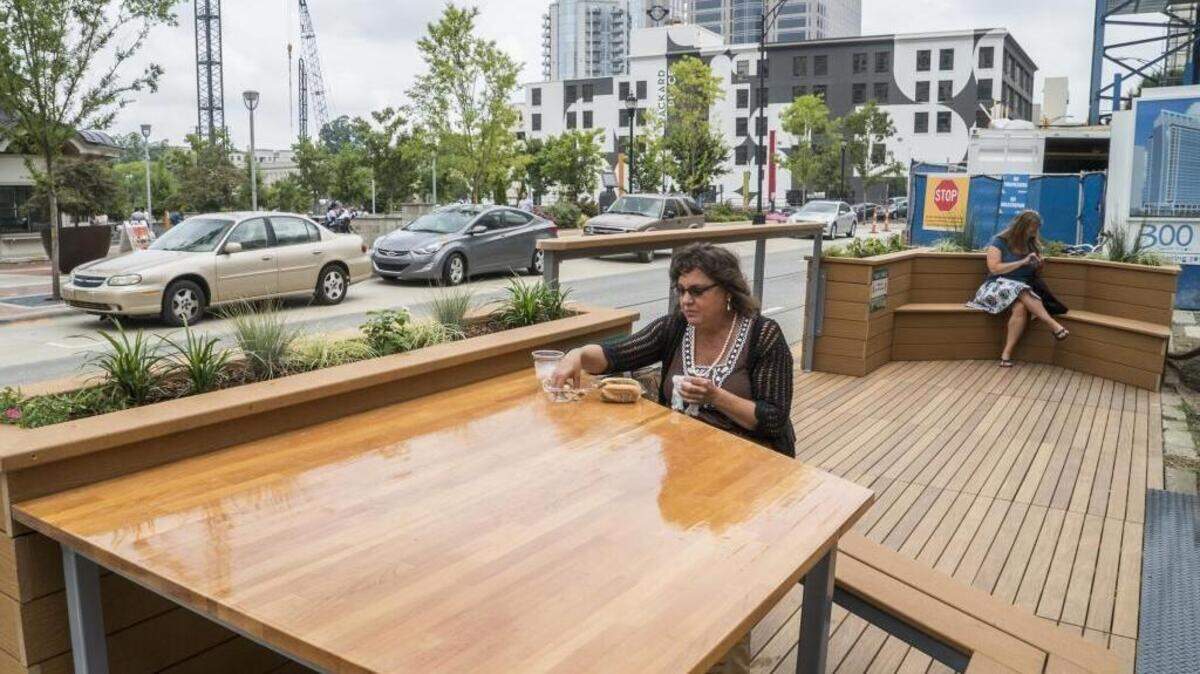
In July, two parking spaces along South Church Street across from Romare Bearden Park disappeared. In their place, crews installed a table with benches surrounded by a small fence.
It was the first of what could be many small parks or “parklets” in the city.
Parklets are normally installed in parallel, public parking spaces on streets with a speed limit of 35 mph. The intent is to liven up block and make it more pedestrian-friendly.
Charlotte has been experimenting with the parklet concept since 2013, when it first participated in International Park(ing) Day. That’s an event in which designers propose options for turning parking spaces into the small parks.
“Instead of storing one empty vehicle, the same space can hold many people, socializing, studying, eating, resting, etc. It’s a much better use of space – affecting more people,” said Keihly Moore, urban designer and organizer of Charlotte’s three PARK(ing) Days.
For the third year in a row, local design firms on Friday will be participating in International Park(ing) Day. They plan to install six temporary, tiny public parks on Tryon Street between Seventh Street and the Levine Avenue of the Arts.
Parklets are a way to reclaim a small amount of public space to beautify and enliven our streets and neighborhoods.
Charlotte Department of Transportation website
Parklets began in 2005 when a design firm organized the first Park(ing) project in San Francisco by transforming a metered parking space into a public park for two hours. Since then, the structures have popped up in cities across the world, including Capetown, Melbourne, Stockholm and Lima.
Building a parklet in Charlotte isn’t as easy as putting a few chairs and a table in a parking spot. Applicants must get signatures of support from nearby businesses and neighborhood organizations. And they must conform to rules, including a 35 mph speed limit on the road.
The costs to build a parklet can range from a few thousand dollars for materials to over $50,000 depending on the size of the structure.
A city program allows residents to install parklets of their own in the designated areas. The city will evaluate the project over the next year to determine if the structures should become permanent.
“Parklets are a way to reclaim a small amount of public space to beautify and enliven our streets and neighborhoods,” according to the Charlotte Department of Transportation website.
Impact on business
While there may be community benefits, French Quarter owner Frank Photopoulos thinks the new parklets aren’t safe around a restaurant-bar environment. His restaurant is adjacent to the parklet on South Church Street.
Though the city prohibits the consumption of alcohol in parklets, that doesn’t prevent customers from venturing onto the platform with drinks, he said.
“We see both sides of it,” Photopoulos said. “Obviously, if people are drinking on there, it needs to be responsible, because you don’t want people hanging off the edge of it and a car coming by.”
Plancharlotte.org released a potential plan for a parklet in front of Price’s Chicken Coop in South End, which would include a seating area in two parking spaces. Price’s currently has no seating for its customers.
But owner Stephen Price said the parking spots are more valuable than a sit-down dining area.
“Parking is already slim here as it is,” he said. “It’s city property and the city is going to do what it wants.”
In some places, businesses in the areas around the parklets have seen a boost in earnings.
Restaurants in Philadelphia and San Francisco, for example, reported increased revenue after the parklets were added, according to the National Association of City Transportation Officials.
About the competition
The Park(ing) Day competition begins at 7 a.m. Friday and the parklets will be closed by 7 p.m. The team with the best parklet design will receive a $500 gift certificate to a Tryon Street restaurant. The Knight Foundation is funding the event in cooperation with Charlotte Center City Partners and the Charlotte Department of Transportation. Participating teams include Gensler, ColeJenest & Stone, Perkins + Will, U.S. Green Building Council Charlotte Chapter, LandDesign and Stantec.
This story was originally published September 17, 2015 at 1:38 PM with the headline "Charlotte looks to turn parking spaces into parks."