
N.C. bill would reduce number of teens in adult courts
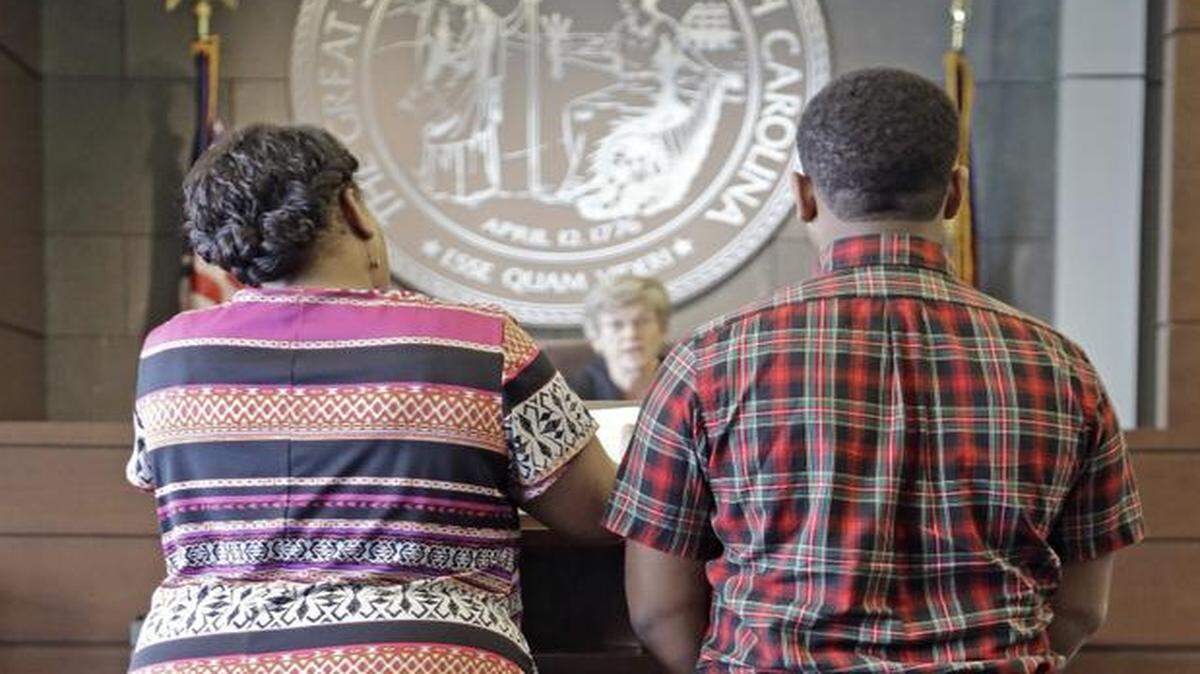
Steal a pair of sneakers in North Carolina the day after you turn 16 and you’ll be charged as an adult. You may not go to jail, but you’ll have an adult criminal record that stays with you the rest of your life. It’s been that way for 96 years – ever since the Juvenile Court Statute of 1919 became state law.
Many juvenile justice observers and youth advocates think it’s wrong to treat 16- and 17-year-olds as adult offenders. They point to research that indicates children who commit crimes have not matured and do not realize a permanent criminal record can have life-changing limitations.
They say the state should help young people with problems, not punish them. They also point to current research that suggests charging those youths as juveniles will save North Carolina’s taxpayers millions of dollars in the long run.
Other states have long since changed their laws and treat teens under 18 as juveniles, leaving North Carolina and New York as the only two states in the country that automatically prosecute a 16-year-old charged with any crime in the adult court system.
Child advocate Frank Crawford of Charlotte calls the law an injustice.
“It’s just criminal for us to treat 16- and 17-year-old offenders as adults when we treat them as children in almost every other way,” said Crawford, a former executive at Youth Homes and the Children’s Home Society of North Carolina.
“Some kids need to be treated as adults ... I get that. Judges and prosecutors should have the discretion of trying 16- and 17-year-olds as adults, but not be forced to automatically treat them all as adults.
“When people ask me, ‘What keeps you up at night?’ this is the first thing that pops out of my mouth.”
For decades, efforts by North Carolina lawmakers to raise the age failed. But last year, the state House – with bipartisan support – passed by a vote of 77-33 a bill that called for 16- and 17-year-olds charged with misdemeanor crimes such as shoplifting, disorderly conduct or writing a worthless check to be tried in juvenile court. Teens charged with felonies would still go through the adult court system. But the measure stalled in the Senate and was never debated.
Rep. Duane Hall, a Wake County Democrat, thinks a new version of the proposal – The Youth Offenders Rehabilitation Act – has a better chance in the Senate this time.
“We have the votes in the overall Senate body,” he said. “The question is whether we can get it out of committee. That was the problem last time.”
Hall and his Wake County colleague, Republican Rep. Marilyn Avila, the lead sponsor of the bill, are looking for senators on the Republican side who can help them.
The measure faces formidable opposition from two statewide law enforcement organizations that say it would be too costly.
Eddie Caldwell, executive vice president and general counsel of the N.C. Sheriffs’ Association, said the organization is not against raising the age but is against the bill because there is a dearth of needed resources, people and programs to help 16- and 17-year-olds.
“The juvenile justice system is already inadequately funded to provide services to juveniles under the age of 16,” Caldwell said. “To add two more age groups to an already overburdened system is not logical.”
The N.C. Conference of District Attorneys won’t support the age change unless it’s funded.
Mecklenburg County District Attorney Andrew Murray, the conference’s president-elect, said increased staffing – up to three new assistant district attorneys and more support staff – would be needed.
“Handling a misdemeanor in regular adult court only takes several minutes, but in juvenile court it takes an hour, on average,” Murray said. “It’s a simple fact that juvenile cases are more employee-intensive. There’s a lot of different parties involved, and all want to have a say about a child.”
But Murray acknowledges that North Carolina “is out of step” on the law with the rest of country.
The bill, now under review by a House judiciary committee, calls for a phased-in approach that would establish an advisory committee to oversee implementation of the plan in all 100 counties. It would create a civil citation program “to ensure swift and appropriate consequences” for adolescents who commit minor crimes while providing “efficient and innovative alternatives” instead of locking them up.
The measure, if passed into law, would go into effect in January 2020.
Marked for life
Mecklenburg District Court Judge Lou Trosch supports raising the age, although he shares concerns about how to pay for it.
“If they don’t, kids won’t be better served and neither will the public,” said Trosch, who works in juvenile court.
Judges are in an awkward situation when dealing with young teens, he said.
“It’s really odd when I’m hearing a case and you’re under 18, you’re considered a child for just about everything,” Trosch said. “You can’t sign a contract. ... You can’t lease an apartment. Your parents are responsible for your decisions. But for criminal purposes, you’re an adult.”
If a 16- or 17-year-old is treated as a juvenile, he said, “There is punishment available, but there is an opportunity to get back on the right track and your life isn’t ruined. Your record doesn’t follow you your whole life.”
Mitch Feld, who leads the Council for Children’s Rights legal team, recently represented a Charlotte teenager caught in both systems. The boy was twice charged with breaking-and-entering offenses, the first when he was 15 and second after he’d turned 16.
The law required him to be tried as a juvenile for the first offense and as an adult for the second.
In the juvenile court case, Feld was able to delve deeper into the youth’s life at home and school and recommend to a judge a custom-made program of treatment.
“If this was only in adult court, you’d find more cookie-cutter programs. The primary focus is on whether the offender did the crime and what the punishment would be,” said Feld, whose team handles 80 to 85 percent of juvenile cases in Mecklenburg County
The teen was missing school, and Feld got him sent to a different school that fit the boy’s goals and “motivated him to attend.” He had a substance abuse problem, and Feld got a judge to order intensive treatment three to four times a week. He had a troubled relationship with his parents, and the judge had the authority to require both parents to take an active part in their son’s rehabilitation.
“We see the greatest degree of success when the parents engage themselves in their child’s treatment,” Feld said. “They (parents) were required to go to his hearings and to make sure he got to his treatments.
“A judge in adult court doesn’t have the authority to order the parents to do anything.”
The teenager had “a positive outcome,” he said. “We’ve found the effectiveness of being holistic and focusing on the child’s needs reduces the chances of him repeating.”
Feld’s legal team tracks clients’ progress. During 2014, only 14.6 percent of their juvenile clients returned to court after being charged with another offense – half the state average of about 30 percent.
A new future
Three years ago, Anthony James Dennis Eaborn was 17 when he was charged with inappropriately touching his adopted 11-year-old sister in Durham.
His story illustrates how the juvenile system can give teens a chance to turn their lives around in a way adult court doesn’t.
Eaborn, now 20, is ashamed of the incident. “I’d rather not speak about that,” he said. “It’s one of those embarrassing charges.”
A Wake prosecutor offered Eaborn a choice: He could plead guilty to a misdemeanor and the case would be handled in juvenile court, but if he pleaded not guilty the case would be tried in adult court on felony charges.
Eaborn, at the urging of his mother, chose to plead guilty in juvenile court because he was afraid of what would happen to him if he was sentenced to an adult prison.
“I’m not very big, and I’m short for my age,” said Eaborn, who weighs about 140 pounds. “I never would have survived in prison.”
As a first-time offender in an adult court, there’s a chance Eaborn would not have been sentenced to prison. Still, a criminal conviction for sexual assault and registering as a sex offender would have placed considerable limitations on his future.
Eaborn had been placed into the foster care system at age 2 because his mother was addicted to crack cocaine and his father was in prison for murder. He landed in four different foster homes in Asheville and suffered physical and sexual abuse at two of the homes. Eaborn was 6 when he was adopted by a Durham couple.
When Eaborn went to court, he was sentenced to one year of probation and ordered to enroll in Second Round, a youth treatment boxing program at Haven House in Raleigh. He was also ordered to undergo therapy for a year.
“Boxing played a big role,” he said. “It made me focus more on the future, what I wanted to do in life – to do my schoolwork, to better myself in life.”
Today, Eaborn is a full-time student at Wake Technical Community College, and he works nights as a server at IHOP.
Costs debated
Opponents of the bill question how much money will be needed to help teens like Eaborn in the juvenile court system, and where that money will come from. Each year, 22,000 16- and 17-year-olds in the state commit their first misdemeanor offense. Last year, 31,560 complaints were filed against juveniles 15 and younger.
Caldwell, with the sheriffs’ association, said the juvenile system is underfunded. Once the system has the money it needs to help children 15 and younger turn their lives around, “then we can have discussions about 16- and 17 year-olds,” he said.
He added that juvenile justice programs for older teens would have to be different than those for younger children, and housing would need to be separate.
“None of that is provided for in this bill,” he said.
Avila countered the criticism, saying opponents were “jacking up the price” because they assume the measure calls for building new facilities. “These kinds of crimes don’t end up in incarceration,” she said.
David Guice, the state’s juvenile justice commissioner, and William “Billy” Lassiter, deputy commissioner, both support the bill.
They say the timing is right because of the 2012 merger of the department of correction, crime control and public safety with the department of juvenile justice and delinquency prevention.
“We are able to manage resources and use resources today in a way that they didn’t have before,” Guice said.
Lassiter said more than half of the youths in the state’s juvenile system are already over the age of 15. “They may have committed the offense when they were 15 and a half,” Lassiter said. “By the time they come to court, they’re actually 16.”
Guice and Lassiter say there is no doubt there would be a significant impact on the juvenile justice system if legislators vote to raise the age, creating a need to increase the number of juvenile court counselors, juvenile detention beds and community-based alternatives. Still, because the bill deals only with misdemeanors, they say the impact on youth development centers would be minimal.
A 2011 cost-benefit analysis by the Vera Institute of Justice, a nonprofit, nonpartisan research center in New York, found that North Carolina could generate $52 million in annual net benefits if legislators raised the juvenile age. Avoiding a lifetime adult criminal record increases future employment and earnings.
Enjoying a second chance
Carmen Daugherty, policy director with the campaign for Youth Justice in Washington, D.C., said there are other troubling issues when children enter the adult criminal system.
Daugherty cited a 2007 report from the Centers for Disease Control and Prevention that said teenagers charged as adults are 34 times more likely to be rearrested, usually for more violent crimes, than their counterparts on the juvenile side.
Moreover, young people behind bars even for 48 hours are 36 times more likely to commit suicide and 18 times more likely to be raped, according to the U.S. Department of Justice’s Bureau of Justice Statistics.
Eaborn recognizes that the juvenile treatment has given him a second chance and a voice.
“I got my frustrations out and my anger,” he said about the Second Round program, where he has a 4-1 boxing record in the lightweight division.
Eaborn receives about $1,000 each year to attend college. He wants to transfer to UNC-Asheville after he earns an associate degree from Wake Tech. He figures that if he had been charged in adult court he would have been required to register with the state’s sex offender registry.
That’s all behind him now. In addition to college and work, Eaborn speaks at fundraisers on behalf of Haven House. He’s trying to get his driver’s license. His goal is to work full time at Haven House.
Perlmutt: 704-358-5061
How North Carolina stacks up
A 2012 report by the U.S. Department of Justice found that on a typical day North Carolina has more inmates under 18 in its adult jails than can be found in neighboring states.
119 in North Carolina
93 in Georgia
32 in South Carolina
19 in Tennessee
3 in Virginia
This story was originally published April 25, 2015 at 4:00 PM with the headline "N.C. bill would reduce number of teens in adult courts."