
Women’s basketball is reaching new heights in NC, SC. Here’s what it can do to rise even higher | Opinion
The week after Christmas, from 1949 to 1960, thousands of North Carolinians converged on Raleigh to watch some of the best men’s college basketball in the country.
The occasion: the Dixie Classic, which pitted the men of North Carolina’s “Big Four” teams – N.C. State, UNC, Duke and Wake Forest – against the best competition available.
Basketball became a North Carolina obsession through a combination of ambition, effort and promotional skill, especially on the part of N.C. State coach Everett Case, who dreamed up the Dixie Classic.
As supporters of women’s basketball seek to make their sport an equally compelling institution – including a bid to revive the WNBA Charlotte Sting – they would do well to study Case and his contemporaries. Although enthusiasm for women’s basketball is running high, making it a permanent fixture on the sporting landscape will require more systematic work.
Men’s college basketball has become such a North Carolina institution that enthusiasm for the sport seems almost natural, prompting speculations on the quality of the state’s water or on the color of the sky, which so suspiciously resembles Carolina Blue.
During the Dixie Classic’s run, spectators crammed North Carolina State’s palatial R.J. Reynolds Coliseum to cheer on their favorite teams. True to the arena’s name, cigarette smoking was the norm. By the final contest, former spectators say, so much smoke had collected at the ceiling that it was hard to see the action from the cheap seats.
The Classic quickly established itself as one of the best tournaments around, attracting the nation’s top teams. In 1958 competitors included the University of Cincinnati, led by the phenomenal Oscar Robertson – though the strictures of Jim Crow segregation meant special accommodations had to be arranged for Robertson.
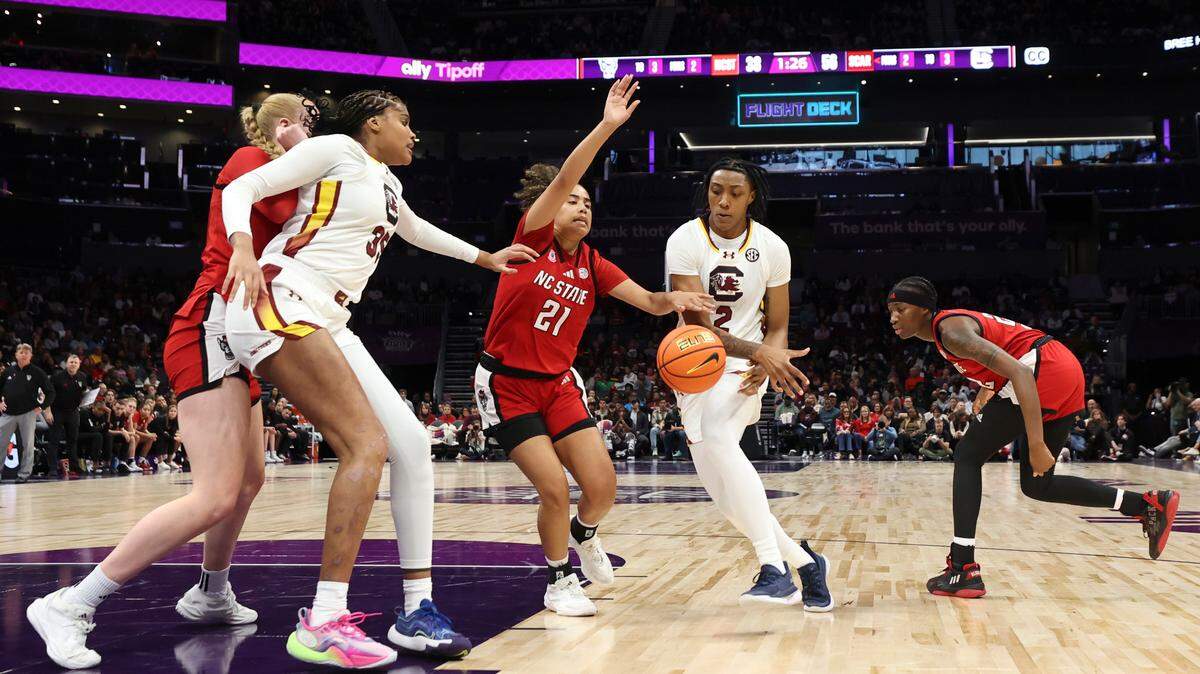
One step in establishing a permanent women’s basketball presence might involve Charlotte’s Ally Tipoff, which last fall hosted three of 2024’s Final Four teams – South Carolina, N.C. State and Iowa – as well as perennial contender Virginia Tech. More than 15,000 fans made the trek to Charlotte to cheer on their teams.
The excitement at those games invoked the feeling of the Dixie Classic – minus the smoke. The crowd at the N.C. State-South Carolina contest filled the arena with color and partisan energy – South Carolina supporters swaying and cheering in garnet, and N.C. State fans sporting Wolfpack red.
The top-flight experience provided by Ally Financial and the Charlotte Sports Foundation has made the Tipoff an attractive invitation. After the N.C. State-South Carolina game, Gamecocks coach Dawn Staley – whose squad has taken two of the past three national titles – remarked that she would be glad to bring her team back every year.
With a few tweaks, the contest could become the women’s basketball version of the Dixie Classic, an annual event that pits the top Carolina teams – South Carolina, Duke, N.C. State and UNC – against the best in the country.
Such a high-profile event would attract more of the corporate sponsorship and television coverage essential to present-day sporting success. It would also help make women’s basketball an integral part of Carolina sporting culture.
Men’s basketball in North Carolina grew from a cultural moment. Not only was college basketball on the rise, Tar Heel leaders were seeking to establish their state as an modern, energetic player in an increasingly prosperous nation. The young men who played the rapid, complex game with skill, poise and teamwork became a compelling model for individual identity and state pride.
Women’s basketball is having such a moment now, with new attention to the game and growing respect for its skilled, confident players. But the sport’s popularity has always been marked by dramatic ups and downs. How to make the present-day energy last?
Part of the answer lies in the Carolinas. Dawn Staley has built national championship teams. Her extensive community outreach has also woven women’s basketball into South Carolina culture, building pride and enthusiasm while inspiring the rising generations needed to strengthen and extend that devotion.
“The kids, you can see it on their faces,” said longtime fan Britanna Wilson. “They’re all excited whenever the girls come out, and when the team starts playing, it just solidifies that. Dawn has really expanded things for them. We’re loving every minute of it.”