
Ron Green bids farewell to the Masters
I’m prowling around the attic of my mind, dust-covered memories here, yesterday’s memories there.
I’m looking for a way to say goodbye.
After 60 years of covering the Augusta Masters golf tournament, I have chosen to stay at home this year. Why? My best golfing buddy explains it as follows: “He’s nuts.”
No, I’m not, not totally. I’m satisfied with what I did in those 60 years in Augusta. I’m more than satisfied. I’m proud of it, OK? I want to leave it alone. It doesn’t need any more chapters.
But while I’m sitting at home this week as the tournament is played, I have no doubt my thoughts will be flying across one fairway to another, from one sloping green to another, to one nasty lie down in the trees, to a menacing bunker, remembering…
Ben Hogan limping up the last fairway, gray cardigan sweater, white shirt buttoned, snap bill cap, gray slacks, wearing a face suitable for a funeral. He could have shot 90, I would have still been watching and waiting to hear his sparse comments afterward. No golfer has ever fascinated me the way Hogan did.
My first column from the Masters, in 1955, was about him.
Hogan, Byron Nelson, Sam Snead, those were the stars of my early years there. Nelson was staying in the same hotel I was. One Sunday, when my roommate was running late, I bummed a ride to the course with Nelson and his wife. Pretty good way to arrive. Byron Nelson as chauffeur.
He even gave me some tips about my game. Unfortunately, he could’ve used a few in his round that afternoon.
In the period following the Hogan-Snead-Nelson era, Arnold Palmer, Jack Nicklaus and Gary Player ruled. Among them, they won eight Masters and had five seconds in a nine-year span. I think that was the best era golf has ever enjoyed.
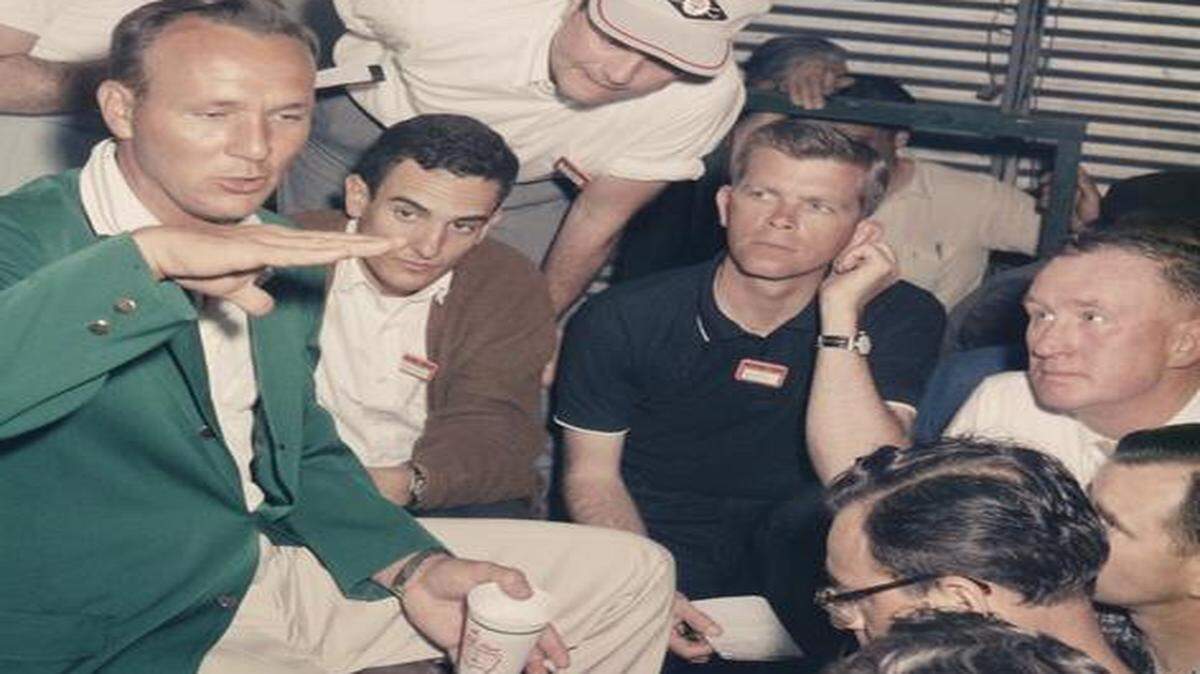
An annual treat was sitting in the locker room on Sunday morning, when the contenders came in to get ready for the showdown. You automatically noticed what they were wearing. Would that go well with a green jacket?
Some of them seemed edgy but many chatted as if they were at an ice cream social. On one of those Sundays, Raymond Floyd, the leader by a wide margin entering the final round in 1976, knocked a box of golf balls out of his locker. It landed on a paper cup full of Coke he had placed on the floor and didn’t spill a drop. He smiled and said, “See how good I’m going?”
Nicklaus and Palmer played a practice round with the new kid Tiger Woods. They concluded that he would win more Masters than they would win between them, 10.
I doubted it but then the next year, the 21-year-old shot 70-66-65-69, a stroke better than anyone ever had – Bobby Jones, Gene Sarazen, Ben Hogan, Byron Nelson, Arnold Palmer, Jack Nicklaus, anyone – to become the first black player to win a major, and the world turned its eyes to golf.
You can no more ignore Tiger than you can ignore a car wreck or a rainbow. As his dad would say, he is armed with thunder, clad with wings. I count Tiger, Nicklaus and Hogan as the best we’ve ever seen.
The golf at the Masters has always been storybook stuff but just being there is a great part of the attraction. You feel privileged. Augusta National is spectacularly beautiful. The clubhouse is more modest than you might expect but it retains an old South feeling, like Tara, and is perfect for its role.
Dignity is draped all over the premises like wisteria. I’ve heard many people talk about their experiences there as if they had gone to heaven. I know what they mean.
Augusta National Golf Club is a lovely place but a day of hiking its hills will send you away aching for a tub and a martini. Over the years, I walked my 1,000 miles or whatever it was but I also hung out under a huge old tree on the clubhouse lawn. You could hear yesterday from there. Gene Sarazen was out there, along with a few more monuments who had known glory and now passed the days as living decorations.
Cary Middlecoff won the first Masters I covered, in 1955. Back then, you could buy a ticket for Saturday or Sunday for $7.50. To promote ticket sales, there was a parade down Broad Street, with players riding in convertibles. Today, I’m having a hard time seeing Tiger Woods or Bubba Watson doing that.
Augusta National is a place steeped in tradition. I had one of my own. On my first day there each year, I would walk alone down the spectacularly beautiful 10th hole, down into the valley where Amen Corner waits with its towering pines and azaleas and dogwoods and a rambling creek where golf balls splash and settle into the sand while the dreams they hold drift on away. Where memories and promises wait. Down there, you could feel the embrace of the Masters before it started, see the beauty, know the peril, look for ghosts, listen for echoes. It gets complicated down there on Sunday.
A golf tournament is a huge, sprawling thing but in the span of a few minutes in 1987, I saw the Masters in a stunning tableau – Larry Mize chipped in from 140 feet for a birdie on the 11th hole to win a playoff.
As Mize ran around the green with club raised and rapture on his face, Greg Norman, a great player who seemed destined to win many majors but kept getting slapped by fate, stood in stony silence, waiting to hit the long tying putt he knew wouldn’t go in, not for him. Meanwhile, Seve Ballesteros, the tough, exquisitely gifted Spaniard, having three-putted the 10th hole to drop out of the playoff, walked back up the hill to the clubhouse, crying.
It was all there in that sunlit Sunday afternoon in that brief time in that beautiful place, the Masters.
The best Masters I saw came in 1975. That was the year Nicklaus made a 40-foot birdie putt on the 16th on Sunday, fending off Tom Weiskopf and Johnny Miller down the stretch. Miller birdied 15 of the last 36 holes and narrowly missed.
Almost forgotten in that excitement was Arnold Palmer’s brief return to the good ol’ days, shooting 69-71 in the opening rounds. As someone said, still a dreamer but a tired one. He hadn’t won at Augusta since 1964 and wasn’t expected to challenge in most any event he entered.
After the second round, I wrote, “In the end, it paled beside the dead-solid perfection of Jack Nicklaus, but for a long time yesterday, the second round of the Masters belonged to a faded hero named Arnold Palmer. Just like it used to be. Words and music by Bill Haley and the Comets. Cokes a nickel apiece.”
Look, I could go on for days, talking about Roberto DeVicenzo and “what a stupid I am,” about Billy Casper’s exotic diet, about pimiento cheese sandwiches, about missed putts, about Ben Crenshaw sobbing after winning in honor of an old friend, about patrons wearing hats decorated with old admission badges. About the excitement at the 16th hole on Sundays, about Dan Pohl going eagle-eagle-birdie-birdie starting at the 13th on Saturday then losing to Craig Stadler in a playoff on Sunday, about …well, there’s more, much more, but we should save it for sometime down the road.
Editor’s note: Ron Green, 86, is a retired Observer columnist. For decades, he covered the Final Four college basketball tournament, flew home to Charlotte and then drove to Augusta to write about the Masters. It was a special week for him, and his readers. He still writes for the Observer occasionally.
RELATED
▪ Ron Green Sr. on 60 years of Masters memories (2014 column)
This story was originally published April 4, 2015 at 5:00 PM with the headline "Ron Green bids farewell to the Masters."