Looking for the best CFP® exam prep courses to advance your career? According to the CFP Board’s salary calculator, even brand-new certified financial planners can expect a salary of $97,000 on average, and this can increase anywhere from $50,000 to $100,000 with each passing decade.
Needless to say, financial professionals make bank, but you’ll need to complete a CFP Board Registered Program to fulfill the education requirements and pass the CFP® exam first—and that means choosing the best CFP® review course.
After spending some serious quality time with some of the most popular CFP® prep courses on the market, here’s my take on which courses to pick and which to pass on (from a former CPA who actually understands what it takes to pass a tricky financial planning industry exam).
CFP® Review Course Comparison | ||
 |
| Get Started |
 |
| Get Started |
 |
| Get Started |
 |
| Get Started |
Best CFP® Study Materials at a Glance
- Best Overall: Boston Institute of Finance
- Best Budget Choice: Kaplan
- Best Coaching: Dalton Education
- Most Practice Questions: Brett Danko
- Most In-Person Locations: Zahn
1. Boston Institute of Finance – Best Overall CFP® Exam Prep Course

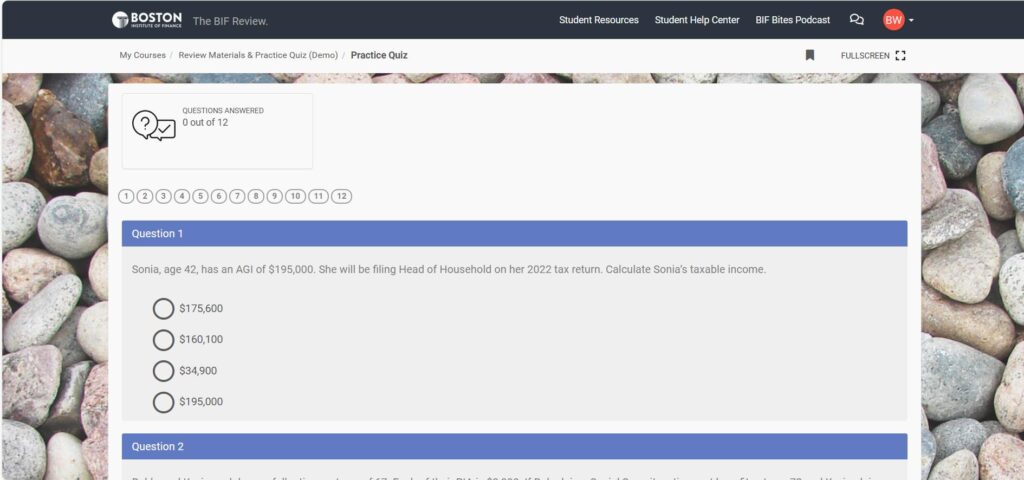
When starting to study with Boston Institute of Finance CFP® review, I was a little apprehensive. I hadn’t heard about them as much as competitors like Kaplan, Dalton, and Brett Danko, so I assumed the experience may not have been on the same level. I was pleasantly surprised to discover that BIF’s lower level of popularity had no reflection on the quality of their materials. First and foremost, though you have access to your materials until the exam (plus a free retake if you choose the Premium BIF Review), the actual education period takes place over eight highly structured study weeks, complete with regular live classes covering a variety of subjects, such as:
- Mini-Sessions: Syllabus content; basic coverage and Q&A
- “JAM” Sessions: Instructors walk you through question-solving strategies
- Every Tuesday over 8 weeks
- “Deep Dive” Sessions: Comprehensive overviews of the most important topics on the exam
- Every Thursday over 8 weeks
Having a strong sense of familiarity, community, and collaboration made the time I spent feel a lot more personalized and special than with other courses. It’s tricky to describe, but it’s the only course that felt more like a cohort, where we all supported one another in trying to achieve the same goal. The camaraderie was unparalleled. Plus, I had no complaints about the experience itself: the interface was nothing special, but it worked reliably. The practice questions were exam-quality, and as someone who can be a “last-minute” kind of guy at times, having that high level of structure made it much easier to actually show up and put in the work.
Key Features
- Course Format: Live and on-demand
- Efficient 8-week structured schedule
- Live Online Classes: Tuesdays and Thursdays
- Practice Questions: 1,500+
- Mock Exams: One BIF mock exam (170 MCQs)
- Video Lectures: Varies
- Guarantee: N/A
| Packages/Features | Premium BIF Review | Core BIF Review |
| Price | $1.8k | $1k |
| 3 Digital Textbooks |  | |
| 8-Week Schedule w/ Virtual Classroom Experience | | |
| 3 Question Banks | | |
| “Deep Dive” and “JAM” Live Sessions | |  |
| 170-Question Mock Exam | | |
| Strategies for Formulas and Case Studies | | |
| Virtual Student Community | | |
| Free Course Retake | | |

Take Up to $800 Off Boston Institute of Finance CFP Education Bundles
Save 15% on Boston Institute of Finance CFP Education Bundles
Pros
- Lots of live classes
- Multiple support touchpoints
- Personable CFP-holding instructors
- Structured 8-week schedule
- On the low end price-wise
Cons
- No pass guarantee
Bottom Line
The Boston Institute of Finance ranks on this list for a number of reasons, but most notably, I really enjoyed the efficiency and accountability of the 8-week program. There was a ton of live support, a sense of community, and I really began to bond with the instructors, who I found equally knowledgeable, experienced, and personable. While the review courses lack a pass guarantee, I still think BIF is an excellent choice for students who need extra structure and organization to keep them “locked in” before the big day (for my neurodivergent friends with time blindness, this is the choice!).
Boston Institute of Finance
2. Kaplan – Best Budget Choice

Where I was pleasantly surprised by BIF’s quality, I was pleasantly surprised by Kaplan’s price. As a professional course reviewer, I study a wide variety of prep materials in numerous disciplines, from finance to college admissions to law. Kaplan tends to be the priciest course on the list, but here, Kaplan CFP® review delivers one of the most accessible price points. So then, I assumed maybe it just wasn’t as good as their other courses, but I was proven wrong.
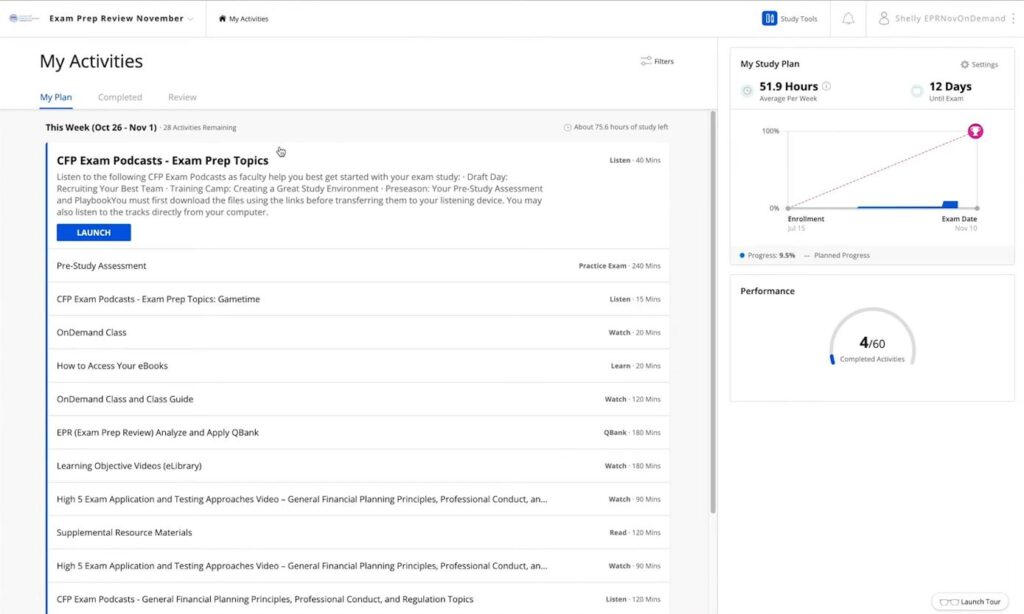
If Kaplan understands anything well, it’s structure and comprehension. There’s a rigid 10-week plan to follow, which is a major bonus if you struggle with time management and motivation (and honestly, at this point, who doesn’t?). My favorite part was the activity feed, which tracked my progress and highlighted daily tasks I could complete to stay on track and successfully complete the course by the end date. I didn’t feel the same sense of camaraderie with Kaplan, but enjoyed the live classes—which may be especially appealing if you live near one of their in-person locations, including:
- Atlanta, Georgia
- Chicago, Illinois
- Dallas, Texas
- Denver, Colorado
- Phoenix, Arizona
I do think it’s worth mentioning that their live online classes follow a 10-week structure, which is two weeks longer than BIF’s, and every moment matters when you have a busy schedule. Kaplan is also notorious for difficult questions and, when comparing their questions to those from the CFP Board, found that this principle still applies (they’re anywhere from 10% to 50% longer, and certainly, more intricate). However, practicing at a higher difficulty than the real thing makes exam day easier, so for some, it will be a confidence booster. It really depends on you and how you learn.
Key Features
- Course Format: Live online, in-person, and on-demand
- 10-week, 11-class plan with daily tasks delivered through an activity feed
- Live Online Classes (Weekday Schedule): Mondays, Wednesdays, and Thursdays
- Live Online Classes (Weekend Schedule): Fridays, Saturdays, and Sundays
- Live In-Person Classes: 4 Days, Wednesday-Saturday or Thursday-Sunday
- Practice Questions: 2,500+
- Mock Exams: One mock exam
- Video Lectures: Varies (~33 hours, based on live class schedule)
- Guarantee: PassProtection™
| Packages/Features | Premium | Essential |
| Price | $1.4k | $600 |
| PDF Textbooks | | |
| Calculator Tutorial Videos + Workbook | | |
| Diagnostic Exam | | |
| Study Strategies and Checklists | | |
| 2.5k+ Practice Questions | | |
| Performance Tracking + Daily Study Tasks | | |
| InstructorLink™ | | |
| Review Classes (In-Person/Live Online) | | |
| Prep Videos and Podcasts | | |
| Case Studies and Topic Summaries | | |
| Full-Length Mock Exam | | |
| PassProtection™ | | |
Pros
- Most budget-friendly on the list
- PassProtection™ ensures access
- On-demand, live online, and in-person formats
- Direct instructor messaging
- Exam prep podcasts
Cons
- Goes deep on everything; less time-efficient
- Difficult questions can get frustrating
Bottom Line
Kaplan is a trustworthy option at an impressively affordable price, and the gamification of daily tasks in the activity feed was key in holding my attention and ensuring I stayed on schedule. I also appreciated the versatile live class options, with weekday, weekend, and 4-day in-person intensive options, which can fit a variety of schedules. While the trickier questions definitely didn’t make me feel great, and the course takes two additional weeks to cover compared to BIF, I can see Kaplan being the dream fit for students on a budget who still deserve a comprehensive preparation experience.
Kaplan
3. Dalton Education – Best Coaching

Dalton’s online program has been one of the most popular options for CFP prep for over a decade, but are they really worth the hype? Long story short, yes and no. The lectures, whether live or recorded, were engaging and easy to understand, making it easier to pay attention and absorb the material. That said, while I understand the value in having difficult practice questions, Dalton’s are rage-quit worthy; I’d argue they’re twice as hard as the actual questions after comparing them to samples from the CFP Board. So yes, there’s value, but I personally feel that Dalton overdid it.
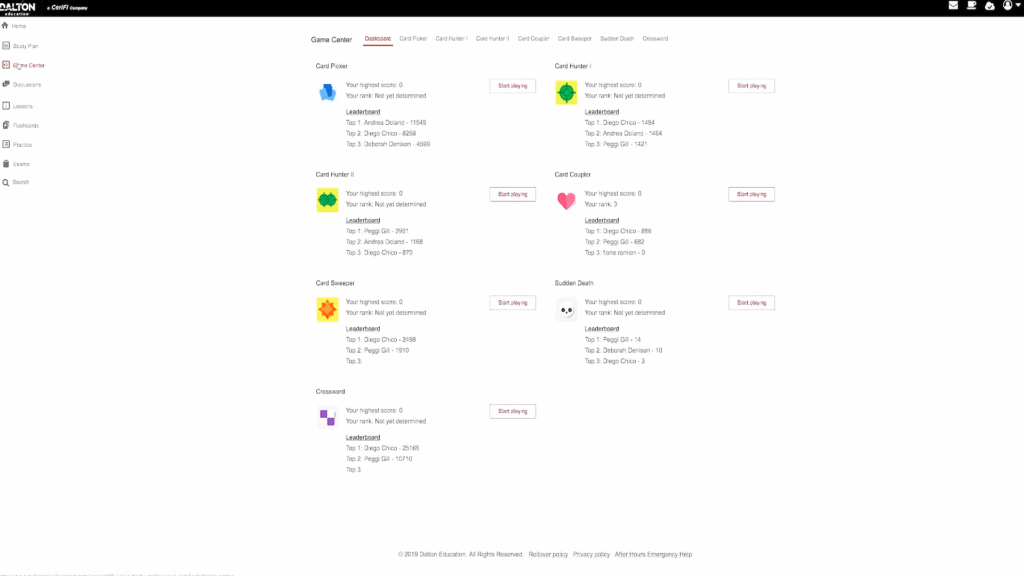
Nevertheless, I do think there’s a lot to love here, especially when it comes to support. Having a pre-review coaching session to prepare me for the road ahead helped to inspire a lot of confidence in both myself and the course. Further, there were plenty of office hour sessions with patient, competent instructors, and the customer service itself was trustworthy and easy to use. The main problem with Dalton is that it feels like a more expensive, more difficult Kaplan, hence its lower placement on this list.
Key Features
- Course Format: Live online, in-person, and on-demand
- 10-week, 11-class plan (3 hours and 15 minutes each)
- Live Online Classes (Weekday Schedule): Mondays and Wednesdays, 7 PM-10:15 PM EST
- Live Online Classes (Alt. Schedule): Tuesdays and Thursdays, 6 PM-9:15 PM EST
- Live In-Person Classes: 4 Days, Wednesday-Saturday (8 AM-6 PM in Local Time)
- Practice Questions: 2,800+
- Video Lectures: Varies (~35 hours, based on live class schedule)
- Guarantee: Guarantee to Pass™
| Packages/Features | The Dalton Review® Guarantee to Pass™ | The Dalton Review® |
| Price | $2.4k | $1.6k |
| Live Online or In-Person Classes (+ Recordings) | | |
| Diagnostic Quiz | | |
| Digital Textbooks | | |
| Question Bank + Mock Exams | | |
| Exam Readiness Score | | |
| Office Hours with Live Q&A | | |
| Guarantee To Pass™ | | |
| Digital Flashcards + Calculator Book | | |
| Extra Lectures + Q&A Sessions | | |
| Pre- and Post-Class Coaching | | |
Pros
- Strong pass guarantee
- Comprehensive content
- Engaging instruction
- In-person availability
Cons
- Expensive compared to other courses
- Twice as hard as the real thing; feels like overkill
Bottom Line
Dalton is a reliable pick. Though it wasn’t my favorite, especially due to the high price point, I think you’d struggle to take this course, put in 100%, follow every step, and fail. The questions are tough for a reason, even if the difficulty is stronger than it should be for efficiency’s sake. However, it’s worth considering that Dalton has a strong reputation for a reason, which helped me feel confident in the material quality. Dalton isn’t for everyone, but if you live in an in-person location near one of their classes, they may be worth the additional investment.
Dalton Education
4. Brett Danko – Most Practice Questions
Brett Danko’s CFP prep courses will appeal extraordinarily well to a select group of students; specifically, students who want live instruction, whether online or in-person, and students who are willing to pay more for that higher level of accountability. That said, Danko really struggles to compete from a price point perspective, often costing double or more than other courses with similar material libraries. However, with 3,500+ practice questions, Danko delivers the highest MCQ count on the list. Post-review, I had to start working through quiz blocks as well, and the difficulty was brutal. However, the practice exam felt much easier than the rest of the materials, leaving me a bit confused as to where I stood in the prep pipeline. One reviewer explains,
“Danko repeatedly tells you that the scores to his quizzes don’t matter. That’s because with each new wave of material, he is teaching you a new concept. His questions are designed to frustrate you, but that is by design. There really is no “hack” or way around doing the work. You have to put in the full three months, and if you do, Danko will get you through.”
u/SU206
Further, Danko’s live classes are definitely not designed for neurodivergent brains, particularly if you have ADHD. Trying to focus for nearly 12 hours felt insurmountable. While I understand the 4-day span is likely to help travelers with expenses, I feel students will miss out on so much due to focus fatigue. A lot of the live in-person classes have a similar structure, but the intensity of Danko’s made my inability to focus over such a long span much more noticeable. However, with up to 170+ hours of instruction available, Danko may still be worthwhile for students chasing structure and substance.
Key Features
- Course Format: Live online, in-person, and on-demand
- Live Online and In-Person Classes: 4 Days, 8 AM-7 PM
- Practice Questions: 3,500+
- Video Lectures: 35 to 155+, depending on package
- Guarantee: N/A
| Packages/Features | Plus | Signature | Comprehensive |
| Price | $2.7k to $2.9k | $2k to $2.2k | $1.2k to $1.4k |
| 3,500+ MCQ Workbook | | | |
| 35+ Hours of Live CFP® Review Classes(Recordings Included) | | | |
| Detailed Study Schedule | | | |
| Signature Calls + 16 Virtual Group Study Hours | | | |
| Digital, Physical, and Audio Flashcards | | | |
| Virtual Course Retake | | | |
| Bonus Recordings and Resources | Signature Call Recordings, 120+ Pre-Study Video Hours, 12 Extra Quizzes, 9 Extra Case Studies | Signature Call Recordings, 6 Extra Case Studies, 6 Extra Quizzes | |
Pros
- Highest number of practice questions
- Group study feels connected and collaborative
- Free retake takes the place of a pass guarantee (no eligibility requirements)
- Unlock over 120+ hours of pre-study videos in Plus Package
Cons
- One of the costliest courses on the list
- In-person class costs more (unlike competitors like Kaplan)
- Too much content each day for live classes (almost 12 hours)
Bottom Line
Brett Danko’s courses are high-quality, and they’ve helped a lot of students pass their exams, but to get the level of content most students would need to pass (Signature Package or Plus Package), you’ll have to spend $200 to $1,000 or more than you would with a package from BIF or Kaplan. In testing the questions, they had a similar difficulty as Dalton, which could be frustrating, and the ~12-hour study days were long. However, if you can afford it and follow Danko’s roadmap, chances are, you’ll succeed.
Brett Danko
5. Zahn – Most In-Person Locations

Zahn is almost like the “Lite” version of packages on this list. You’re still getting four days of live instruction, either through a virtual classroom or at a given location. However, you’re getting 1,800 practice questions (a nearly 50% decrease from Danko’s 3,500+), no pre- or post-coaching sessions as offered by Dalton, no pass guarantee like Kaplan, and a weaker sense of community than BIF. All of that said, you’re still given enough to pass, given that you’re a pretty good test taker in general. If you want a strong budget option but haven’t found yourself “clicking” with Kaplan, Zahn is a sound alternative (especially if you’re eligible for one of their scholarships).
Now, if you’re easily shaken by tricky questions—which is a totally normal thing to experience— Zahn’s tricky post-review MCQs and case studies might not be the best match for your needs. According to one student,
“50-75% range for those post-study questions is totally normal. These questions are designed to push your knowledge and throw you a bunch of curveballs similar to the exam.”
u/Unfair_Hearing_1602
Doing poorly on these tricky questions in the final stretch before the exam might shake your confidence, leading you to more nerves—and potentially, more mistakes. So, only go with Zahn if you think you’ll be able to stay calm, even if you’re getting 50% on your practice exams.
Key Features
- Course Format: Live online and in-person
- Live Classes (Consecutive Weekend): 4 Days, Friday-Monday
- Live Classes (Two Weekends): Sat-Sun + Sat-Sun
- Schedule: 9:45 AM to 7:00 PM
- Practice Questions: 1,800+
- Lectures: ~34 classroom hours, ~37 hours total with breaks
- Guarantee: N/A
| Package | Live Review: In-Person | Live Review: Virtual |
| Price | $1.2k | $1.2k (Same price) |
| MCQs | 1.8k | 1.8k |
| Two Workbooks | | |
| Quizzes, Cases, Final Exams | | |
| 4 Days of Live Classes | | |
| Tough Post-Review Questions and Cases | | |
| Catered Networking Lunch | | |
Pros
- Highly affordable compared to other courses
- Large number of live locations
- Live review scholarships available
Cons
- Lacks a solely on-demand option
- Smaller number of practice questions
- Lighter material load than competitors
Bottom Line
If you want a cheaper in-person option and don’t live in an area covered by providers like Kaplan, Dalton, or Danko, Zahn is a solid choice. While you’re getting 1,800 practice questions compared to the top-five average of 2,420 (a difference of ~26%), I loved paying $1,000 less than I would with a different pick, and I still got plenty of materials—with my background as a former CPA, more than enough to pass. However, I think this course is the best fit for candidates who are either quick learners or experienced in the industry; otherwise, you may have to supplement your studies with additional resources to get the depth and comprehension of other courses.
Zahn
6. Florida Atlantic University – Best University Prep Program

In testing Florida Atlantic University’s CFP® prep course, I immediately noticed how different it felt compared to the big commercial players like BIF or Kaplan. Instead of sprawling dashboards, gamified feeds, or 8–10 week class plans, FAU focuses on a straightforward, instructor-led format that’s clearly designed for students who’ve already gone through their education program. In fact, if you’re an FAU alum, the prep course is completely free—a significant CFP® course discount compared to the $1,000–$3,000 range you’ll pay for most competitors.
That said, the limited number of practice questions stands out. While Kaplan offers 2,500+ and Dalton 2,800+, FAU’s program includes 70 quizzes and four 50-question practice tests, which is solid but nowhere near as comprehensive. The shorter class schedule—six sessions on Saturdays from 8:30 AM to 3:30 PM—was honestly a refreshing change after slogging through four consecutive 12-hour days with Danko. But that condensed structure also means you’re getting less overall contact time than most other programs, and there’s no coaching or supplemental live support like Dalton provides.
I appreciated the instructors’ expertise, and the pacing felt much more manageable. But since FAU uses Kaplan’s textbooks rather than their own, it felt less like an independent course and more like a hybrid between a university program and a commercial review. Ultimately, FAU works best for students who are already comfortable with the material—especially locals who can attend in person and take advantage of the free pricing. If you’re looking for a full exam-prep ecosystem with expansive question banks or advanced support systems, Kaplan or BIF offer a lot more structure.
Key Features
- Course Format: Live online and in-person
- Live Classes (Consecutive Weekend): 6 Sessions, Every Saturday
- Schedule: 8:30 AM to 3:30 PM
- Practice Questions: 70 Quizzes, Four 50-Question Practice Tests
- Lectures: 36 Hours (3.6 CEUs)
- Guarantee: N/A
| Package | CFP® Exam Preparation Course |
| Price | $850(Free if you completed the Education Program) |
| Six Sessions | |
| On Campus or Live Online | |
| Executive Summaries of Key Concepts | |
| 70 Quizzes (One For Each Topic) | |
| Four 50-Question Practice Exams | |
Pros
- Free for FAU Education Program completers
- Ideal for locals in Florida
- One of the most affordable choices
Cons
- Small sampling of practice questions; no “bank”
- Lacks coaching
- Uses Kaplan’s textbook, not an original guide
- Not as comprehensive as other courses
Bottom Line
Florida Atlantic University is an interesting entry. While their instructor-led course excels in the team’s knowledge, using resources from companies like Kaplan within their course detracts from their reliability. Further, while I loved the shorter classes that made focus easier (~7 hours every Saturday), not everyone will want to cover in a month and a half what others cover in four consecutive days. Ultimately, FAU’s price tag is their biggest draw, but BIF’s and Kaplan’s courses are more reliable alternatives.
Florida Atlantic University
7. Pro Exam Tutors – Best Refresher Course

Pro Exam Tutors is exactly what it sounds like: a quick, targeted tune-up rather than a full-scale review program. I went into their two-day, six-hour course expecting a supplement, not a comprehensive prep, and that’s exactly what I got. Compared to the 8-week BIF program or Kaplan’s 10-week structure, this felt almost like a cram session before a big test—focused, practical, and brief.
The format is simple: live online or on-demand, with recordings available afterward. There’s a 150+ page slide deck, but no practice questions, no mock exams, and no extended coaching or student community. It’s cheaper than every major course on the list—but also far less comprehensive. For context, Dalton offers 35+ hours of instruction, Danko offers up to 170, and even Zahn’s “lite” option gives you 34 classroom hours. Six hours here isn’t going to teach you everything.
That said, I actually found this course surprisingly useful as a refresher—especially for key testable concepts and strategy pointers in the final stretch before exam day. It’s not the right pick if you’re starting from scratch, and honestly, for a supplement, it’s a bit expensive. But for experienced professionals or strong test takers who just want to tighten things up before the big day, this can fit nicely into the final weeks of prep.
Key Features
- Course Format: Live online and on-demand
- Live Classes: Two Consecutive Days
- Schedule: 6 PM to 9 PM
- Practice Questions: N/A
- Lectures: 6 Hours
- Guarantee: N/A
| Package | Live Tune-Up | Recordings Only |
| Price | $499 | $297 |
| 6 Hours of Instruction | | |
| Class Recording Access | | |
| 150+ Page Slide Deck | | |
| Live Q&A | | |
Pros
- One of the cheapest picks
- Focus on key testable topics and strategies
Cons
- Not a complete prep course
- Only 6 hours of lectures
- No practice questions
- Expensive for what it is
Bottom Line
Pro Exam Tutors is branded around tutoring for a reason. While this 2-day tune-up is still valuable for a quick refresh and some key concepts for passing, you’re not going to get the depth you’ll need for a total course. And, as far as supplements go, I’d honestly consider the tune-up on the pricier side. However, maybe you’re an industry vet and you only need two quick 3-hour sessions to get back into the loop. In that case, this could be the best pick for you, even if it isn’t my top choice for the average student.
Pro Exam Tutors
8. CFP Board – Best Mentorship Program
The CFP Board’s resources are an odd mix of incredibly valuable and mildly frustrating. On the one hand, they offer two full-length mock exams and a mentorship program that’s genuinely helpful—and mostly free. On the other hand, they charge extra for things like a second mock exam and their mobile app, which feels a bit opportunistic considering how much candidates already pay in registration and program fees.
When I tried the CFP Practice App, I found it helpful for drilling concepts in short bursts, but its functionality, polish, and question quantity lag behind the robust QBank experiences of Kaplan or Dalton. The lack of lectures or structured classes also means this is not a standalone review option—it’s more of a supplemental resource. And, unlike Pro Exam Tutors, which at least gives you live sessions, the CFP Board offers purely on-demand tools with a fairly limited mentorship enrollment window.
Still, I’d never tell anyone to ignore these resources entirely. They come straight from the exam creators, and that’s worth something. I just wouldn’t rely on them exclusively, especially when commercial courses give you far more structured timelines, community, and content. Think of the CFP Board’s offerings as a solid supplement, not a replacement for a full course.
Key Features
- Course Format: On-demand
- Practice Tools: Two full-length mock exams
- Mobile App: CFP Practice App
- Coaching: CFP Mentorship
Pros
- Mostly free resources
- From the creator of the exam
Cons
- No full-length prep
- Practice app and second practice exam cost money
- No lectures
- Small window for mentorship enrollment
- Cost adds to CFP Board bill
Bottom Line
Ultimately, while I understand the need for the CFP Board to fund their company, charging even more money from candidates on top of expensive registration just feels a little icky—even if those materials are genuinely helpful for prep. However, I found the app disappointing, and paying hundreds for an additional mock exam is wild. I don’t think this is the right investment for most students seeking paid CFP exam prep materials, though I do think the free mentorship program is a no-brainer.
CFP Board
CFP® Courses That Missed the List
- Rattiner’s Financial Planning Fast Track
- UW Green Bay’s Minor in Personal Financial Planning
- Mometrix
- Varsity Tutors (Tutoring Only)
- MyGuru (Tutoring Only)
- Nissim Tutoring (Tutoring Only)
CFP® Prep Providers Head-to-Head
Boston Institute of Finance vs. Kaplan
When I compared BIF and Kaplan head-to-head, I was honestly surprised at how close the race was. BIF’s 8-week structured program felt like being part of a tight-knit study cohort. The regular Tuesday “JAM” sessions and Thursday “Deep Dive” classes created a sense of accountability that worked wonders for my time-blind brain. The live instructors were personable and accessible, and even though the interface was nothing fancy, it did exactly what I needed. What stood out to me most was the feeling of collaboration—BIF had that “we’re all in this together” energy that made showing up easier.
Kaplan, meanwhile, brought its trademark structure and polish to the table at a lower price. Its 10-week plan, integrated activity feed, and multiple live schedule options (weekday, weekend, and 4-day intensive) gave me flexibility that BIF didn’t. The 2,500+ practice questions were significantly tougher than the CFP Board’s, but that actually made the real thing feel easier. Kaplan doesn’t quite replicate BIF’s cohort vibe, but for students on a budget or those who thrive with daily task checklists and direct instructor messaging, Kaplan is an impressive all-around pick.
👉 Choose BIF for structure, community, and accountability.
👉 Choose Kaplan for affordability, flexibility, and rigorous practice questions.
Boston Institute of Finance vs. Dalton
BIF and Dalton both offer structured live instruction, but the experience felt very different. With BIF, the 8-week schedule was highly digestible: two evenings per week, consistent live support, and just enough rigor to keep me on track without feeling crushed. The material quality was strong, and although there’s no pass guarantee, the approachable difficulty level of BIF’s questions helped me build confidence over time.
Dalton, on the other hand, felt like Kaplan’s intense older sibling. Their 10-week program was engaging and polished, and the pre- and post-coaching sessions gave me an extra layer of accountability that BIF doesn’t offer. But the question difficulty is brutal—easily twice as hard as the real thing—which sometimes left me feeling demoralized rather than motivated. It’s also substantially more expensive than BIF. If you like a challenge and want the comfort of a pass guarantee, Dalton may be worth it. But if you prefer manageable structure and a supportive community without overkill, BIF feels more balanced.
👉 Choose BIF for balanced structure, community, and confidence-building.
👉 Choose Dalton for coaching, intensity, and a strong pass guarantee.
Kaplan vs. Dalton
I found Kaplan and Dalton to be similar in structure—both offer 10-week programs, live online and in-person options, and comprehensive materials—but their tone and pricing couldn’t be more different. Kaplan’s activity feed was one of my favorite features across all courses. It gamified daily progress in a way that genuinely kept me engaged. Its $600–$1,400 pricing also undercut Dalton significantly, while still providing 2,500+ practice questions, a PassProtection™ guarantee, and a variety of scheduling options that suited my busy calendar.
Dalton’s edge lies in its coaching and question rigor. The Guarantee to Pass™ gave me peace of mind, and the office hours were consistently helpful. But its $1,600–$2,400 price point and punishing question difficulty meant I often spent twice as long working through assignments compared to Kaplan. Some students thrive on that level of difficulty, but for me, Kaplan’s balance of challenge and efficiency made studying for the CFP less of a grind.
👉 Choose Kaplan for value, flexible structure, and a manageable (but still challenging) workload.
👉 Choose Dalton for strong instructor support, coaching, and an ironclad pass guarantee.
Dalton vs. Brett Danko
Dalton and Brett Danko both lean into live instruction and difficult practice questions, but they deliver those elements differently. Dalton’s 10-week structure felt predictable: two nights a week, coaching before and after, and office hours throughout. The 2,800+ questions were extremely tough, but consistent in tone with the live instruction. It’s expensive, but the Guarantee to Pass™ added a layer of reassurance.
Brett Danko’s approach was more intense—borderline overwhelming. His 4-day live classes ran nearly 12 hours per day, which was incredibly difficult for my ADHD brain to sit through. That said, the 3,500+ practice questions and 120+ hours of pre-study videos (in the Plus package) make it a powerhouse for students who can keep up. The lack of a formal pass guarantee is balanced by a free retake, but the pricing—up to $2,900—makes Dalton look reasonable by comparison.
👉 Choose Dalton for structured coaching, predictable pacing, and a pass guarantee.
👉 Choose Brett Danko for massive content libraries, huge question banks, and intense live instruction.
Boston Institute of Finance vs. Brett Danko
The contrast between BIF and Brett Danko is one of structure vs. intensity. BIF’s 8-week cohort model was paced and collaborative; I always knew exactly what was coming next, and the environment felt warm and approachable. With 1,500+ practice questions, the difficulty level matched the exam nicely, helping me build confidence without burning out. It was also considerably cheaper than Danko’s higher-tier packages.
Danko’s courses, by contrast, felt like boot camp. The 3,500+ MCQs, 120+ hours of pre-study, and long in-person days created an immersive, sink-or-swim environment. Some students thrive in that; personally, I found it overwhelming. There’s no pass guarantee, but you do get a free retake, which is nice—but at $2,000–$2,900, that’s a steep entry price. If you need camaraderie and structure, BIF is better. If you want sheer volume and don’t mind intensity, Danko delivers.
👉 Choose BIF for structured pacing, community, and value.
👉 Choose Brett Danko for content volume, difficult practice, and high-intensity prep.
Kaplan vs. Brett Danko
Kaplan and Danko represent two very different philosophies. Kaplan is structured, affordable, and built around consistency. Its activity feed, 10-week schedule, and multiple live options gave me flexibility without losing focus. With 2,500+ tough questions and PassProtection™, it offered more than enough challenge for a fraction of Danko’s price.
Danko’s program is all about intensity and volume. If you want to drown in material, his 3,500+ questions, 170+ hours of live instruction, and huge pre-study libraries will keep you busy. But the 4-day, 12-hour sessions were brutal for me, and I struggled to stay focused. It’s also significantly more expensive, with no pass guarantee—just a free retake.
👉 Choose Kaplan for balanced structure, affordability, and challenging practice.
👉 Choose Brett Danko for sheer content depth, intense live instruction, and massive question banks.
Final Verdict
Earning the CFP certification is no walk in the park, and choosing the right CFP exam review course can make or break your attempt. Whether you want to go at your own pace with a self-study program or you’re after a structured classroom environment, hopefully, you now know the right or wrong answer to your perfect match.
So, let’s recap. The Boston Institute of Finance’s community, collaborative environment, and true sense of connection—all at a budget-friendly price, mind you—make it an excellent all-around pick. Meanwhile, Kaplan is ideal if you want a reputable company at a reasonable price. Dalton offers coaching sessions before and after your review to help you stay on track, whereas Danko’s 3,500+ practice questions help it earn the title of the largest question bank.
So, whether you’re planning a career in risk management or personal financial planning, your next step is a click away.
FAQs
It depends on your needs. Boston Institute of Finance is best for structure, Kaplan offers the best value, Dalton excels at coaching, and Brett Danko has the largest question bank.
Yes, but in a different way than CPA or CFA exams. The questions are long and tricky, and top courses intentionally make practice harder than the real thing.
Most courses follow 8–10 week study plans. Brett Danko compresses everything into four intensive live days plus pre-study work.
Not necessarily, but live formats help with accountability. BIF and Dalton are highly structured, while Kaplan blends live and on-demand options.
Brett Danko offers the most with 3,500+, followed by Dalton (2,800+), Kaplan (2,500+), and BIF (1,500+). Zahn and FAU have much smaller banks.