The line of customers at La Luna Tienda Latina forms outside even before the store opens most mornings.
In it is Tiep Pham, owner of the Vietnamese restaurant Pho An Hoa next door. When the door opens and customers stream in, Pham doesn’t have to do much to get what he came for.
Pham catches the eye of the woman at the counter and raises his hand in a familiar gesture. She hands him a pack of Marlboro Gold cigarettes. No words are required, and no money is exchanged before the two wave goodbye. Their ritual is built on mutual understanding and trust.
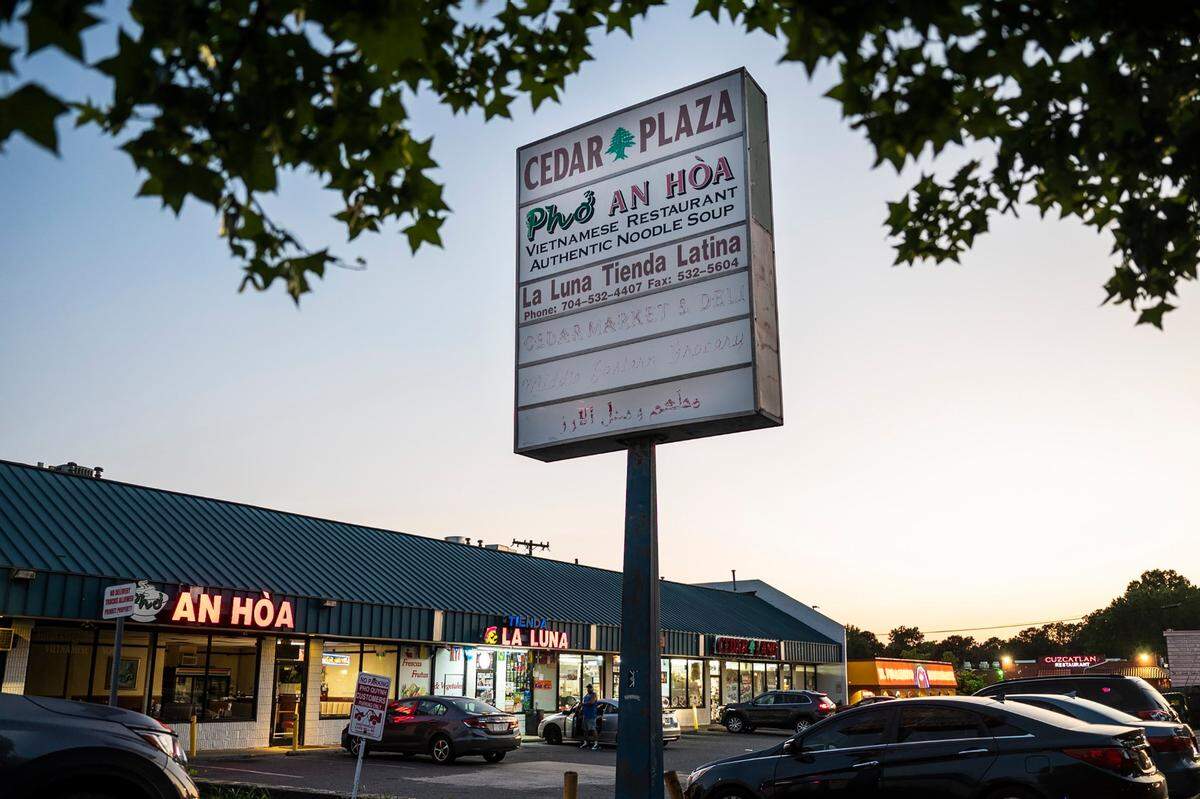
La Luna Tienda Latina, Pho An Hoa and Mediterranean grocery and restaurant Cedar Land have shared a parking lot for years.The little plaza is a microcosm of the diversity that embodies east Charlotte — folks from countries all over the world are represented in the three neighboring businesses on Central Avenue.
And as the cost of living has risen in the quickly growing city, the community of immigrants has somehow still persisted — stronger, together.
“You see all kinds of people … if you’re standing in front here for an hour,” Cedar Land owner Musa Imreish said. “You see something beautiful.”
While 1 in 7 Charlotte residents are immigrants and the area’s population has generally diversified in recent years, many parts of the city are racially and ethnically homogeneous. The opposite is true in communities along much of Central Avenue, though.
According to the Charlotte-Mecklenburg Quality of Life Explorer tool data from 2000 until 2020, more Asian and Latino people have moved to neighborhoods along the strip of Central Avenue starting at Briar Creek and ending at Albemarle. The population of people who self-identify as Latino has grown from 18.9% to 32.8%, and Asian from 4.7% to 6.5%. The area’s Black population has decreased slightly, from 35.3.7% to 27.8%.
But Charlotte’s immigrants haven’t just found community on Central Avenue — they’ve found opportunity, too.
Three businesses from three different cultural backgrounds reside in this small shopping center along Central Avenue; Cedar Land, a Middle Eastern deli and grocery; La Luna Tienda, a Latino market and convenience store; and Pho Anh Hot, a Vietnamese pho restaurant. Although they comes from different countries and traditions, they work together as they serve the community around them. Melissa Melvin-Rodriguez mrodriguez@charlotteobserver.com
Pho An Hoa
When Pham started working as a dishwasher at Pho An Hoa years ago, the name of the restaurant spoke to him.
“An hoa” means “peaceful” in Vietnamese.
Pham was promoted to a waiter and then a kitchen cook before deciding to buy the restaurant in 2011, soon after getting married.
But in the first few months of owning the business, things weren’t so “peaceful.” Pham lost 30 pounds in the span of a few weeks, as a new dad and business owner.
“I knew nothing about restaurants,” he said. “Man, it’s terrible ... (owning a) small business is a tough time from the beginning.”
After some time, though, business leveled out and Pham found his footing. Now, it’s how he provides for his family of four, including a 10-year-old daughter and 7-year-old son.
To Pham, customers are like family, too.
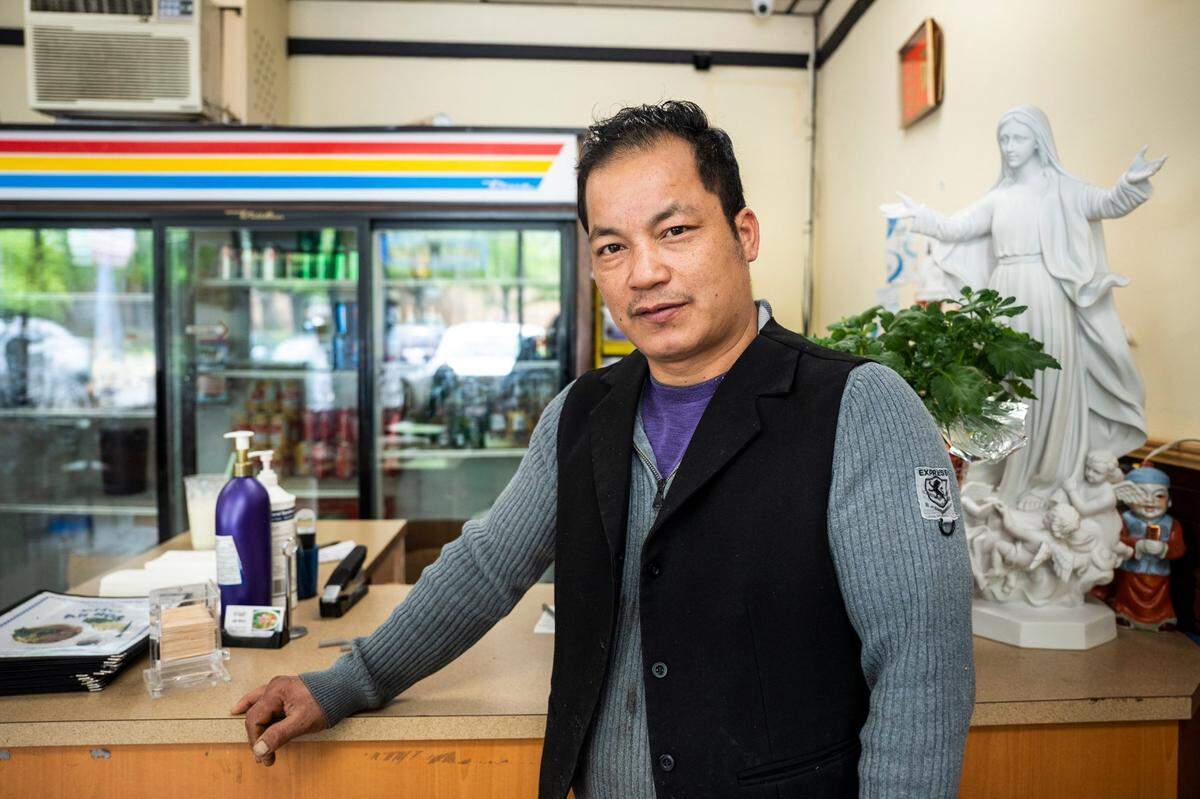
Tiep Pham, owner of Pho An Hoa, poses for a portrait inside his Central Avenue restaurant. Melissa Melvin-Rodriguez mrodriguez@charlotteobserver.com
Charlotte has a competitive Vietnamese food scene, Pham said. But the Vietnamese restaurant doesn’t just see Vietnamese customers — Pham thinks his multicultural clientele has to do with the restaurant’s location, next to Latino and Mediterranean markets.
That, and Pham believes his pho is some of the best in Charlotte.
It’s a time-consuming process, making traditional Vietnamese broth, but foundational to the quality of the pho. Some days, when the soup doesn’t turn out tasty, Pham pours out the pot and closes the restaurant. It’s all about consistency for him.
“That’s how you make the customers come back,” he said.
Cedar Land
Fava beans and seed oilswere elusive grocery items in Charlotte when Musa Imreish arrived in the 1970s.
As a college student at University of North Carolina at Charlotte, he’d stuff himself into a small car with other friends and take monthly trips to Washington, D.C., to get what he needed.
Finally, one too many trips pushed him to start his own store in Charlotte. Imreish started a couple of Ali Baba grocery stores before helping a friend get Cedar Land up and running in 1994. Imreish later bought him out and has been running the store ever since.
When the store first opened, it was hard to get the word out, Imreish said.
“If you said ‘falafel,’ they would think you said ‘waffle,’” he said, of Charlotteans decades ago. “They were scared.”
Born and raised in Jordan, Imreish stocks the store with the food he grew up with, as well as spices and delicacies from several countries on that side of the globe. Customers can find everything from injera, an Ethiopian flatbread, to Mediterranean grape leaves, to samosas and sweets during Ramadan.
Its customers come from all over the world, including Africa, Bosnia, Germany and India. Some drive from other states to buy his food and products — just like he used to make pilgrimages to D.C.
Musa Imreish, right, chats with a customer inside Cedar Land on Central Avenue in Charlotte. Born and raised in Jordan, Imreish stocks the store with the food he grew up with, as well as spices and delicacies from several countries on that side of the globe. Customers can find everything from injera, an Ethiopian flatbread, to Mediterranean grape leaves, to samosas and sweets during Ramadan. Melissa Melvin-Rodriguez mrodriguez@charlotteobserver.com
La Luna Tienda Latina
Though La Luna Tienda Latina has been in its location on Central Avenue since 1995, it was purchased by Jorge Morales, the current owner, in 2002. He had just moved from Colombia and wanted something that reminded him of home in his new city.
That’s when the little bodega expanded from selling Latino food and drinks to include money order and transfer services. Now, that’s one of the store’s biggest attractions.
Manager Maribel Morales has been working in the store since 2005, just a year after she moved to Charlotte from Mexico. The customers have become like family over the years, largely due to the owner’s mission of getting to know his neighbors.
“His idea was to develop a local store like something that reminded him of the corner stores back home,” she said. “He wanted to meet the people that lived nearby and learn about their stories. He wanted to learn more about the community that surrounded him.”
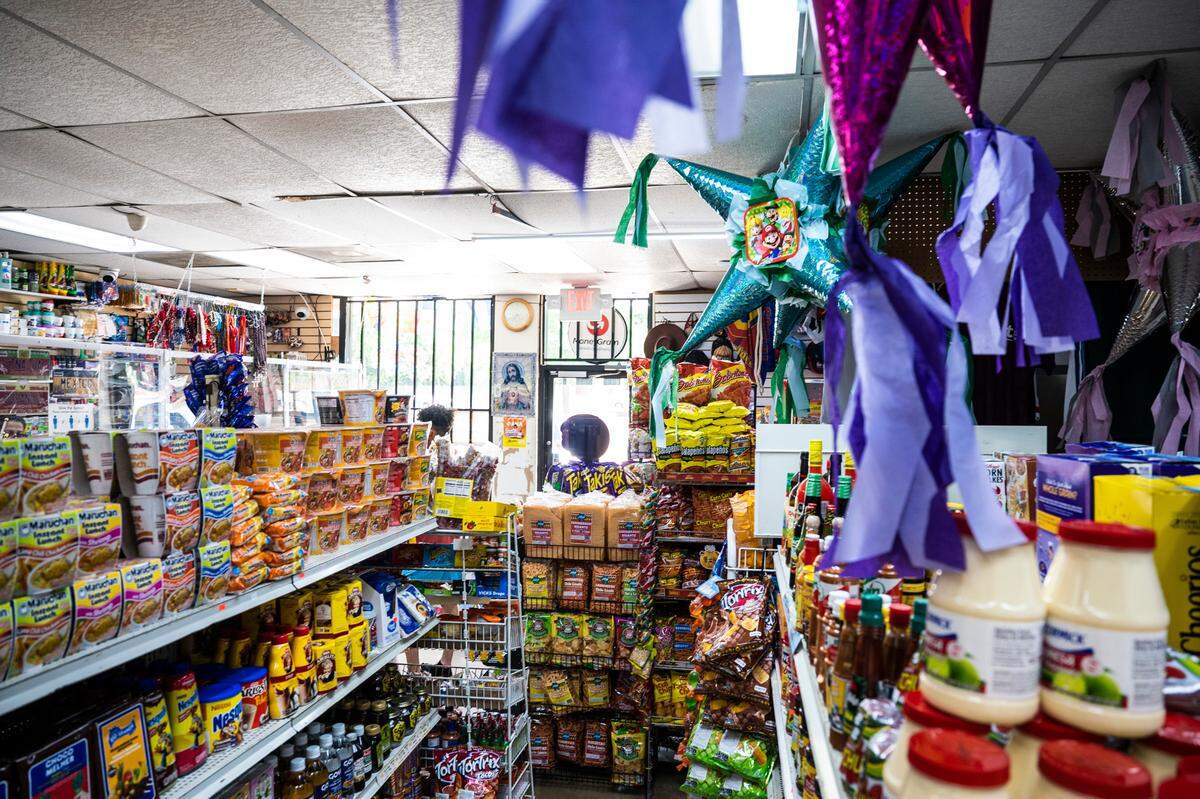
La Luna Tienda Latina on Friday, June 10, 2022 in Charlotte, NC. Melissa Melvin-Rodriguez mrodriguez@charlotteobserver.com
And as customers stopped by the store to send money to their families in Guatemala, Mexico, Honduras, El Salvador, and Dominican Republic, Morales learned more about their stories.
“It was through building this store that he has had the opportunity to meet and learn about the families and loved ones of his clients,” Morales said. “Because they send money back home to them, it’s easy to learn about their names and stories because people tend to open up about their lives when they feel they can trust you, especially since they’ve been part of the community for so long.”
And it’s that familial trust that allows customers to purchase items “al fiado,” or on credit — like Pham and Imreish.
“It’s something that happens when there’s trust that the person will pay back,” Morales said. “Sometimes it’s a box of cigarettes, some potatoes for their business, some chiles, and we take a list and at the end of the day they pay it back.”
East Charlotte isn’t immune to the city’s rising cost of living. Still, the store has managed to keep prices down and keep up practices like “al fiado.” Morales said those traditions are what makes it feel like home.
“They are no longer just clients. They’re part of the family.”
This story was originally published June 23, 2022 at 6:00 AM.
Devna Bose is a reporter for the Charlotte Observer covering underrepresented communities, racism and social justice. In June 2020, Devna covered the George Floyd protests in Charlotte and the aftermath of a mass shooting on Beatties Ford Road. She previously covered education in Newark, New Jersey, where she wrote about the disparities in the state’s largest school district. Devna is a Mississippi native, a University of Mississippi graduate and a 2020-2021 Report for America corps member.