
Go with us inside this Charlotte-area malt house. It supplies local breweries
That pint of beer poured at a local brewery like Heist, Triple C or Legion in Charlotte likely was made with barley grown in fields less than an hour away.
Since 2018, Carolina Malt House in Cleveland has malted barley and other grains grown from over a dozen neighboring farms within a 10-mile radius. The malting process activates the sugars in the seeds for fermentation for food and drinks.
Turning into the gravel driveway off Statesville Boulevard is a large, hard-to-miss propane tank that acts as a billboard with the company name painted on the side. Behind it is the barn-red metal building with four silver silos on over 60 acres in Rowan County.
Carolina Malt House has over 100 customers in North Carolina, South Carolina, Tennessee, West Virginia, Virginia and Georgia. The majority of breweries and distilleries using Carolina Malt House products are in the Charlotte region. There’s over 30 of them.
“Especially any small craft brewery in North Carolina or South Carolina, it’s a very good chance that we’re in that beer,” said Aaron Goss, 42, co-owner and founder of Carolina Malt House. “We’re the only malt house in the world offering completely North Carolina-grown malt. It’s a chance to drink a beer that’s actually unique.”
Malt is the largest ingredient of beer, other than water.
Goss, a former computer programmer and lawyer, turned his home brewing hobby into a third career, opening Carolina Malt House seven years ago.
“I had made some beer using locally grown barley, and I liked that beer very well and a lot of other people did, too,” the Salisbury native said. “I felt the difference was that local flavor combined with just the freshness of it.”
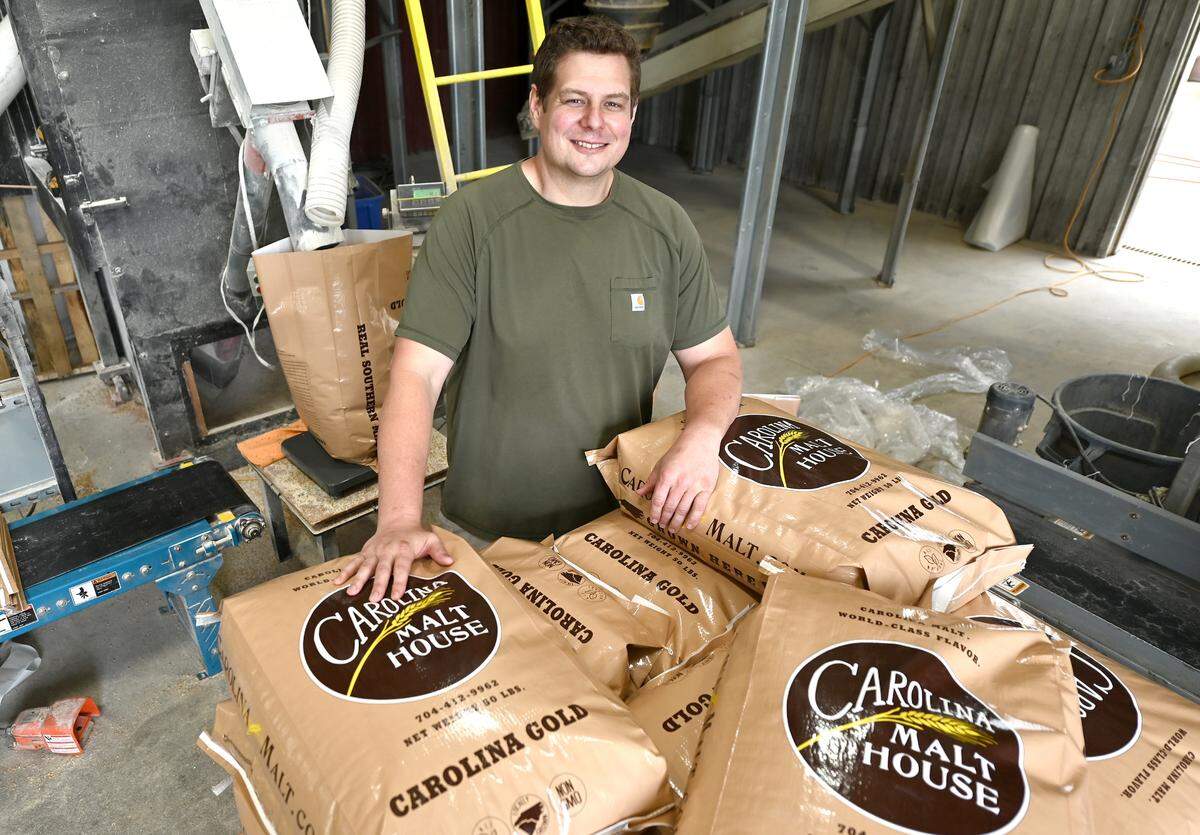
The Charlotte Observer recently toured Carolina Malt House’s operation. Here’s what we learned:
Behind the malting operation
Ten years ago, Goss started touring malt houses in a number of countries, including seven in the United Kingdom, two in Germany, three in Canada and two in the U.S.
“There are a lot of different methods for making malt,” Goss said. “I tried to bring back the best ideas here.”
Carolina Malt typically grows a little over 1,000 acres of barley a year. The company also malts wheat, oats, sorghum, rye, rice and corn.
“Malt is the thing that makes beer beer. If wine is grapes, then beer is malt,” Goss said. “Everyone knows about hops but nobody knows about malt. Hops are just the spice.”
Building a malt house
The little red building off to the side of the gravel driveway is a grain grading shack. In late May or early June, Goss and some of his 10 full-time employees will grade the quality of the inbound barley from the one harvest a year that Carolina Malt House will use.
Goss designed and, with his team, built most of the equipment in the nearly 12,000-square-foot, 28-foot-tall building.
Past two rows of nearly ceiling-high shelving of stored and finished Carolina malts ready to ship to customers comes the sound of ear-piercing metal grinding from a back room. One of Carolina Malt House’s employees welds ductwork for the third production line that’s under construction and expected to open this year.
The initial investment into Carolina Malt was $2 million, Goss said. He designing the machinery and everything was built on site. Otherwise, he said an operation this size would cost up to $30 million.
“Building everything ourselves, we’re able to be price competitive and that’s how we get business from bigger places like NoDa Brewing,” he said.
Carolina Malt chose this spot in North Carolina to be close to the barley fields in what Goss called the “North Carolina Grain Belt.” “You couldn’t get North Carolina malt anywhere before I built this place,” he said.
Carolina Malt House started with one production line in 2018, and added a second two years later. The business has grown 230% over eight years, Goss said.
In all, the building could house five germination lines.
“We could easily grow this place to 100 times this size,” he said. “We could supply the state of North Carolina at that point.”
The malting process
Three large bins of malted corn bought straight from the fields of local farms sit waiting to be malted.
“We’ve set up our own seed cleaning operation,” Goss said. Using a gravity table, the same machine used in gold mining operations to separate out the heavy dirt, the seeds are sorted based on size and density.
The malt process takes three steps — steeping, germination and kilning.
Walking through a door into a cool room is the sound of swooshing. The barley seeds are being washed in a 17-foot-tall vat designed by Goss. Up a flight of steep metal stairs is a deck overlooking the process that hydrates the grain. The seeds are tossed in waves of 60-degree water for about three minutes at a time.
“This is our steeping process,” Goss said. Basically, it imitates being rained on.
White foam shows how well the grain has been cleaned, Goss said. Then through an air-locking double door is the kilning phase. The room is a toasty 150 degrees.
“During this phase, we’re evaporating 20 tons of water over 24 hours,” Goss said. “So this is just drying it out.”
The process runs for 24 hours on burners Goss built. “We burn about 50 gallons an hour of propane,” he said.
The propane tank in front of the building powers the operation.
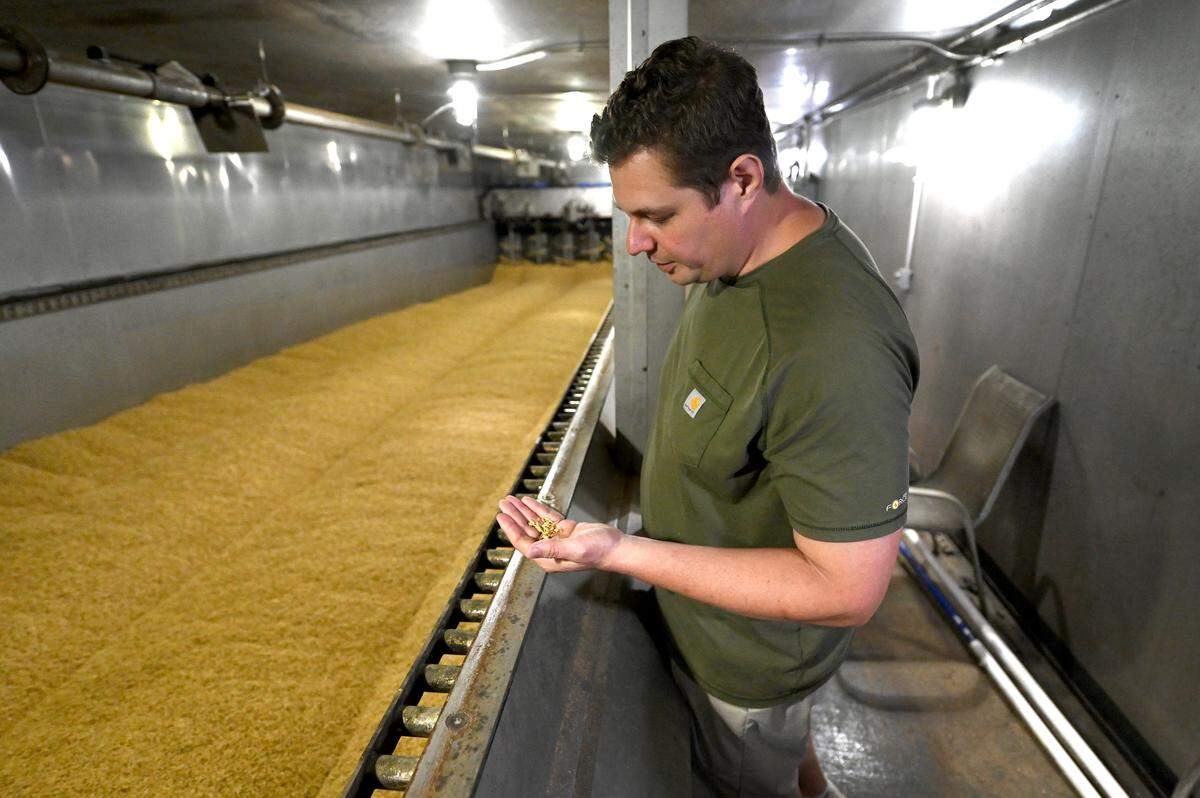
After exiting another pair of airlocking doors and walking through a metal door sits two germination rooms. One line has wheat seeds and the other barley. About 4 feet of seeds are piped into each room. The sweet, pleasant aroma seems like it should be made into a candle scent.
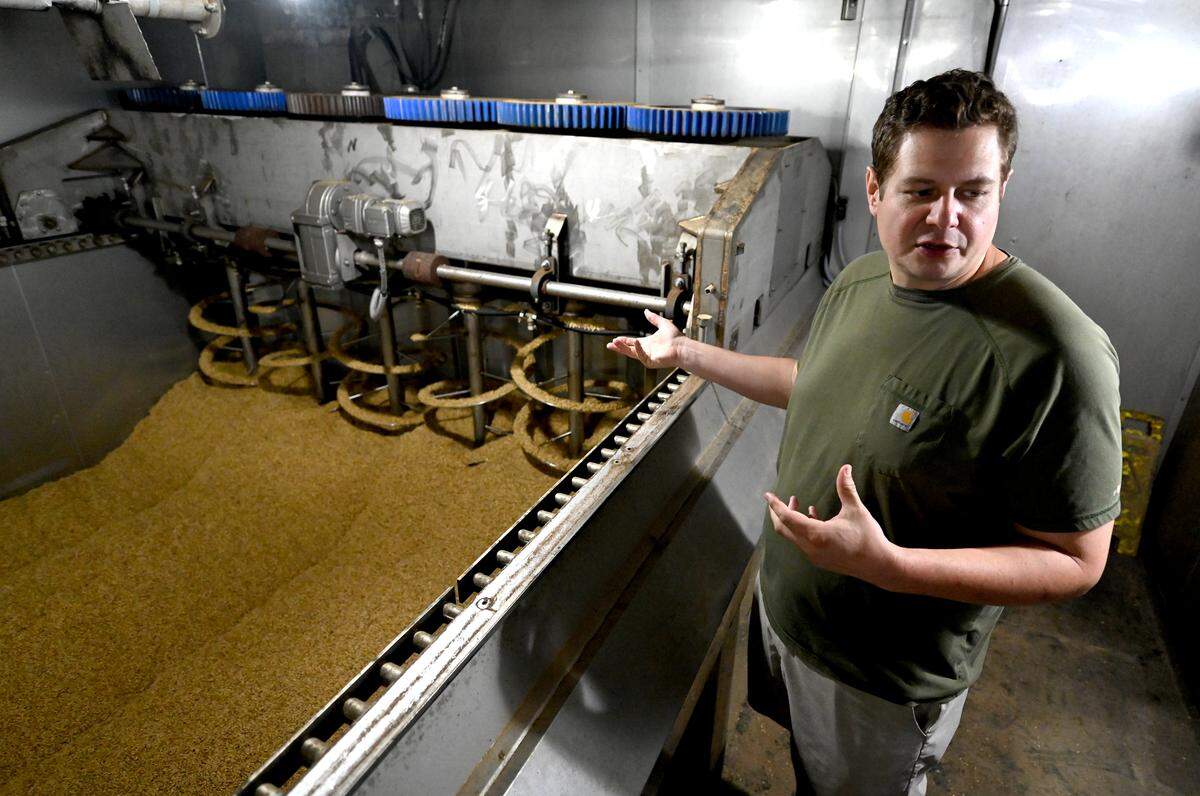
“The floor under the grain is perforated, so we’re blowing cool humidified air into it,” Goss said. “It is alive and producing heat, so we have to evacuate all that heat.”
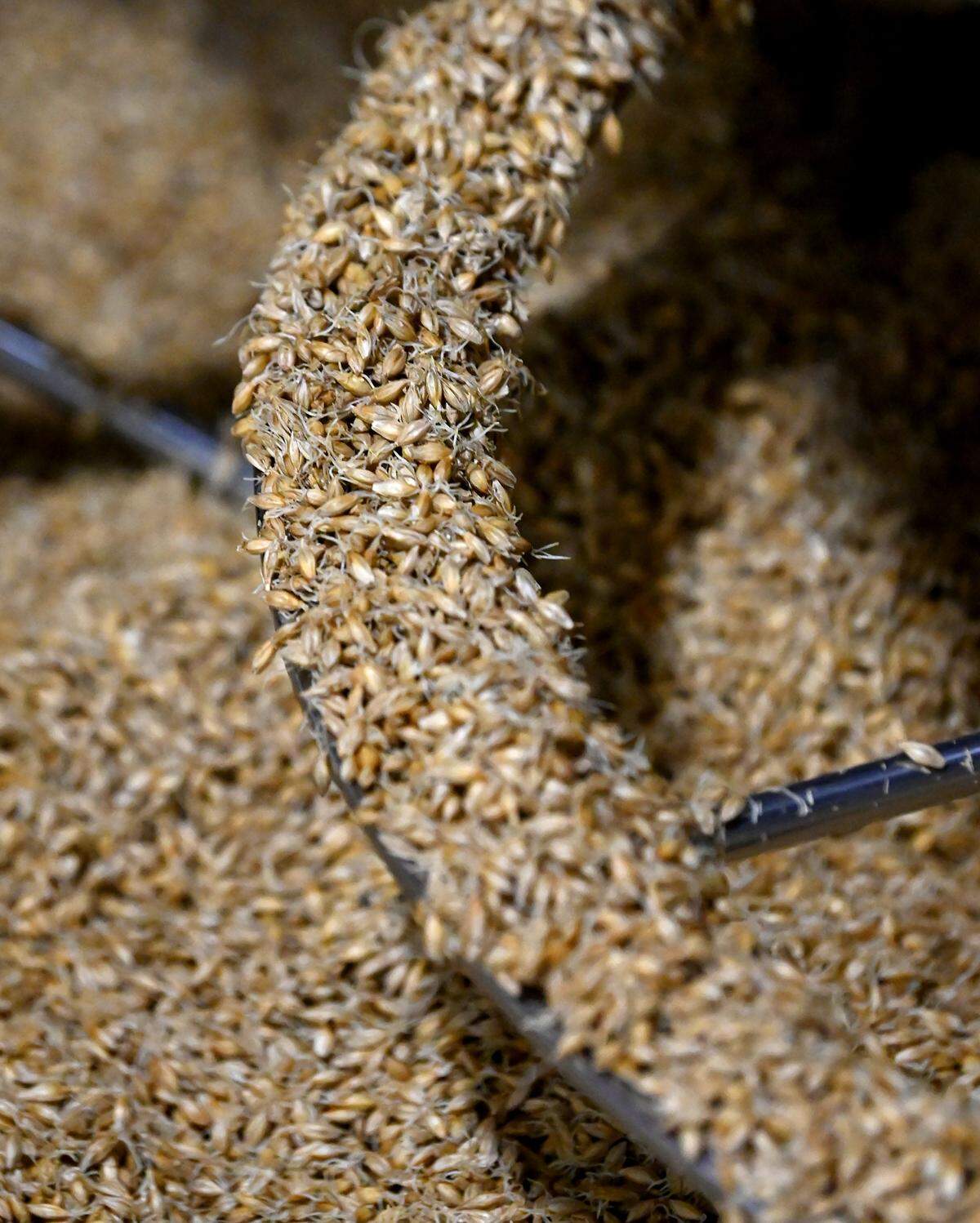
Scooping up a handful of barley grains, Goss inspects it. “This is very close to done. I can tell by the root length,” he said. “So this will go into kilning soon.”
Like the machines in the other rooms, the grain turner is Goss’s design. The gears walk the grain turner down racks as the helixes spin it about every eight hours. The turner runs the length of the 50-foot room, keeping the grains from clumping.
It’s all controlled by computers.
“We take over 15.4 million readings of temperature pressures, gas levels, humidity levels on each batch,” Goss said. “It watches not only the temperature, but the rate of change in temperature to determine when to kick the cooling stages on and off.
“By tightly controlling the temperature, I can make a pale malt every time I want to make a pale malt, or Pilsner malt exactly to spec every time I want, and it saves me on warehousing space,” Goss said.
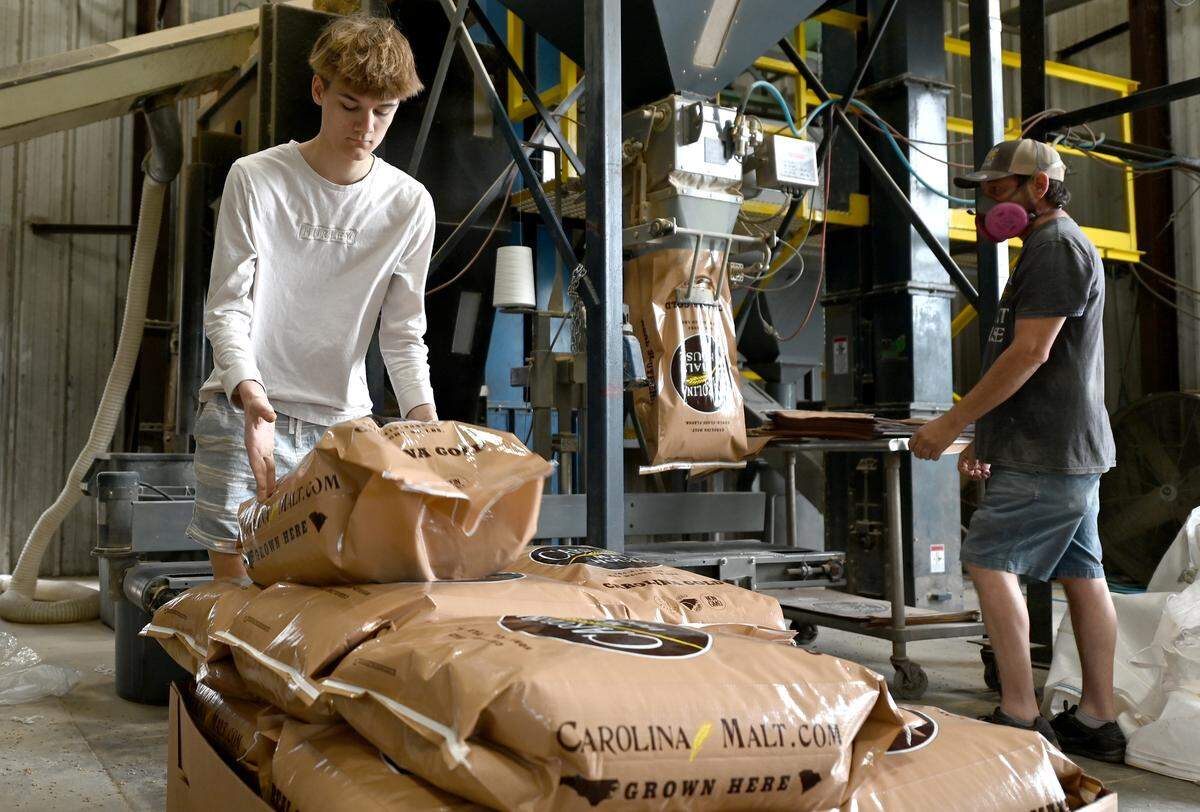
Next, the finished seeds are piped to the ground-level bagging area in front of the building. It’s loud with the sound of vacuums and grains being shot into 50-pound bags where workers will haul it off.
A whiteboard is filled with order information from breweries and distilleries. Then the brewer will mill it to crack the grain, mash it to convert starches to sugar and finally ferment it, turning the starches into alcohol, Goss explained.
What breweries say about Carolina Malt
For most beers, the only thing different from one state to another is the water because breweries use the same malt, Goss said.
“This is a different agricultural product with our own barley varieties adapted to this area,” he said. And it’s exactly what many local breweries are looking for.
“All of us are very much about drink local, be local, and what Carolina Malt has done is really helped us do that,” said Matt Virgil, NoDa Brewing Co. co-owner and director of operations. “We really liked being able to use grain that was grown nearby.”
NoDa Brewing was one of Carolina Malt House’s first customers, using products in small batches. About a year ago, NoDa began using Carolina Malt in larger quantities, comprising 40% of the brewery’s entire usage and averaging orders of 8,000 pounds a week.
Prior to Carolina Malt, NoDa sourced malt from the United Kingdom and Germany. But over the last two years, it has focused on locally sourced. “Carolina has been a really big player in that, meeting the standards of that quality,” Virgil said.
NoDa’s Pitchside Pilsner, for example, is nearly 100% Carolina Malt House malt grains, while the brewery’s signature Hop, Dop and Roll batches use a smaller amount.
Over at Free Range Brewing, co-owner Jason Alexander said the majority of its beers now use Carolina Malt.
“Their malt is in every beer we make these days,” he said. “It’s extremely fresh. It’s extremely consistent. You can taste the effort that goes into creating it.”
There are two other malt houses in North Carolina — Riverbend in Asheville and Epiphany in Durham. Unlike Carolina Malt House, Riverbend and Epiphany are in more urban settings and also work with farms outside of North Carolina.
“We want people to see us the same way as how they think about local food,” Alexander said. “It’s as much about what goes into it as it is about where it’s located.”
As for Goss, he no longer feels the need to homebrew.
“Now I get to do this part and then have that creative product turned into beer that’s as good as I ever made by brewers all over the state,” he said. “I love all of the beers made with my malt.”
This story was originally published April 29, 2025 at 5:45 AM.