
An artist’s latest project at JCSU celebrates the history of Charlotte’s west side
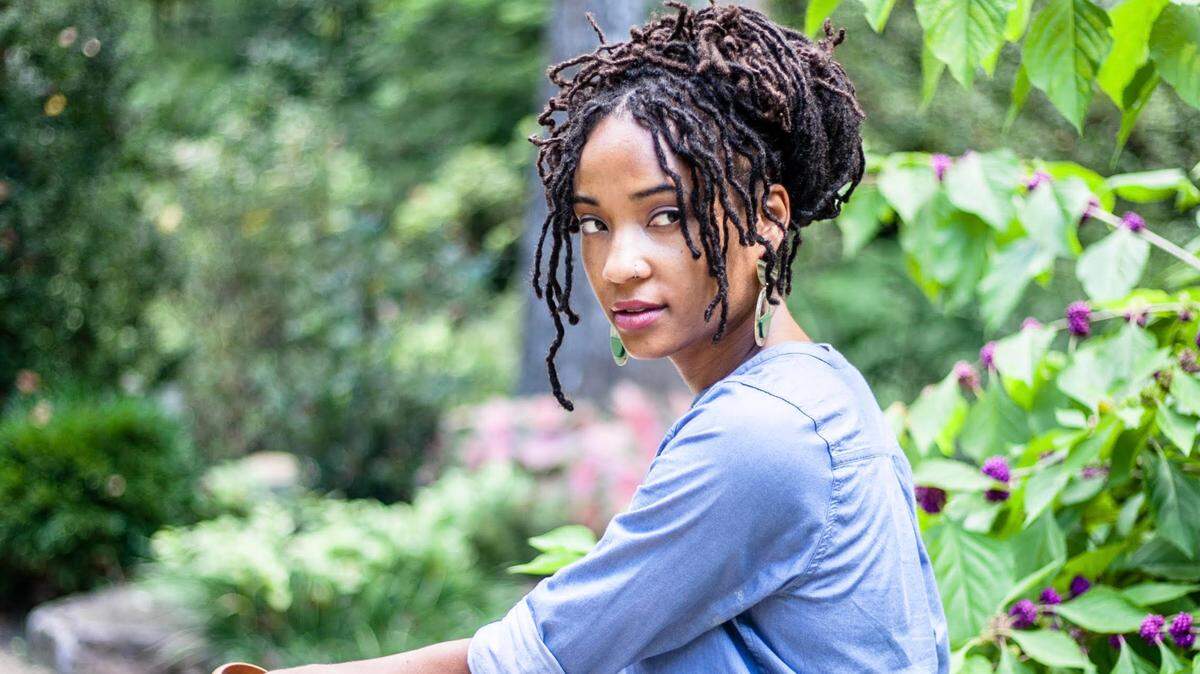
A 2017 fellowship showed Charlotte artist Janelle Dunlap how effective public art can be in supporting neighborhoods like the one that surrounds Johnson C. Smith University.
Now, she’s creative director for a new project at JCSU, a public art installation that uses past and present Black narratives to share the history of the area.
“JCSU is a historically Black university in the center of a rapidly gentrifying community, and I feel an obligation to that space,” said Dunlap, whose father, aunt and grandmother attended HBCUs. “The older I get, the more I understand their value to the surrounding communities. With the transition the neighborhood is going through, I’m doing whatever I can do to support it.”
Dunlap’s collaborative JCSU project will consist of three installations in an outdoor classroom setting. It’ll include contemporary sculpture, graphics, light installations and a soundtrack.
The project pays homage to JCSU’s first Black professor, George Davis, who helped establish 5,300 Rosenwald Schools, the first public schools for African American children in the segregated South.
Dunlap’s work is funded by several grants, including $9,000 from the Arts & Science Council and $50,000 from the Institute of Museum and Library Services’ African American History and Cultural unit.
ASC grants and services program director Liz Fitzgerald was drawn to the fact that Dunlap’s idea celebrates the neighborhood.
“The way Janelle approaches the work is grounded in the neighborhood, celebrating the voices and reflecting the history and (presenting) stories of the area back to the community,” Fitzgerald said. “I’m excited about the project. The (funding) panel also responded to the use of JCSU’s outdoor spaces as a potential gathering space for the community.”
The beekeeper
Dunlap considers herself a “social justice creative” who uses her art to disrupt expectations of time, culture and community.
According to her bio on the League of Creative Interventionists website, she creates art as a way of “building bridges, blurring lines and providing visibility to moments and people who, often aren’t, but should be seen.”
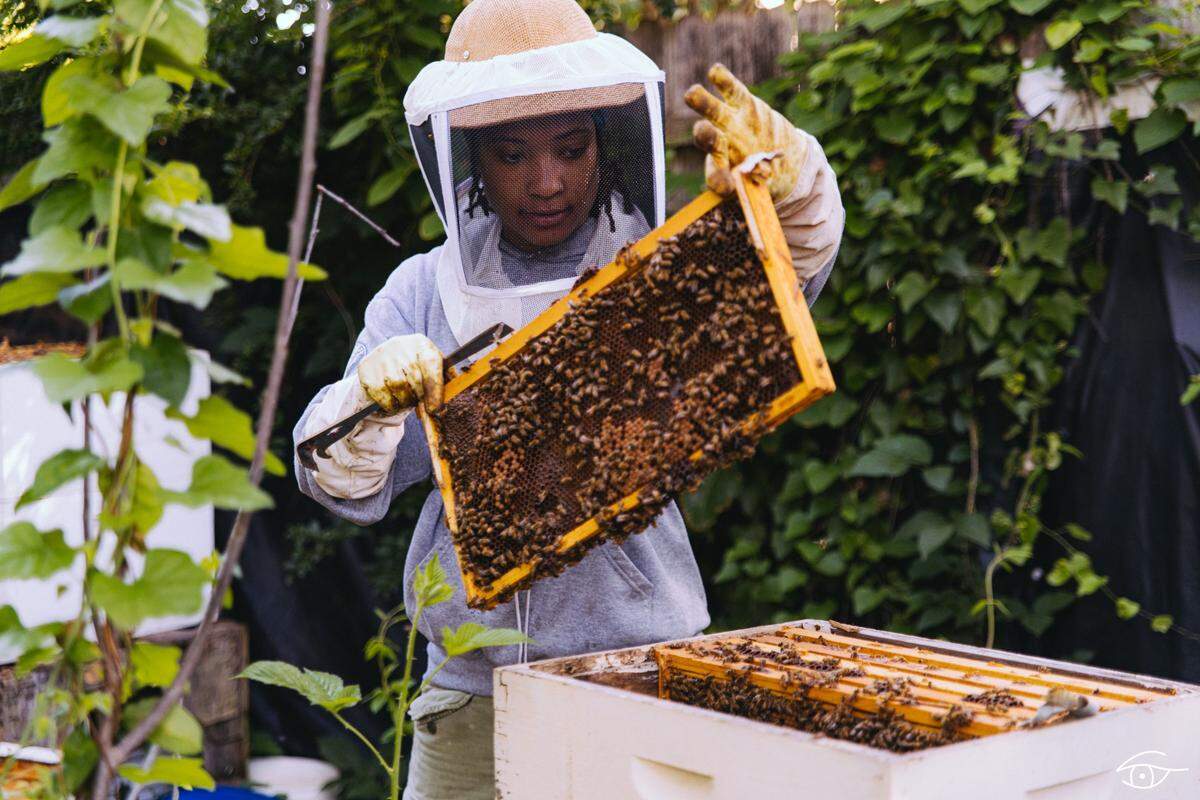
Dunlap is also a certified beekeeper, which she says influences her art.
A few year ago she established a bee farm at JCSU to support the neighborhood where she does most of her work. Dunlap uses her beekeeping practice to inform visual arts pieces, collecting wax from the hives to create abstract paintings and recording sound from the hives for a series of ambient soundtracks.
“Beekeeping helps me take a better look at society, at humanity,” she said. “I’m thinking about the wellness of people who look like me specifically, whose wellness is often not considered, but also the wellness of all of us.”
She acutely feels the pain of the gentrification taking place in Charlotte’s historically Black neighborhoods.
People who built and sustained businesses, organizations and the social fabric of a community are being displaced by affluent newcomers, drawn by cheap homes in a housing shortage. The urgency is not simply the loss of neighbors, Dunlap said, but the erasure of their ever having been there.
“We lose stories and narratives and don’t really understand the value of them until they’re gone,” she said. “Then learn we could have avoided it if we’d paid attention to what happened before. History informs us.”
Reclaiming the past
As part of her 2017 fellowship, Dunlap created RCLM 37 at JCSU, an interactive public art series that chronicled past and present Black narratives on Charlotte’s west side. It gave voice to the area’s long-time residents while providing historical perspective for new ones.
RCLM 37 (pronounced Reclaim 37) was named for Exit 37 off of Interstate 77.
The project recalls the federal program that from the 1950s through the 1970s ran new expressways straight through Charlotte’s Black areas. Property values plummeted, and once-bustling neighborhoods along the spine of Beatties Ford Road bore the brunt.
“These are the oldest surviving African-American communities in Charlotte,” said Monika Rhue, director of Library Services at JCSU.
Rhue saw RCLM 37 as a way to utilize the university’s archives and increase visitors’ knowledge of the history of the area.
“We want to make sure the new members of the community understand the legacy they are joining and make sure long-time members are aware of it,” she said. “The goal is to reclaim the past and legacy as the future is embraced.”
Reflecting stories
To create RCLM 37, Dunlap and her team combed JCSU archives and public records, as well as recorded over 50 oral histories. RCLM 37 has been on display at JCSU’s James Duke Library for two years.
Dunlap’s latest creative endeavor at JSCU is called RCLM 37 Pt. II. It takes the original premise and extends it outdoors with an open-air exhibit and learning environment. It’s multidisciplinary and ambitious.
Collaborators on the project are Stephen Hayes, Quintel Gwinn, Marcus Kiser, and Lavonte “ FLLS” Hines. Hayes is a Duke University professor and sculptor. Gwinn is a designer, Kiser a graphic artist, and Hines a producer.
Hayes’ part of the project includes “Beacon,” an acrylic, aluminum and metal statue. Gwinn is designing a 10-foot interactive wall called “Amplify,” which will integrate Hines’ soundscapes. And, arched concrete benches in the garden will be wrapped in Kiser’s graphics.
Dunlap says sources of inspiration for “Part II” included Davis, the university professor who tirelessly promoted the Rosenwald schools.
”Davis toured the entire Southeast raising money for them, based on Booker T. Washington’s ideology,” Dunlap said. “The local communities raised half the money and built 5,500 schools across the Southeast, most of them in North Carolina.”
RCLM 37 Pt. II will be located in JCSU’s Zen garden, book-ended by the university’s 90-year-old church and new STEM department — symbolic given the exhibit’s past-present-future focus.
By reclaiming a space and reclaiming the area’s history, Dunlap hopes the installation will help people connect to history through a different lens.
“The point of reclaiming is to be an inspiration for people who want to invest in their communities,” she said.
More arts coverage
Want to see more stories like this? You can join our Facebook group, “Inside Charlotte Arts,” at https://www.facebook.com/groups/insidecharlottearts/
This story was originally published March 24, 2021 at 12:21 PM.