
NC museum exhibit tracks the resilient Black experience with subtlety and surprises
It’s hard to know whether you’re in an art exhibit or a treasure hunt.
“Vision & Spirit: African American Art,” a collection of more than 100 works tracking the black experience from the Underground Railroad to contemporary equality themes, is as remarkable for what it hides as what it shows.
Filling two galleries at the Harvey B. Gantt Center for African-American Art + Culture on South Tryon Street, the exhibition repeatedly startles the visitor into double-takes.
So many pieces contain a subtle subtext, a hidden icon, an odd historical juxtaposition that even the most casual viewers find themselves stirred to amateur detectivedom, drawn deeper into the photos, canvases and stitchings to unlock what lurks within.
Channeling the West African cloth tradition in “Coming to Jones Road No. 3: Aunt Emmy,” a 1999 figurative quilt of a woman, artist Faith Ringgold hides an urgent message around the border that whispers to a runaway slave: “Look for an old farmhouse with you dead mama’s star quilt on the roof. I’ll be waitin for you. God is on your side. You as good as free.”
A quilt on a roof was a signal of a safe-space for passengers of the Underground Railroad, explains Tia Warren, the Gantt’s lead docent.
Quilt symbolism extends even to the skin of the Gantt along Stonewall Street, the geometric lines drawn by architect Phil Freelon, who went on to design the National Museum of African American History and Culture along Washington’s Mall.
Visitors inevitably pause at “Rehearsal,” an oil and collage on canvas by Benny Andrews showing a church matron with her son rehearsing hymns with the church pianist. Andrews, who grew up picking cotton in Plainview, Ga., during the Depression and later joined the Southern exodus to the urban North, presents what at first looks like a mundane religious ritual.
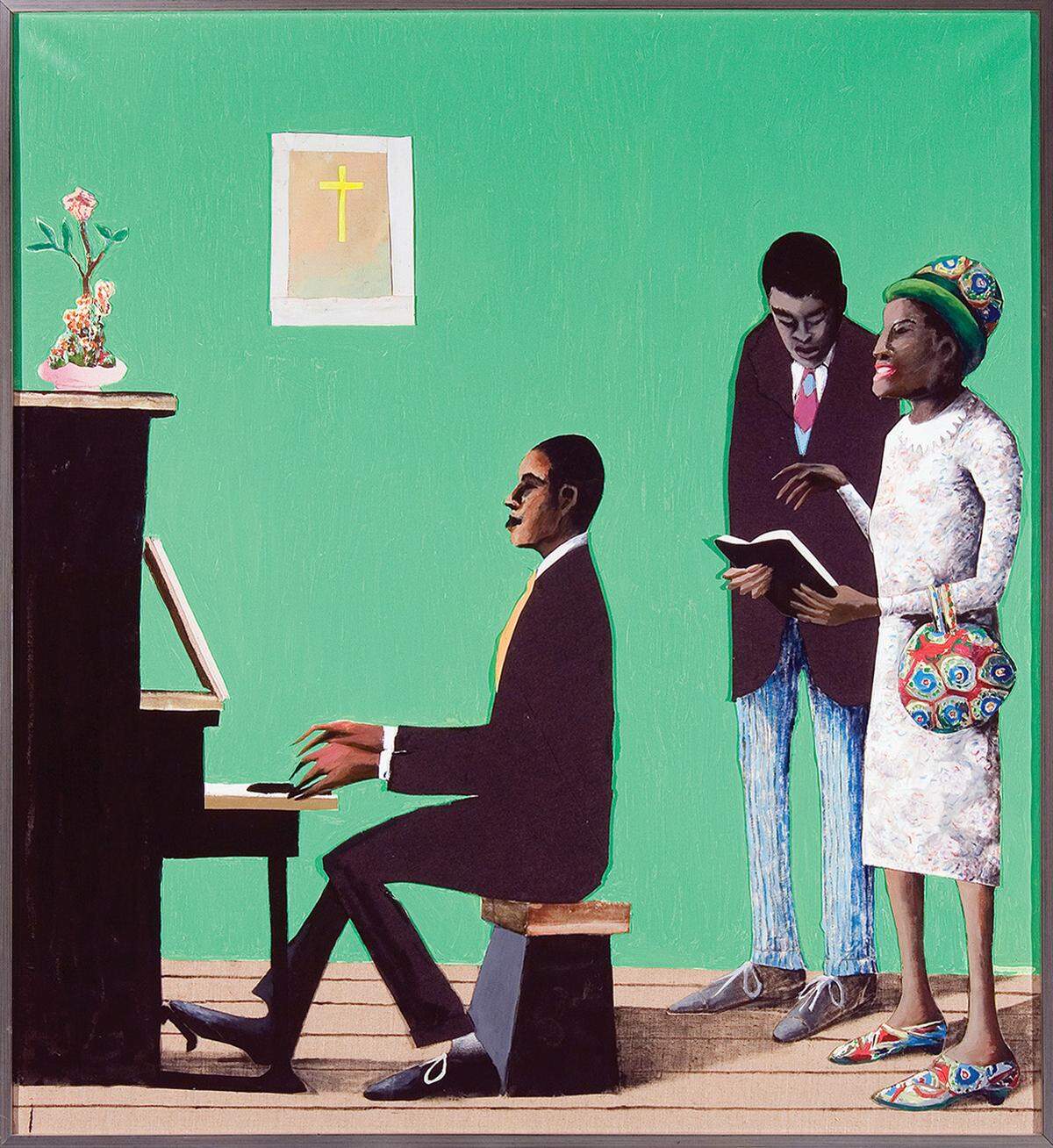
But peering closer, we notice a generational tableau unfolding, the youth bent into the hymnbook as the matron sings from memory, the pianist ramrod straight in dignity. Here we unpack a cultural touchstone reflecting the resilience of faith.
“If you grew up in a church, you’re familiar with this scene,” says Warren. “It’s one of the favorite pieces in the exhibit.”
‘Our strength and our humanity’
Exhibition curator Dexter Wimberly adopted resilience as his central theme in the show, which runs through July 31.
“But what does resilience mean in this context?” says Wimberly, a former advertising executive, in an essay about the Gantt’s presentation. “Is it perseverance? Is it staying power, or is it something much deeper? I think resilience reflects our strength and our humanity.”
In images at turns grim and celebratory, Wimberly draws on the attitude, style and conventions of the Black subculture. Through the works of 48 artists, he probes the themes of family and wealth, protest and politics.
In one provocative choice, Wimberly exposes us to a rarely-seen series by Charlotte native son Romare Bearden. In three screen prints, resonating with Bearden’s playful tricks of color, the artist reimagines the classical Greek journey of Odysseus as having occurred in Africa.
Morroccan domes and Muslim minarets pass as the skyline. Troy blazes as the Trojan Horse sits discarded; African beasts preside over the perils of a black, toga-clad Odysseus. Is it emblematic of the black diaspora? Another mystery to solve.
BOFA’s collection
Wimberly had a vast catalog of works to choose from — the art hoard of Charlotte-based Bank of America, widely considered one of the largest and finest corporate collections in the world.
Bank of America has never disclosed its exact scope or value, but it is believed to include thousands of works collectively worth millions of dollars. It is strongest in post-World War II American works and includes works by noted artists like Ed Ruscha, Joan Mitchell and William Eggleston.
Much of it was acquired since the 1970s when BofA bought banks with strong art collections, including Security Pacific National Bank in Los Angeles, Boatmen’s Bancshares in St. Louis, Seafirst in Seattle and FleetBoston.
Bank of America at one time considered selling its collection, but decided instead to make it a public relations asset.
Under the bank’s Art in our Communities Program, qualified non-profit venues can apply for pre-packaged exhibitions, provided at no charge. Among the shows are seven decades of American impressionists, pop works by Andy Warhol and one celebrating three generations of the Wyeths.
“Vision & Spirit: African American Art” is the latest BofA traveling show, and the Gantt is the first museum to host it. Works from seven artists — including Raelis Vasquez, Chelle Barbour and Murry DePillars — were acquired by the bank for the exhibition.
The bank and the Gantt have had a strong relationship since the museum’s 2009 opening.
At that time, the bank gave the museum the cornerstone of its permanent collection in the celebrated Hewitt Collection, 58 works from 20th-century African American artists. It included Bearden’s 1983 lithograph “Homage to Mary Lou,” which served as inspiration for August Wilson’s play “The Piano Lesson.”
Photo magic
Wimberly included a variety of photographers in the show, a blend of street art and historic images. Some are haunting and stark, like Earlie Hudnall Jr.’s 1993 portrait of a pre-teen aspiring to the hip-hop lifestyle.
It’s yet another puzzle to challenge the visitor — time in the image appears somehow warped.
Hat backward, his chest adorned with a gold chain, a beeper in his pocket and britches adroop, the youth projects the countenance of man and boy at once, and he offers no clue in his frigid gaze suggesting experience beyond his years.
Other photos rely on the power of premonition. Dozens of striking Memphis sanitation workers gather solemnly, all holding “I Am A Man” placards in Ernest C. Withers group portrait. Looking deeper, though, the picture has an eerie sense of foreboding — it was taken in 1968, only days before Martin Luther King arrived to support the cause and died at the hands of an assassin.
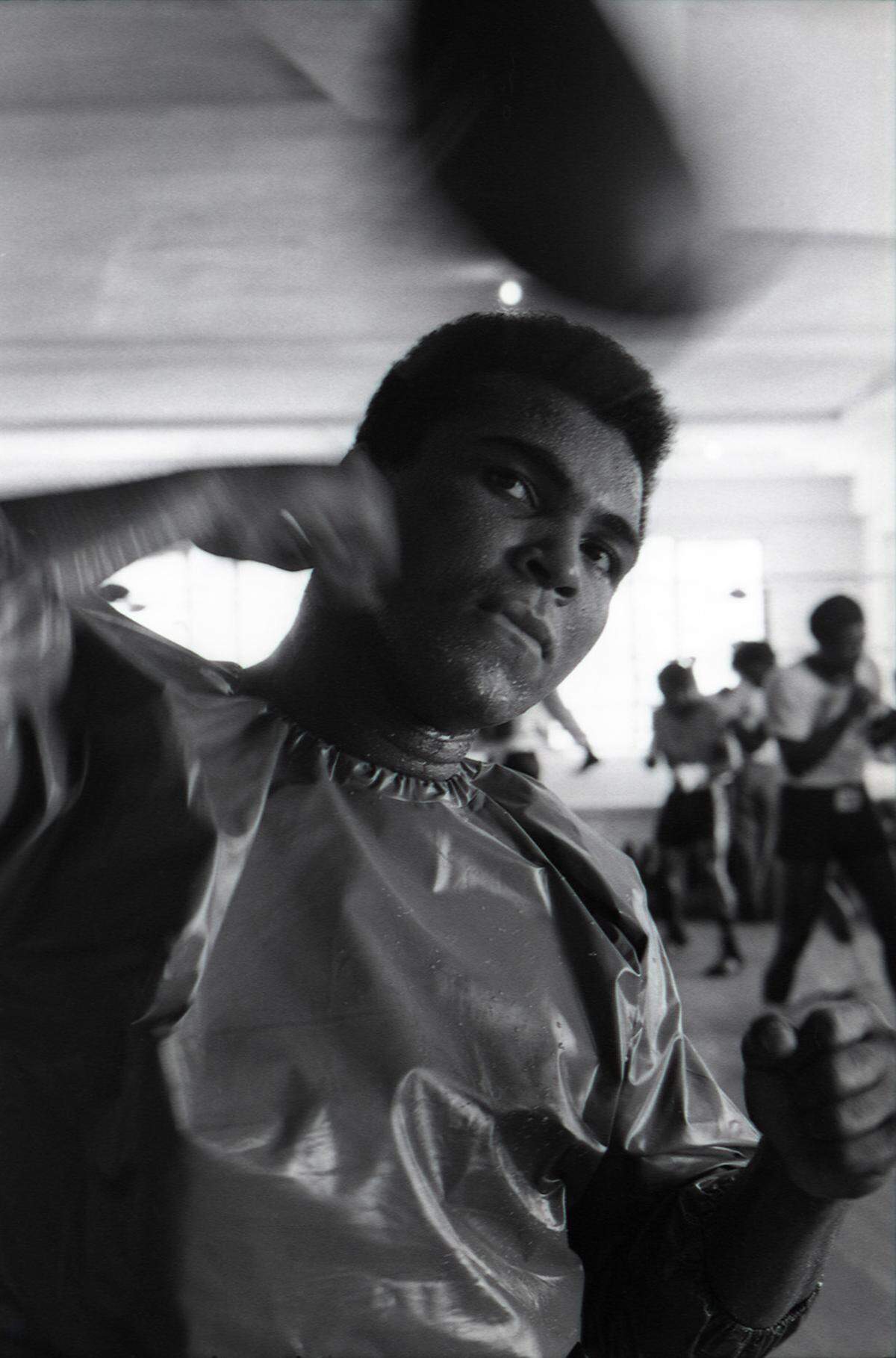
Perhaps the most dynamic image is that by Gordon Parks, who went to Miami Beach in 1970 to photograph Muhammad Ali, then training there. His untitled portrait for the influential Life magazine is confined in a too-small frame, yet the energy seems to splash all over the wall of the Gantt.
Again, a deeper look uncovers the unexpected layer — there, in the determined face of the sweating champion — Parks reveals a stoic vulnerability, one that his public would not recognize until decades later when Parkinson’s would humble the athletic giant. It is yet another gold coin to be exposed in the cryptic depths of “Vision & Spirit.”
Want to go?
Vision & Spirit exhibit, through July 31.
Gantt Center for African-American Art + Culture
551 S. Tryon St., Charlotte
Admission: $9 adults.
Hours: Fridays noon to 6 p.m.; Saturdays 10 a.m. to 6 p.m.; Sundays noon to 6 p.m.
More information: ganttcenter.org; 704-547-3700
This story is part of an Observer underwriting project with the Thrive Campaign for the Arts, supporting arts journalism in Charlotte.
More arts coverage
Want to see more stories like this? You can join our Facebook group, “Inside Charlotte Arts,” at https://www.facebook.com/groups/insidecharlottearts/
This story was originally published March 31, 2021 at 6:30 AM.