
Mint Museum exhibit plans to celebrate this nearly forgotten American Impressionist
You already know about Claude Monet and Giverny.
The French Impressionist made the village in Normandy, France, his home from 1883 until his death in 1926. He painted water lilies, church spires and haystacks, becoming nearly synonymous with Giverny in the way Georgia O’Keeffe is linked to the American Southwest and Andy Warhol is linked to New York.
The pastoral beauty that attracted Monet attracted other artists. “Over the course of the 1880s and ’90s, there were something like 300 artists in Giverny,” said Jonathan Stuhlman, senior curator of American art at the Mint Museum. “It really became a destination.”
John Leslie Breck was among those who settled there.
“I would argue Breck is the last major American Impressionist to have never had a solo museum exhibition or monograph on him,” Stuhlman siad. “We’re very pleased to be pioneering both.”
When the Mint Museum Uptown opens “John Leslie Breck: American Impressionist” on Sept. 18, the museum plans to give Breck his due. Other American Impressionists (John Singer Sargent, Childe Hassam and Mary Cassatt) are better known. But it was Breck who introduced Impressionism to the United States, by way of his native Boston, in 1890 after he returned from Giverny.
A life cut short
He died just nine years later, just before his 39th birthday, by gas poisoning. Scholars believe it was suicide. “There’s an element of tragedy to his life,” Stuhlman said. He never married, didn’t have children and always traveled with his mother. She was with him in Giverny.
“When he first brought his paintings back (from France), they met with mixed critical success,” Stuhlman said. “After a couple of years, he came to be known as ‘the American Impressionist’ around Boston. But he never really broke into the New York art scene. He just … wasn’t fully accepted.”
“There’s an argument as to who got to Giverny next after Monet,” Stuhlman said. “Breck was certainly part of the first major group of seven or eight North Americans — there was a Canadian in the mix, too — to arrive. They all got there, for the most part, in 1887, and Breck stayed the longest — nearly three years. He even stayed through the winters, which not many of them did.”
“American Impressionism lagged behind European Impressionism in scholarship and study,” Stuhlman said. “But American audiences warmed to it more quickly than European audiences and critics had.”
For all its popularity now, Impressionism wasn’t adored at first.
“It’s so popular today,” Stuhlman said. “And to our eyes, they are pretty, pleasing pictures. But in their own times, the Impressionists were at first reviled. It was thought that the paintings lacked academic finish. It’s interesting how times and tastes change.”
Breck comes to the Mint
Breck isn’t a household name, nor is he necessarily well-known in art history circles. Stuhlman first learned of him in the 1990s, when he worked at the Virginia Museum of Fine Arts. Breck’s descendants have held on to most of his works, so they rarely come up for sale.
“They had a beautiful Breck landscape of the Charles River. The Virginia Museum’s painting, as far as I can tell, is the first ever purchased by a museum.”
That landscape was embedded in Stuhlman’s memory. When the Mint Auxiliary approached him in 2015 about acquiring “a classic American painting,” he knew just which artist he wanted.
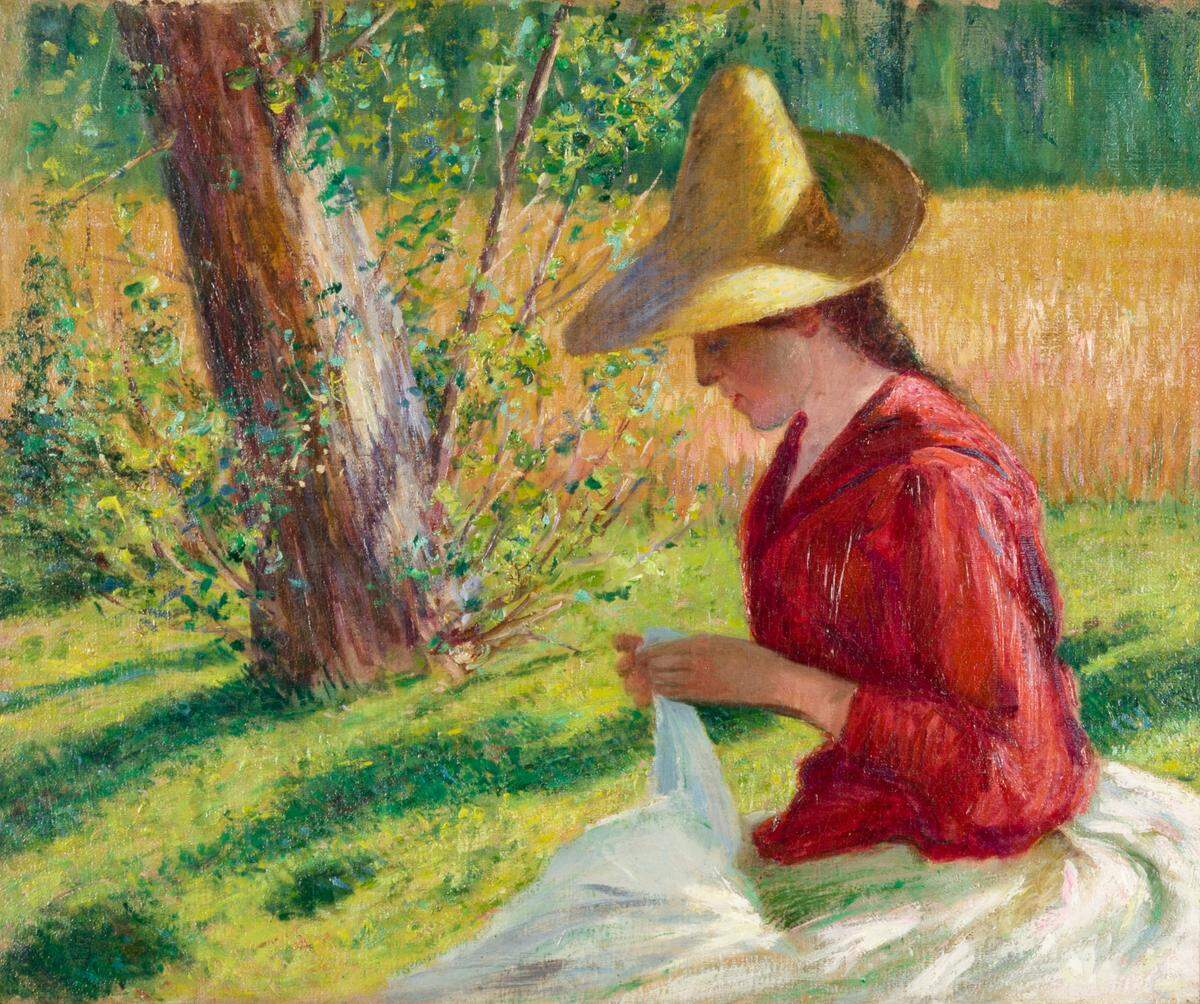
The Mint bought Breck’s “Suzanne Hoschedé-Monet Sewing” in 2016. The acquisition prompted Stuhlman to begin planning a solo exhibition of the nearly forgotten artist’s works.
The exhibition includes 70 of Breck’s works, drawn from public and private collections, as well as the Terra Foundation — “a museum without walls.” Ten works by Beck’s American contemporaries complete the show.
Hoschedé-Monet, the subject of the Mint’s Breck, was the eldest daughter of Alice and Ernest Hoschedé and — more importantly for art history’s sake — the stepdaughter and favorite model of Monet. She went on to marry American Impressionist Theodore Earl Butler.
When you see Breck’s version of Hoschedé-Monet, it likely won’t be the first time you’ve seen her likeness. She’s the “Woman with a Parasol, Turned to the Left” in Monet’s 1886 painting. (Women with parasols were a favorite theme of the Impressionists.)
Breck also left his mark on Giverny. “He encouraged the owners of the little coffee house and grocery store to turn it into an inn with artists’ studios and it became … the social center of the town,” Stuhlman said. Breck may have accidentally pioneered the co-working space so popular today.
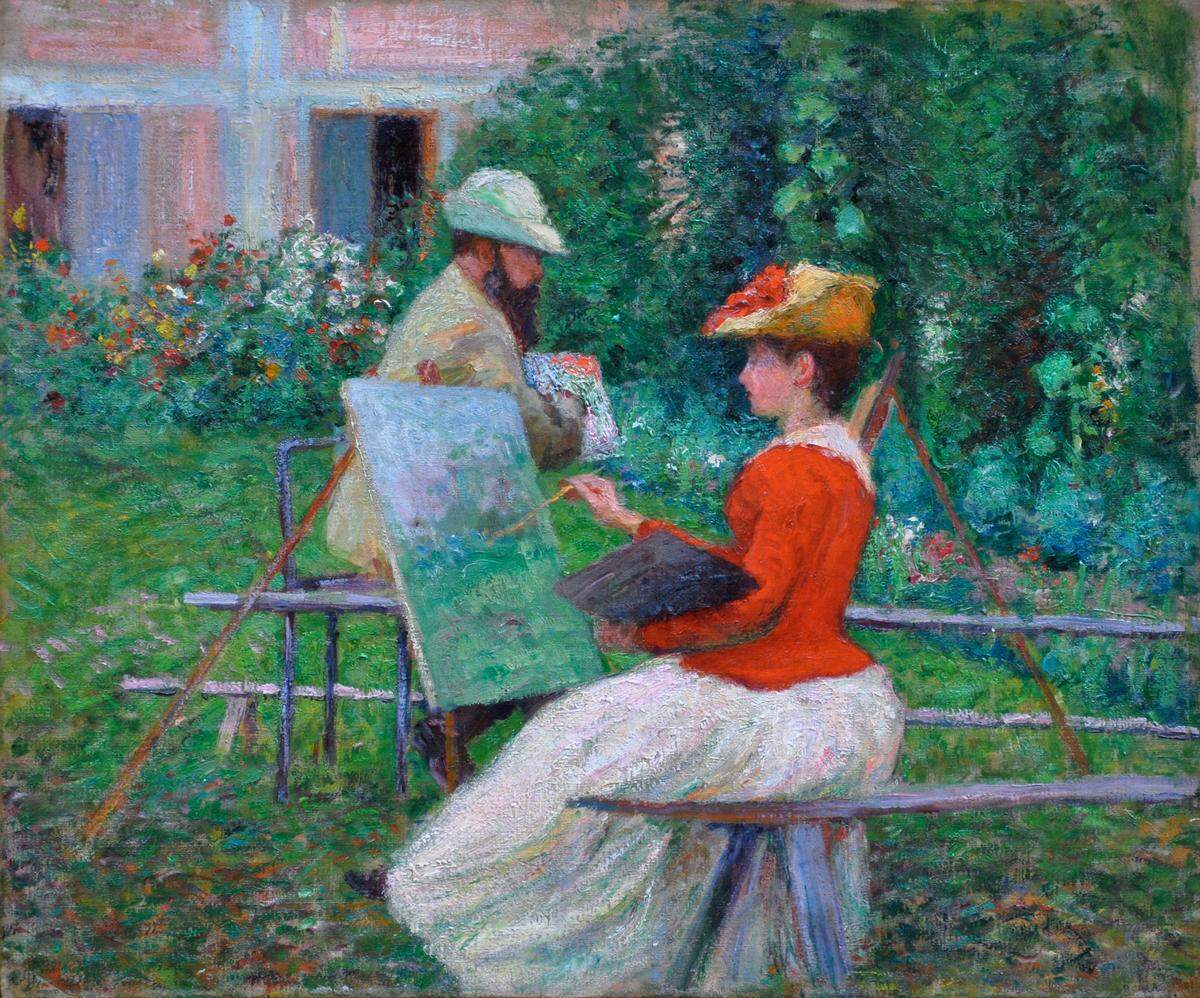
He also “got to hang out with Monet’s stepdaughters,” Stuhlman said. “They would go ice skating and dancing — and he grew close to Monet, too. We have strong evidence that they would paint alongside each other in Monet’s gardens. There’s a Breck painting in the show — ‘Chez M. Monet’ — that depicts Monet at work on a canvas with another one of his stepdaughters, Blanche, working on a painting of her own.”
A stroll through time
The exhibition moves chronologically from when Breck first arrived in Giverny.
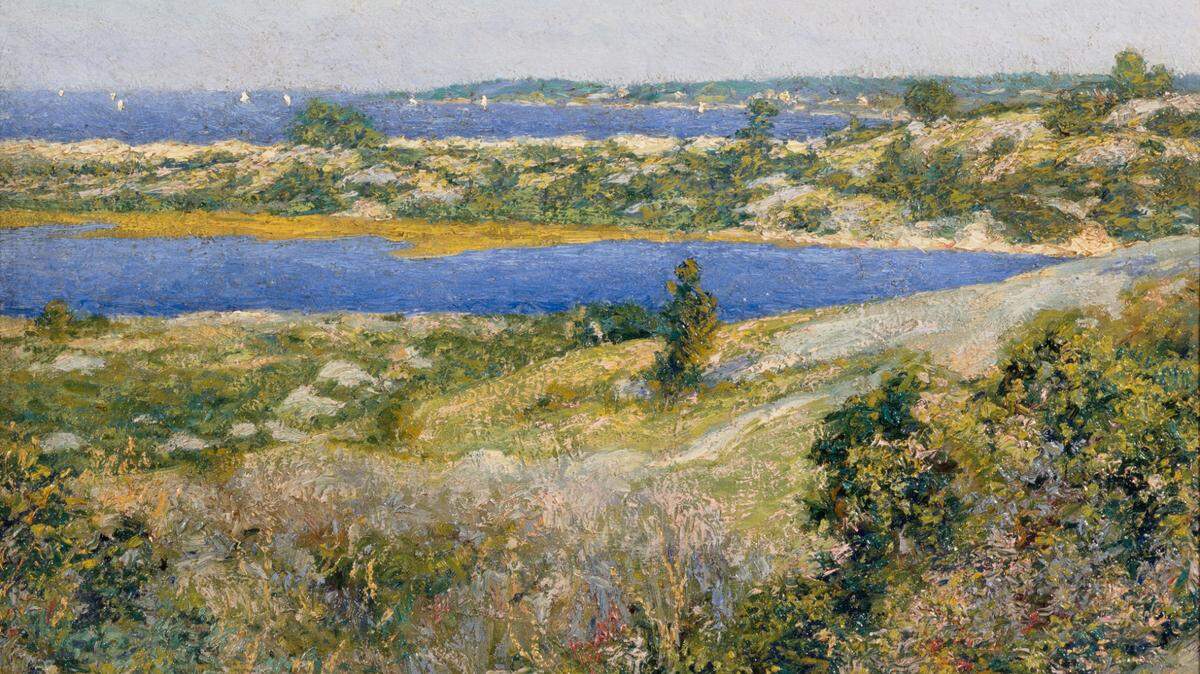
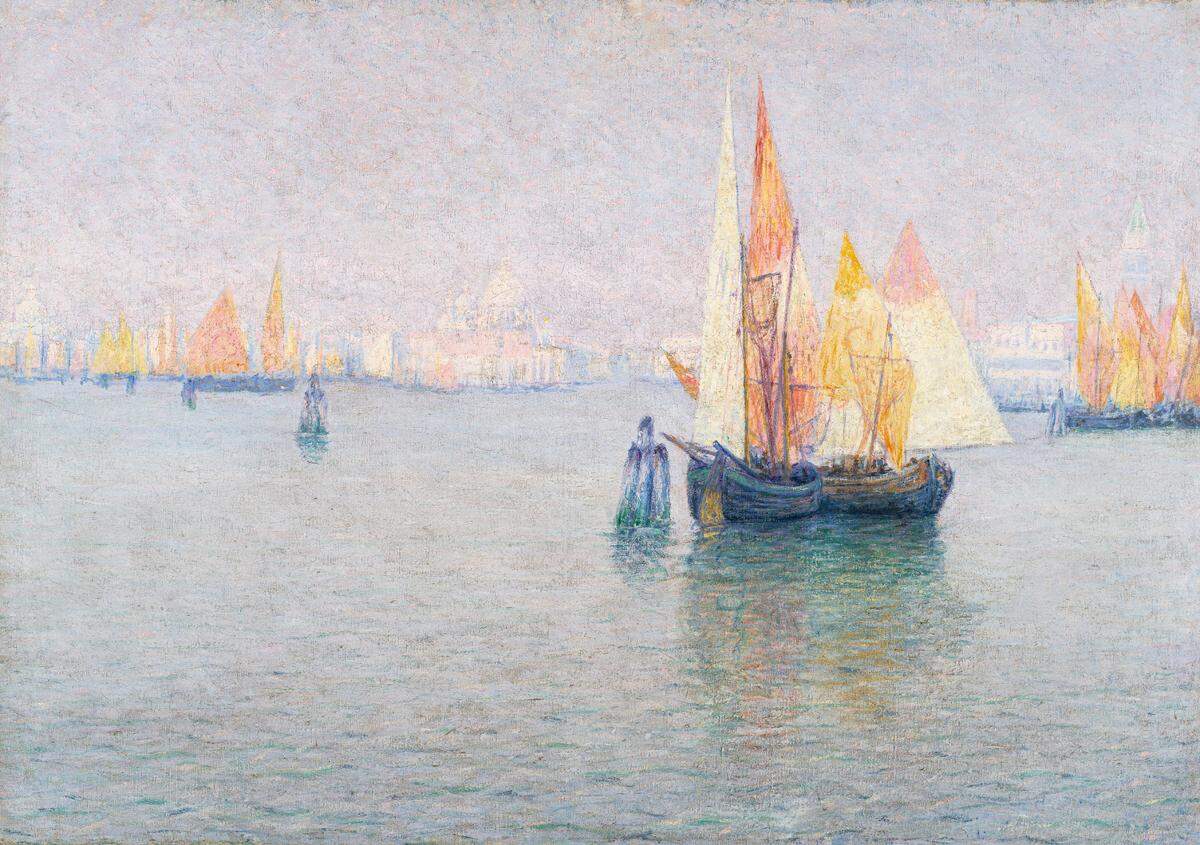
“We bring it back to America and show the paintings he did in the Boston area around the Charles River,” Stuhlman said. “He did a trip to California, and there are three paintings from that period. There’s a little series of central Massachusetts — his family had a place there — a small section from a sojourn with friends to Maine, and his last big trip was to Venice. He made a series of large works toward the end of his career, based on his Venice travel.”
Tim Parati, a local artist and scenic designer, has created scenes on the gallery walls to help provide a sense of place and scale, Stuhlman said. “In some cases, he’s taken some of Breck’s paintings and done outlines of the forms,” Stuhlman said. “It’s very subtle.”
“Tim did the same kind of thing when he worked with us on our Tony DiTerlizzi show ‘Never Abandon Imagination: The Fantastical Art of Tony DiTerlizzi,’” in 2019. “His wall paintings will orient you to where Breck’s works were painted — you’re looking down the street in Germany (where Breck’s European sojourn began), looking at the coast of Massachusetts or a lighthouse there. He painted grain stacks to scale — they’re about 9 feet high.”
Nearly every painting is a landscape. “We’re encouraging people to reflect on their relationship with the landscape,” Stuhlman said.
Although the exhibition was planned long before anyone had heard of COVID-19, what the virus did for the great outdoors is linked to the show.
“Over the past 18 months, we’ve seen a skyrocketing use of parks and outdoor activities,” he said. “People have really been appreciating a break from their houses. We have a big map of different parks and green spaces in Mecklenburg County and are encouraging people to get out and explore.”
“John Leslie Breck: American Impressionist” will be on view at Mint Museum Uptown, 500 S. Tryon St., from Sept. 18 through Jan. 2, 2022. Learn more at mintmuseum.org.
More arts coverage
Want to see more stories like this? You can join our Facebook group, “Inside Charlotte Arts,” at https://www.facebook.com/groups/insidecharlottearts/
This story was originally published August 25, 2021 at 6:30 AM.