
Charlotte strings musicians aim to promote diversity and works by Black composers

Two summers ago, during the uncertainty of the growing COVID-19 pandemic, combined with escalating social and racial tensions, Malik Johnson did what he knows best: He played his violin.
Along with roughly 20 other musicians, Johnson, who teaches elementary music education at Cabarrus Charter Academy in Concord, grabbed his bow and stepped into his frame on the virtual stage.
“We were all looking for an outlet,” Johnson said. “The social injustice, the riots and Covid — everything was so crazy and unsure.”
The group, now called the Charlotte Strings Collective, aims to highlight the work of Black composers and encourage educators to learn about historic and contemporary pieces by those musicians too.
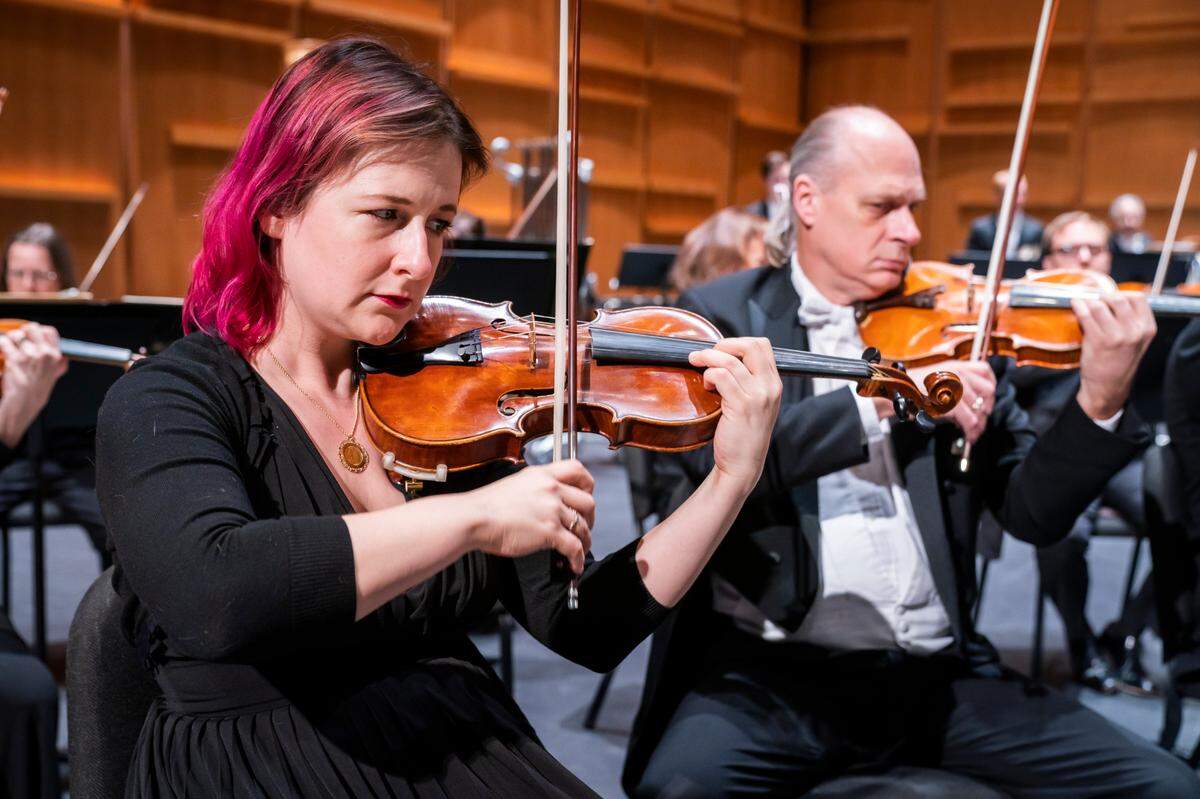
The group is composed of student musicians, faculty and alumni from UNC Charlotte, Winthrop University and Northwest School of the Arts, plus members of the Charlotte and Union Symphonies, Charlotte-area public school music teachers and freelance musicians.
“I needed some way to focus my energy on something positive,” Johnson said. “I’m not the type of person that would want to riot, but I had to do something. I’m glad this turned up.”

Highlighting notes of excellence
Mira Frisch is a cello professor at UNC Charlotte and also a member of the collective.
“In the beginning, we were a group of colleagues and friends and students who wanted to support Charlotte’s Black community, to affirm that Black lives matter,” she said. “We’ve continued to highlight the excellence of these wonderful Black composers in their music.”
In December, the ensemble received $18,000 in funding from UNC Charlotte’s College of Arts + Architecture Research Fund, including a faculty research grant, and support from the Arts & Science Council, among other sources. The $3,000 from ASC supports “String Music by Black Composers,” which includes a public performance, video recording and a national conference presentation.
According to Frisch, funding covers travel costs when the group performs at conferences, but also professional honorariums for each musician.

In the summer of 2020, Johnson and the rest of the group played their first virtual show. They performed “Mother and Child,” a tender movement from William Grant Still’s 1943 Suite for Violin and Piano, which the composer later expanded for string orchestra.
Still, a Mississippi-born composer of more than 200 works, was the first Black composer to have a symphony performed by a professional orchestra in the U.S. He also became the first African American conductor of a major U.S. symphony orchestra, leading the Los Angeles Philharmonic in 1936.
“We thought that recording a piece by a Black composer, this piece in particular would be really fitting for that moment in time,” said violinist Kari Giles, a member of the collective and Assistant Concertmaster for the Charlotte Symphony.
By October 2021, a small group, including Frisch and Johnson, traveled to Rochester, N.Y., for the annual College Music Society National Conference. After performing the works of Still and other underrepresented composers, the members spoke about each work and what it meant for them personally to be there.
The strings group performs works by artists of color like Joseph Bologne, Chevalier de Saint-Georges, a Guadeloupe-born French virtuoso violinist, conductor, and composer of the Classical period; Florence Price, whose Symphony in E Minor was the first composition by a Black woman to be performed by a major orchestra; and Dorothy Rudd Moore.
Performing at UNC Charlotte
On Feb. 8, the collective played at Rowe Recital Hall on the Charlotte campus in collaboration with Assistant Professor of Dance Tamara Williams and her company, Moving Spirits.
One contemporary work on the program, “Ode to Breonna,” composed by Timothy Adams, Jr., pays homage to Breonna Taylor, a Black medical worker who was shot and killed by Louisville, Kentucky, police officers in March 2020 during a botched raid on her apartment.
Other contemporary composers that the ensemble has covered include Atlanta-based Vanessa Fanning and Jessie Montgomery, a New York-based composer-in-residence for the The Sphinx Organization, which supports young string players of color. The collective has also performed hip-hop duo Black Violin’s arrangements for strings.
In March, the group plans to travel Atlanta for the national conference of the American String Teachers Association.
Continuing to promote diversity
Concerts by the collective are part of the group’s larger initiative to address the lack of diversity in classical music, something that has become more and more pertinent in recent years.
For instance, when the Baltimore Symphony was looking at programming numbers in 2015, composers of color and women composers comprised 4.5% of the orchestral repertoire in the U.S., according to Rob Deemer. He’s director of the Institute for Composer Diversity, an organization dedicated to the discovery, study, and performance of music by composers from underrepresented groups.
By 2019, that number had risen to 12%, and in the current 2021-22 season, it’s now at 22%. “I think this bodes well for the diversification of orchestra repertoire moving forward,” Deemer said in an email.
Playing music by one of their own
As an adjunct professor of violin at Winthrop, the CSO’s Giles teaches senior Madison Bush. Bush is a violinist and composer, who joined the collective for the “Mother and Child” performance in 2020.
“As a teacher, you want your students to see themselves, in the music and on the stage,” Giles said. “I always love performing, but it’s really special to me to be able to perform with my students.”

In future concerts, the collective will play Bush’s composition, “Columns,” a piece that Bush described as “a spinning column of lights that gradually spins faster and faster before it dies out.”
“It’s a little scary,” Bush said. “It reminds me of how difficult it is to get this type of music performed, especially if you’re a composer of a certain set of demographics.
“That can be daunting. But there’s also a level of respect that we all have. I like that it acknowledged—how difficult it is to be in this position, as a composer, as a Black person, a person of color, a woman.”
Bush spoke of how much she enjoys working with the strings ensemble.
“They’re adults and very, very talented individuals, which is kind of surreal sometimes, because I’ve only been playing with my peers,” she said. “I’ve never felt like an outsider in that group, which is really important.”
Giles welcomes the diversity, both in the group and for the selections that are used.
“There’s so many voices out there that have created and are continuing to create wonderful music,” Giles said. “Our experience as audience members and players is just getting richer, the more voices we get exposed to.”
More arts coverage
Want to see more stories like this? Sign up for the free “Inside Charlotte Arts” newsletter at charlotteobserver.com/newsletters. You can also join our Facebook group, “Inside Charlotte Arts,” at facebook.com/groups/insidecharlottearts.
This story was originally published February 24, 2022 at 6:00 AM.