
Charlotte dance professor revives and revitalizes the steps of a Korean trailblazer
Kim Jones is on a quest to uncover some lost art — of dance.
The latest efforts by the UNC Charlotte associate professor of dance involve reconstructing and reimagining choreography of Choi Seung Hee, Korea’s first female modern dancer.
A former dancer with the Martha Graham Dance Company, Jones has gained acclaim for reconstructing and reimagining choreography by some of the great icons of American modern dance, including works by Martha Graham and Paul Taylor.
Choi (1911-1969) toured widely through the United States and Europe during the 1930s, garnering fans including Charlie Chaplin and Pablo Picasso. But she also became a controversial figure at home.
Because Choi rose to prominence in Japanese-occupied Korea, a regime which repressed Korean culture, and she eventually moved to North Korea, many of her contemporaries considered her a traitor. That left her legacy to fade.
“What I’m doing is adding Choi Seung Hee to the canon of history that’s been erased in modern dance,” Jones said. She will be presenting the most recent draft of her choreography, inspired by Choi, at the UNC Charlotte Faculty Dance Concert Jan. 28.
The concert is open to the public. Jones has partnered with several Korean-born artists on the project, who will help bring it to life for local audiences.
The work, “자유 Dance for Freedom: Re-imagining the Dances of Choi Seung Hee (1930’s),” will be performed by Martha Graham Dance Company dancer So Young An, with music composed and performed by Vong Pak, and an original film by HaeJin Han.
Who was Choi Seung Hee?
Choi, who was born in Seoul, worked as an artist during a tumultuous time in Korea’s history.
She lived through the Japanese occupation, WWII and a civil war. Korea was divided into North and South in 1948.
The contours of Choi’s life story are fascinating and tragic. She ended up in North Korea, like many other artists, Jones said, where work was available: “It’s not black and white on politics and the arts and families.”
KBS, South Korea’s public service station, said Choi eventually fell out of favor with the North Korean government, noting, “Her husband was executed by the North Korean regime in 1958 and she is also said to have suffered the same fate in 1967.”
The Korean Herald newspaper said Choi was purged in 1967, disappearing from public view: “It was only in 2003 that Pyongyang made an official announcement that the dancer had died in 1969.”
But in the early part of her life, Choi established links with important artists of her day. She studied with the celebrated Japanese modern dancer Ishii Baku. He had been a student of the German artist Mary Wigman, an influential choreographer and pioneer in expressionist dancing.
Although Choi was a Japanese-sponsored artist during the imperialist era, Jones said her work helped preserve Korean history. She visited Korean villages to learn dances, which she modernized and performed around the country.
It’s thanks to Choi’s work, Jones said, that these dances didn’t completely disappear.
Personal connections to Choi’s work
Jones, who grew up in a diverse, working class neighborhood in Queens, New York, loves history and learning other people’s stories.
“I always thought I would be an archaeologist or an anthropologist, as a child,” she said.
But studying Choi is not only of academic or artistic interest for her. It’s also personal — Jones’ mother comes from Korea.
“When my mother was born, the entire country was annexed and occupied,” Jones said. “So my grandmother, my uncles, my aunts all were under the Japanese occupation.”
By law, they had to take Japanese names, learn the Japanese language at school and only speak Japanese in public. “If they were caught speaking or singing Korean songs, they literally would get beaten,” Jones said.
Through her ongoing research, Jones has been able to learn more about her own cultural heritage.
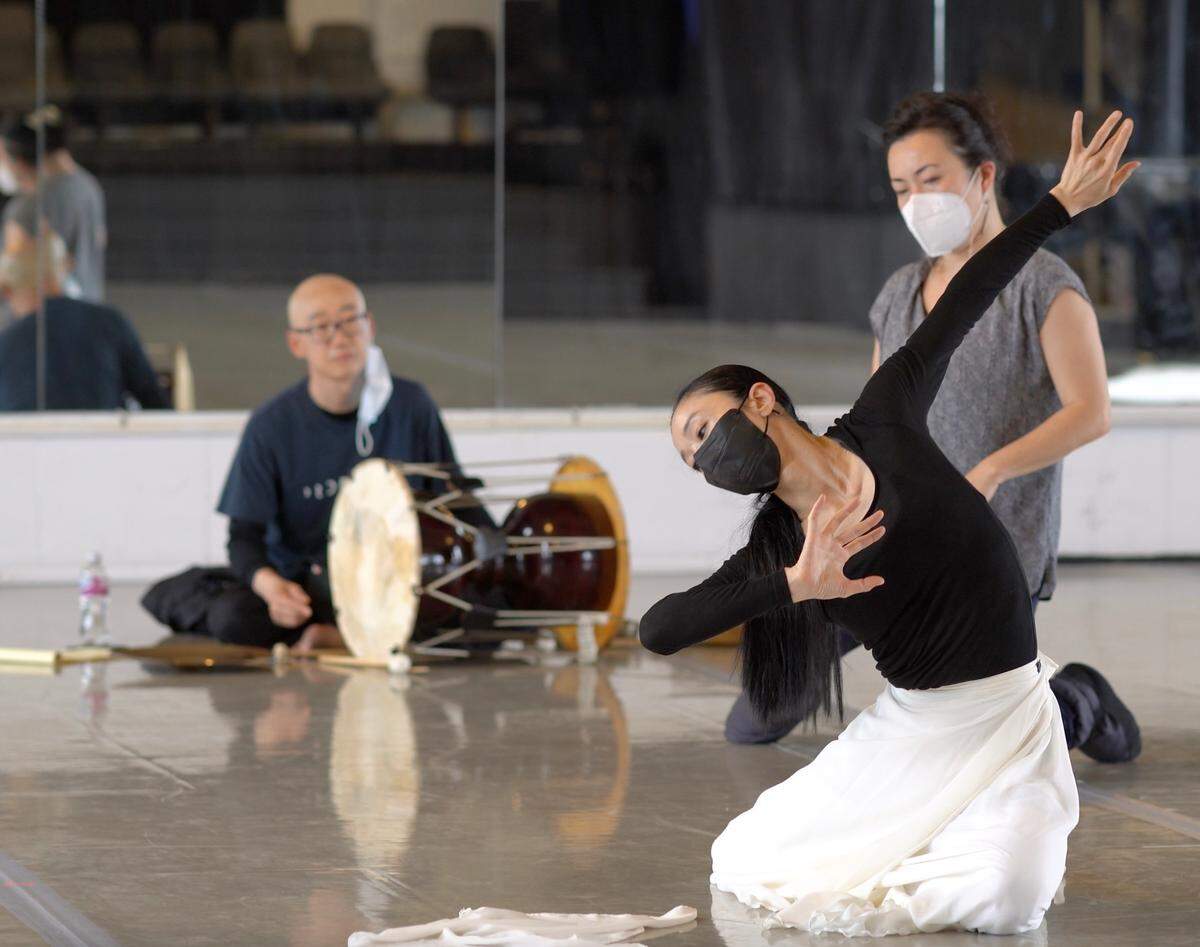
That work took her last May to a New York City dance studio along with several other artists.
About 50 copied pages of memorabilia related to Choi — including photos, reviews and programs — littered the floor, to serve as inspiration for Jones and the other artists. They moved through the space, reading and contemplating artifacts gathered through Jones’ years of ongoing research.
Researching and reimagining
Jones isn’t trying to recreate Choi’s dances the same way she did them. “Dance is ephemeral.” she said. “It’s fleeting. It’s in the moment.”
But the research provides inspiration. Reconstructing works also has allowed Jones to continue “wandering” — something she feared she’d left behind when she transitioned to academia.
Jones credits two former dance students, Lillian Willis and Tracy Heim, who served as UNC Charlotte research scholars in the summers of 2016 and 2017, with helping her get the project started. Since then, Jones has sifted through archives at libraries around the U.S. in search of artifacts to help piece together Choi’s life and work.
Most recently, she spent three weeks last summer at Chicago’s Newberry Library, through a National Endowment for the Humanities fellowship program, called “Making Modernism: Literature, Dance, and Visual Culture in Chicago, 1893-1955.” There, Jones was able to explore the library’s rich archives.
Some of her favorite findings: a studio photo of Choi in costume, with a sword in each hand (which will be used in the upcoming performance) and a diary belonging to someone who saw Choi perform several times and described her work in detail.
“Part of reimagining is going back to the space of wandering in timelines, in history with bodies and people of the past, dead or alive,” Jones said.
Changes in plans
In April 2020, Jones had planned to travel to Seoul, South Korea, with support from a faculty research grant, to interview a former student of Choi’s. The woman, Kim Yeong-Sun, now in her late 80s, is a North Korean refugee.
But the COVID pandemic derailed Jones’ travel plans.
Unsure of when her next opportunity to travel might be, Jones was thrilled to discover two Korean-born, New York-based artists she knew would be in Seoul that December 2020.
She was able to redirect her grant so stage manager Haejin Han and dancer So Young An, along with a team of videographers, could spend three days interviewing and dancing with Kim Yeong-Sun. Jones connected to each of their rehearsals via Zoom.
Both artists continue to be part of the project. The recordings of those sessions have not only have been useful for understanding nuances of choreography and culture but also in creating the music.
Jones said when composer Vong Pak heard Kim singing in the video, he recognized it as an old sound that he wanted to incorporate in the piece.
“My artistic roots are in traditional Korean music and dance,” Pak said in an email interview. “When we first developed this production, Kim (Jones) brought many research sources, including Kim (Yeong-Sun’s) video. All those material, eg. pictures, articles, Korean history, gave me inspiration.”
Collaboration is key
Jones said that input from her team of artists inspires her, too. They have enriched the project through their contributions and lived experience as Korean-born artists.
“There’s something to be said when seasoned artists come into a room together and create,” she said. “There are definitely ‘aha moments’ that are noted. There’s a respect in the room. Listening and sharing is important.”
Last summer, Jones and Pak performed another segment of her work-in-progress at the Danza in Arte a Pietrasanta Festival in Italy. She also recently received an Arts & Science Council grant to support her ongoing research and rehearsals.
Jones doesn’t know exactly what the final result of her work will be but she’s comfortable with that.
“It’s funny because you go in thinking it’s one thing and then it turns out to be another thing,” she said. “That has been a challenge in academia for me because I’m an artist... I don’t live in very strict boundaries, generally.
“I’m a creative thinker and I’m OK not having the answers to things. I allow things to happen. And because I feel very secure in that, I watch things unfold.”
Want to go?
Kim Jones’ recreation of Choi Seung Hee’s choreography will be part of a performance at the Faculty Dance Concert at UNC Charlotte.
The performance is open to the public: Saturday, Jan. 28, at 7:30 p.m. in Anne R. Belk Theater at Robinson Hall.
For tickets and more information: coaa.charlotte.edu/events/2023-faculty-dance-concert
More arts coverage
Want to see more stories like this? Sign up here for our free “Inside Charlotte Arts” newsletter: charlotteobserver.com/newsletters. You can join our Facebook group, “Inside Charlotte Arts,” by going here: facebook.com/groups/insidecharlottearts. And all of our 2022-23 Fall Arts Guide stories are here: charlotteobserver.com/topics/charlotte-fall-arts-guide
This story was originally published January 19, 2023 at 6:00 AM.