‘I was getting lazy,’ Charlotte reporter says. So, at 31, she’s off to Army boot camp.
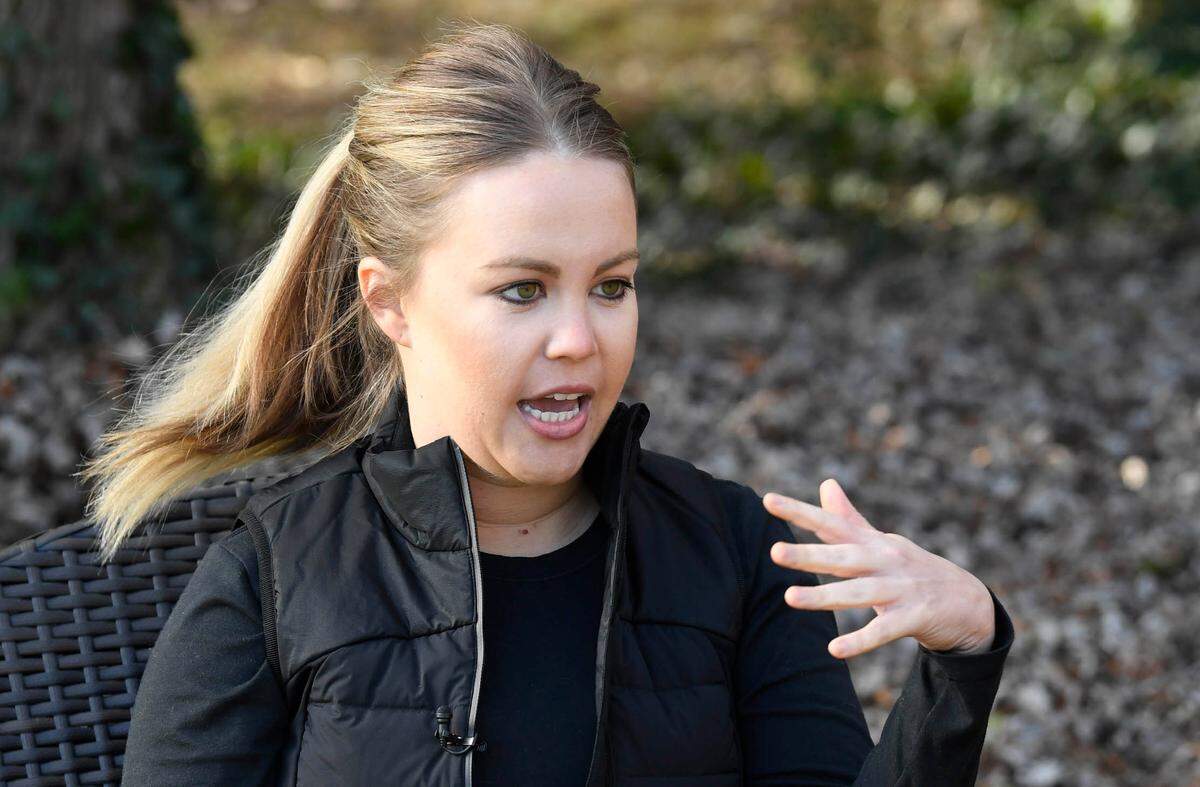
Even now — closing in on a year after the idea first popped into her head and more than two months since it became official — there’s a part of Sarah Blake Morgan that still can’t believe this is happening.
Can’t believe she’ll be spending a full six months away from her job as a reporter with the Associated Press in Charlotte, where she originally made a name for herself as a reporter for WBTV News.
Can’t believe she’s about to trade waking up next to her husband, WBTV reporter Nick Ochsner, and their two dogs in their cozy home in the Sedgefield neighborhood for waking up in a barracks on a U.S. Army base 800 miles away with a bunch of future soldiers more than a decade her junior.
But there’s no turning back now for the 31-year-old journalist, who March 15 will report to basic training at Fort Leonard Wood in Missouri, followed by Officer Candidate School at Fort Benning in Georgia. If all goes according to plan, when Morgan returns to work at the AP in September, she’ll do so as a second lieutenant in the Army Reserve.
“There are many nights that I’ll just wake up at 2 in the morning and just stare up at the ceiling, like what have I done?” Morgan says. “But at the same time, I know I have to. I —”
She pauses for a second, her eyes welling up with tears.
“I’m at this point — sorry,” she says, as her voice breaks, “I’m at this point in my life where I have to do something drastic. That gives me a greater purpose and a greater meaning, and kicks my tail in gear. Or I keep living in this kind of state of mediocrity. And that’s what I feel like: I’ve been kind of treading water and doing blah for a couple years now. And I don’t want to do that. I don’t want to look back with regret.”
‘What the heck did I just do?’
Morgan insists that enlisting in the military had never crossed her mind prior to 2020.
The wheels were set in motion last January, she says, when she suddenly started regularly covering stories related to Fort Bragg as members of the 82nd Airborne Division’s Immediate Response Force were being deployed to the Middle East amid rising tensions with Iran.
A few weeks later, on Jan. 23 — which, coincidentally, marked her eight-year anniversary in journalism — she got the opportunity to embed with 75 paratroopers from the same division during a weeklong training exercise at Colombia’s Tolemaida Air Base.
There was only one other woman on the mission: Sara Sanders, a medical sergeant. Upon arrival in South America, Morgan says, “One of her (Sanders’) superiors said, ‘OK, the women are in a barracks over here’ and she piped up and said, ‘Uh, sir, I want to stay with my men.’ And because I, you know, always have to prove myself, I said, ‘Well, if she’s staying here, I’m staying here, too.’ And then I instantly was like, What the heck did I just volunteer to do?
But, she adds, “I just had the time of my life ... being amongst that camaraderie. I don’t know what it was about it that hooked me in.”
.jpeg "Image (8).jpeg")
Of course, it should be noted that a number of other significant factors and influences in Morgan’s life laid a lot of the groundwork for all of this.
Her maternal grandfather, Hugh E. Quigley, was an Army colonel who fought in World War II, Korea and Vietnam.
Her mother, Brigid Morgan (who raised Sarah Blake alone after her husband died in a plane crash when she was pregnant), worked as a physician’s assistant at a VA hospital for most of Sarah’s childhood; then, at 57, Brigid took a bold leap of her own by taking a job as a diplomat with the U.S. State Department; she now works as a medical officer at the U.S. Embassy in Kabul, Afghanistan.
The father-in-law she never knew, Jim Ochsner, was a Green Beret out of Fort Bragg who was killed in 2005 by a roadside bomb that exploded near his Humvee while serving his fourth tour in Afghanistan.
And Sarah Blake Morgan didn’t exactly luck into that Colombia trip. She’s always wanted to be a war correspondent, and from the moment she landed her first job, at KCBD-TV in Lubbock, Texas, she’s never stopped pitching stories about or related to the military.
So a little bit of each of those things in her DNA crystallized over the course of her week in Colombia.
The day after she returned to Charlotte, she was on a plane to Des Moines to cover the Iowa Caucus, and recalls being “super bummed the entire time.” She says she spent most of the trip daydreaming about Colombia.
Her husband, Nick Ochsner, remembers having doubts when she first broached the idea with him.
“I could tell she enjoyed being down in Colombia and wanted to be supportive,” he recalls, “but also was skeptical of whether or not she would go through that. Just, that’s a big thing to do at 30.”
But two weeks later, she walked into an Army recruiting office.
Getting the ball rolling
In talking about what got her in there that day, Morgan mentions that desire to keep chasing the sense of camaraderie she formed with the men of the 82nd.
But she also tries to explain what she describes as a “hole” that she had been sinking into for some time.
“I’m huge on comparing myself to people around me, and I would see friends that would make it to the network ... or I thought I would be reporting in Syria by now, and I’m not,” she says.
.jpeg "Image (4).jpeg")
“Especially as a journalist, my identity was so rooted in my work, and I had felt like for a long time that I just wasn’t doing great work. I felt like I was getting lazy, and anybody who worked with me at WBTV would have said that’s not me, that I was always churning out quality pieces. But I hadn’t done that in awhile. ...
“So I thought this would be the ultimate challenge. The ultimate way of pushing me out of my comfort zone.”
Her initial meeting with a recruiter, though, was a bit of a bust.
Morgan says she went there straight from work, still wearing her blazer, and that the man she met with wasn’t impressed.
The read she got some him, she says, “was just like, ‘OK, you know, you seem older, you seem a little prissy. You’re dressed nice. You have makeup on. Eh.’ ... He kind of blew me off. Just told me that Officer Candidate School is near-impossible to get into. I walked out of there with his card, but didn’t think that that was gonna go anywhere.”
At the same time, she wasn’t ready to take no for an answer.
So she texted some of her military contacts, and — long story short — she was connected to a recruiter who was much more encouraging.
Though the country came to a standstill in early spring due to COVID-19, she was able to get the ball rolling toward enlistment. And when she scheduled her physical a few months later, her husband abandoned his doubts. “Alright, I guess this is happening,” Ochsner remembers thinking. “She’s real serious about it.”
Says Morgan: “I think when I started the process of applying — since it was such a lengthy process — I thought, well, let’s see where this goes. I’m a big believer in signs and that your steps are ordered, and I thought if something else career-wise or whatever comes up, then that would be my sign that I wasn’t supposed to go through with this. Or I wouldn’t pass my physical, or I wouldn’t get in to OCS.” (The latter was important to her because she felt it made more sense due to her being older.)
“But I kept getting through each step.”
It culminated at the end of October, when she found herself standing in a room at the Charlotte Military Entrance Processing Station in the Whitehall Corporate Center with a handful of teenage boys, raising her right hand and reciting the oath of enlistment for the Army.
.jpeg "Image (12).jpeg")
‘This is my chance to serve’
Being apart for six months actually is not a new concept for Morgan and her husband. They spent the first half-year of their marriage in different states — she in Charlotte and he at WVEC-TV in Norfolk, Virginia — before WBTV hired him, too.
On top of that, since Ochsner was raised as an Army brat and was used to his dad being off in the Middle East for long periods of time, the prospect of his wife being away for military duty doesn’t seem like a big deal to him. (The couple does not have any children.)
As for what her specific duty is: Morgan has signed up for the Army Reserve, which — like the National Guard — is a reserve force of the Army that allows people like her to continue to work civilian jobs in their chosen profession while living anywhere in the country they choose.
Both the National Guard and the Army Reserve can be called into full-time service to support Army combat missions. The main difference is that Guard members can be called on by their state governor or the federal government, while reservists do not have a state mission and, for example, cannot be called to respond to hurricanes and floods.
Army reservists train one weekend per month and two weeks every summer, and receive drill pay as they fulfill those commitments (the same is true for the Guard). In Morgan’s case, she’s being assigned to Fort Jackson on the edge of Columbia, South Carolina, where the plan is for her to be part of a civil affairs brigade.
Although there is a possibility that she could be deployed during her six-year service contract, if it happened, she wouldn’t wind up on the front lines. Instead, the idea is that she would work as part of a unit whose members would be liaisons between military commanders and U.S. ambassadors and locals in foreign countries.
However, when she reports to Fort Leonard Wood in mid-March, she’ll be thrown into basic training for 10 weeks with the general population of fresh Army recruits. Nope, there isn’t a special boot camp just for Army reservists.
It’s the thing that most keeps her up in the middle of the night.
“That’s a great question,” Morgan says, when asked whether there’s a part of her that secretly sort of wishes she hadn’t made it all the way through the long process for enlistment. “But, yeah, I probably wouldn’t have been so disappointed if I would have been disqualified for something physical or — I don’t know,” she says, interrupting herself and sighing.
“Someone asked me recently, ‘Are you excited?’ And excitement isn’t the word,” she says, laughing. “There is a bit of dread. There’s a lot of dread. Because I have a very comfortable life. I have very little structure. My husband and I ... we have a nice life. We’re very comfortable. And I’m giving that up for the ultimate amount of structure, with no phone ... with a bunch of 18- to 20-year-olds. So that is terrifying to me.”
.jpeg "Image (3).jpeg")
Meanwhile, Morgan is doing the best she can, physically, to get ready for basic — she says she wasn’t in shape prior to enlisting but has since taken up running and started working with a personal trainer; and she is staying positive by keeping focused on the idea that, when she returns in September to her job at the AP (which she describes as having been “incredibly supportive”), she’ll be reinvigorated.
“It’s going to be a struggle. I know it’s gonna be a struggle. Someone told me that I’ll probably cry myself to sleep the first couple weeks,” she says. “But ... like I said, I need a challenge. I need to do something hard. I need a greater purpose. ... This is my chance to serve my country. And, yes, it’s a country that has many, many, many faults.
“We saw that, obviously, in Washington,” she says, referring to the breaching of the U.S. Capitol last Wednesday by pro-Trump supporters, and specifically to the ones who stole and destroyed Associated Press television equipment outside of the building. “We saw it all of last year.”
“But it’s still a country,” Morgan says, “that we’re very blessed to live in.”
“That’s what my mom and my husband’s family’s sacrifice has given me: belief in our country, and I think if you can (serve), if you have the desire, go for it.”
Morgan, by the way, will turn 32 on June 2. The age limit for someone wanting to enlist in the Army Reserve with no prior active-duty military experience? It’s 34.
This story was originally published January 12, 2021 at 6:30 AM.