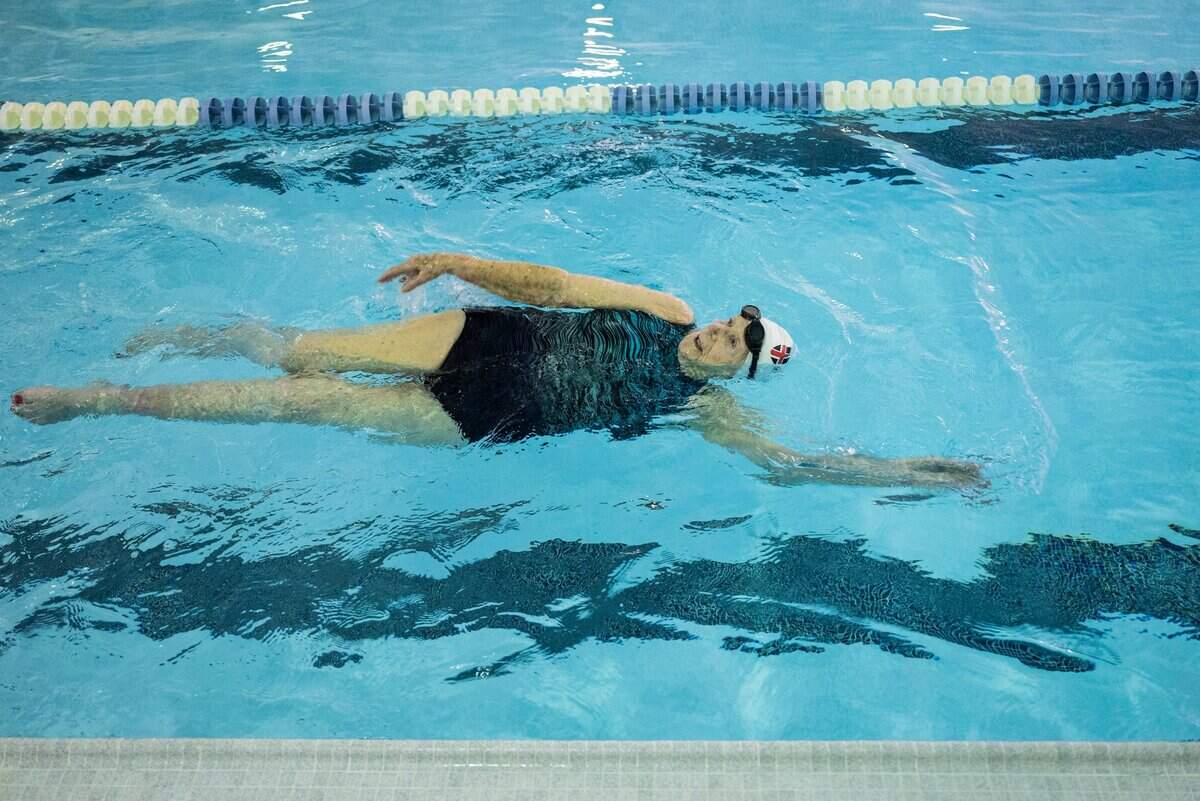
At 97, this NC woman is swimming at the Senior Games. Is that inspirational? She says ‘no.’
Joan Wayne is sitting in her apartment at the Brookdale Charlotte East senior living facility with a scornful look on her face, the type a person’s might contort into if you tried to tell them the sun was going to rise in the west and set in the east tomorrow.
Except, in this case, she’s simply reacting to a suggestion that she could be described as ...
“Inspirational? No, I don’t think of me being inspirational,” says the 97-year-old mother of three/grandmother of five/great-grandmother of two, in her light British accent, with a dismissive laugh. “My children don’t think I’m inspirational. They’ve never mentioned it if they did.”
Ask anyone she regularly comes into contact with during her thrice-weekly visits to the pool at Charlotte’s Simmons YMCA, though, and they’ll gladly tell the types of things Wayne claims her children are withholding from her.
Or, consider this: Wayne is registered this weekend to compete at the 50-meter and 100-meter distances in the breaststroke, the backstroke and the freestyle at the 2022 National Senior Games in Fort Lauderdale, Florida. A veteran of several Senior Games since they were founded in 1987, she is making her first appearance at them in five years. Depending on which of her six events you’re talking about, at most there are just three other women in her age group; in three events, her competition includes only one. In other words, she is guaranteed to come home with a medal.
Yet she won’t give an inch on the whole “i” word thing.
“You think I am?” asks Wayne, as she shoots a slightly bewildered look at two visitors in her living room. Both give firm nods. She scoffs again. “Is it because I’m still active a little bit for my age?”
And we have to admit, it is.
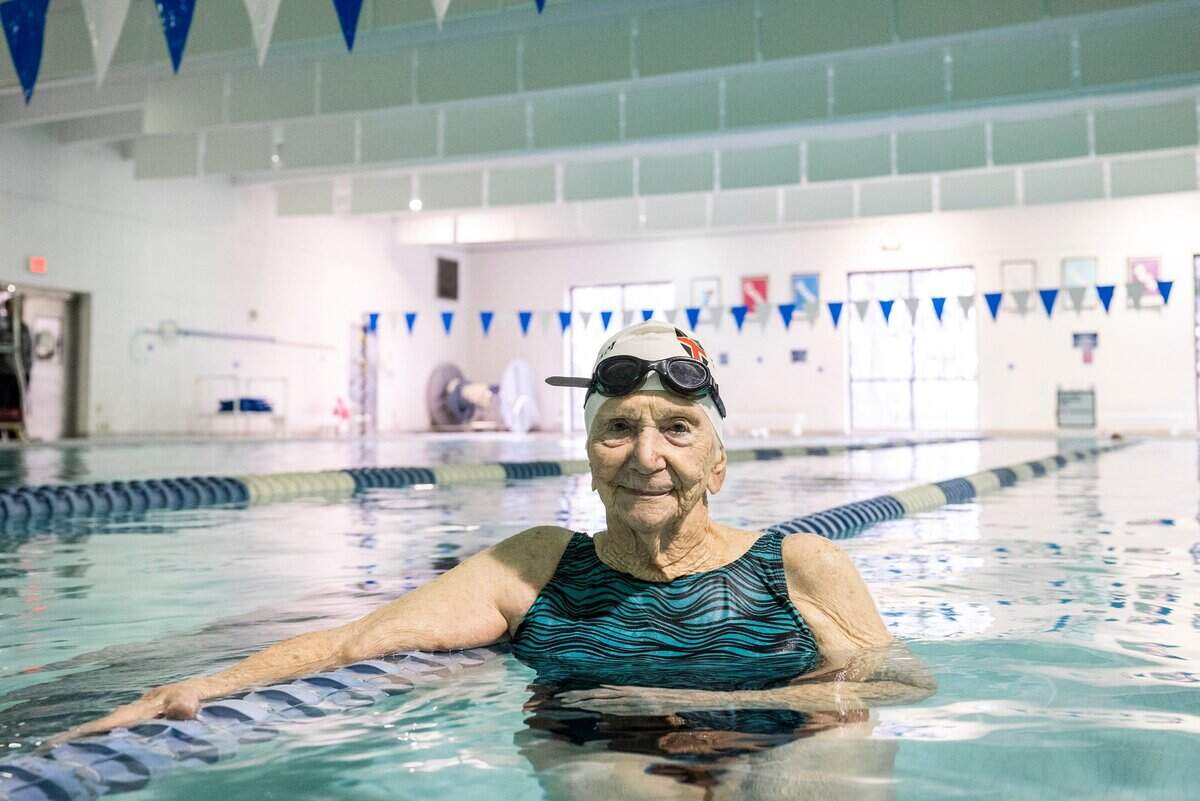
An overachiever at 97 years old
There’s little doubt that we, as a society, tend to condescend to people Wayne’s age by perceiving them as not being able to do much beyond move from a bed to a chair to watch TV to a table for a mealtime and back to bed — then reacting with astonishment upon hearing about an older person who can do more.
But think about all the 97-year-olds in your life for a second. Are there any? If so, now imagine them saying things like this:
- “The other day, I had to get this valance down from above the window. I got it down (with a grabber tool) to wash it. But I thought, How am I ever going to get it back up? Well, I pushed these two chairs right in front of the window, then I stood on a stool between them. That way, if I was to start to fall, I’d have those two chairs that I could lean on.”
- “I do still drive. To the grocery store, to my doctor. I can drive myself over to the Y. But I don’t. I take the bus (a shuttle provided by the Brookdale). Because I’m so afraid they’ll stop the bus from going if people don’t use it. There were only three this morning. If they stop the bus, then when it gets to where I can’t drive, I wouldn’t have a way to go. So I try to support the bus.”
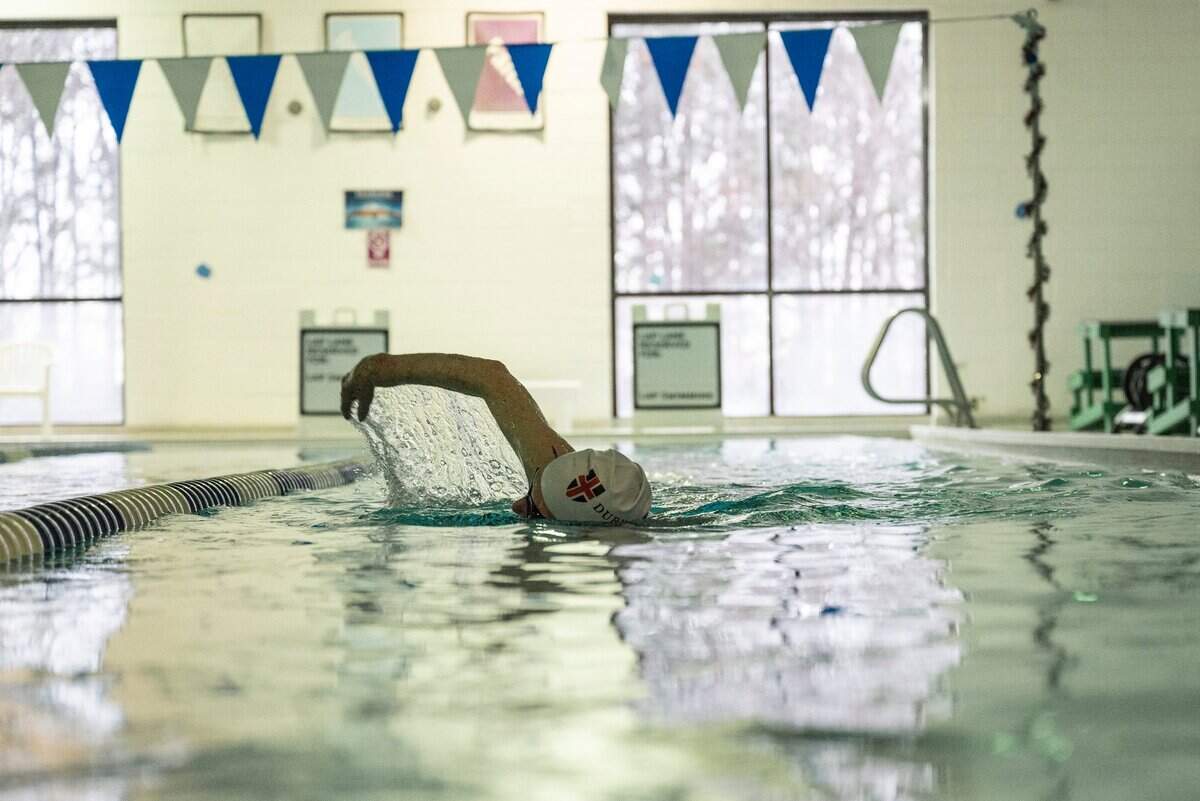
- “When I get into the pool, first I warm up. Then I usually start out doing 50s (50-yard intervals, or two lengths of the Y pool). A 50 back, 50 free, 50 breast. Then I do a few exercises. I always lift the water with my hands. Then one that’s very good for your shoulders, where you just put your chest out, put your shoulders back. Then I kick in the deep end. So I do those three exercises, and then I switch to 100s. 100 back, 100 free, 100 breast. My goal is to do about 900 every time I go.”
Wayne typically goes to the Y three times a week. And it seems safe to say that that’s three times more than the average 97-year-old goes and swims at the Y every week.
In fact, Bette Miller, aquatics director at the Simmons YMCA, believes Wayne might be the branch’s oldest regular. “There’s another person with her same birthday that still has an active membership,” Miller says, “but we haven’t seen her in the branch since maybe 2011. So she’s just supporting us with her monthly check,” and not actually coming in to work out.
As such, Wayne is something of a celebrity at Simmons Y — all because she just keeps swimming.
The evolution of her love for swimming
To some extent, it’s in her genes.
Her uncle and her father, she explains, were very good swimmers, and any conversation about swimming and her father — who died five months after she was born in Great Britain — leads to the story about how he once saved a teenage boy from drowning. (If she’s in her apartment when she tells it, she’ll even pull out the medal he was awarded by the Carnegie Hero Fund for his bravery.)
Wayne learned to swim when she was 4 years old, eventually doing so competitively for the Durham City swim club out of a facility in Durham, England, managed by her grandfather. But at age 10 she was sent off to a boarding school that had no pool.
For the rest of her childhood and throughout her service in the signal corps for the British Army, swimming was barely a part of her life at all. Not until after the war ended, when she came to the U.S. with an American signal corpsman she’d married, that she found an excuse to regularly get back into the water again.
They initially settled in East Lansing, Michigan, where her new husband, Burton, was working on his Ph.D., and it was there that Joan Wayne answered a newspaper ad seeking volunteers to teach troubled kids how to swim.
Then, after Burton got hired at UNC Charlotte and they moved South in 1964, when she was just shy of 40, her second life took off.
First, Joan volunteered as a swim teacher at various YMCAs, to keep herself busy while her own children were in school. Later, she joined an effort to raise money to have a pool built in east Charlotte’s Shannon Park neighborhood. After the campaign succeeded, she was tapped to give lessons to kids and started a summer youth swimming program. Before long, she decided to put together a swim team, and then swim teams plural, and then she formed a swim league; she and her husband wound up being the leaders of the swim club at Shannon Park for more than two decades.
In the meantime, Wayne was gradually doing more and more swimming herself.
“I just have always enjoyed it,” she says. “When I get in the water, I just felt like your mind goes clearer, your body feels good, and you just feel good, and that good feeling stays with you for most of the day. The next day you may be back and things are bothering you, but for that period of time, you are so relaxed and you feel so good.”
Then, in the early ’80s, a member of Wayne’s bridge club mentioned she was leading an effort to get UNC Charlotte to host the inaugural North Carolina Senior Games, and that she wanted Wayne to participate if it came together. When it ultimately did — in 1983, not long after her 58th birthday — she was there.
“That’s how I got swimming again,” Wayne says. “Really, really swimming. Me swimming, not helping kids swim. ... I think it was more the challenge to myself.”
“And I hate to say it, but I most always won,” she continues. “Perhaps I might have felt different (about competing) if I hadn’t done that. I don’t know. But if I won and my time was terrible, I felt awful. I had to improve my time even it was only by a second. So I think I was more interested in the time and to see what I could do. If I could do better.”
It came as little surprise, then, that she eventually wound up at the first National Senior Games in St. Louis in 1987, when she dominated the women’s 60-64 age group on her way to winning nine medals (including five firsts) and laughing at comedian Bob Hope as he emceed the closing ceremony.
The National Games have been held every two years since. Although she hasn’t been since 2017 — she skipped 2019 for personal reasons and then 2021 was canceled due to COVID — Wayne has attended them more often than she hasn’t.
To date, she holds a number of Games age group records, including the fastest 85-and-older time ever in the 50-meter breaststroke (1 minute, 1.46 seconds) and 100-meter breaststroke (2 minutes, 0.01 seconds).
‘We all want to be like her’
On the day back in December when we first met Wayne, while she swam back and forth in the water at Simmons YMCA, bystanders and acquaintances on the pool deck raved about her up and down.
“She’s the envy of everybody,” says Barbara Kalinski, another member, who was waiting her turn to swim. “Everyone in the locker room is like, ‘We all want to be like her when we grow up.’”
“She’s amazing,” adds Katherine Kendrick, 88, who has just finished a water aerobics class. “I pray and hope I can get to be her age.”
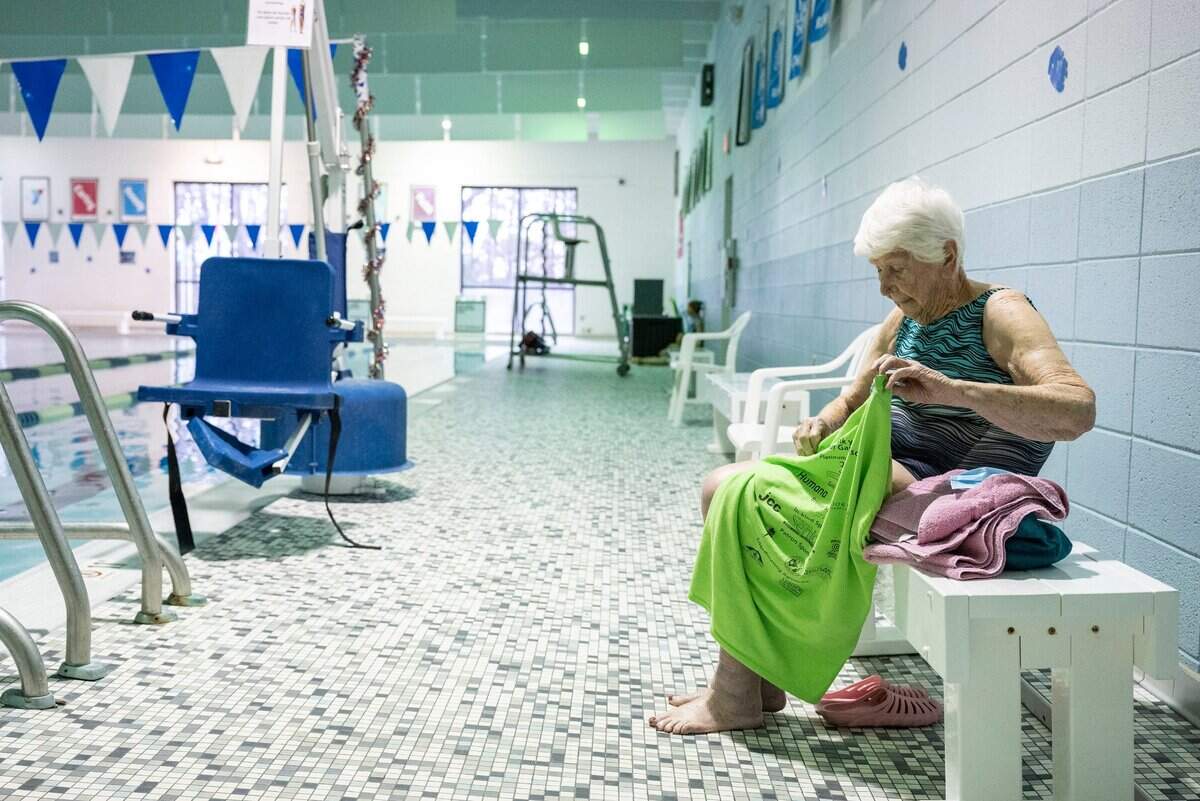
And as Miller, the branch’s aquatics director, points out: “She usually uses the regular ladder to get in. She doesn’t crawl in there,” she says, gesturing to the end where gentle steps lead down into the water, “and go over. It’s very —” uh-oh, here comes that word again “— inspirational to me.”
Back in her apartment, Wayne laughs when she hears these compliments repeated to her, almost sounding slightly put off. For the umpteenth time, she says she doesn’t think she’s inspirational.
But in the next breath, she says something to offer clear proof that she is.
“I just do it,” Wayne says. “I asked my doctor, ‘Do you think I’d be better with a walker?’ He said, ‘Well, it’s up to you.’ So I don’t. Now, I have thought, ‘Well, perhaps I’m foolish. Perhaps if I have a walker, walking would be easier.’ But on the other hand, I feel if I do that, then I’ll start doing something else that makes things easier, and I think you fall into a trap of not making yourself active and not making yourself do things.”
She pauses, before adding the most inspirational kicker she possibly could.
“If anybody says, ‘Would you like to do this?’ You should always do it. That’s my advice to you. At the time, you might think, ‘Oh, I really don’t want to.’ But you may never get another opportunity. And once you start doing it — whatever it is, to go a place or to do a thing — who knows?
“You might enjoy it.”