Jimmy Carter once helped build 14 houses in Charlotte, laying the foundation for a legacy
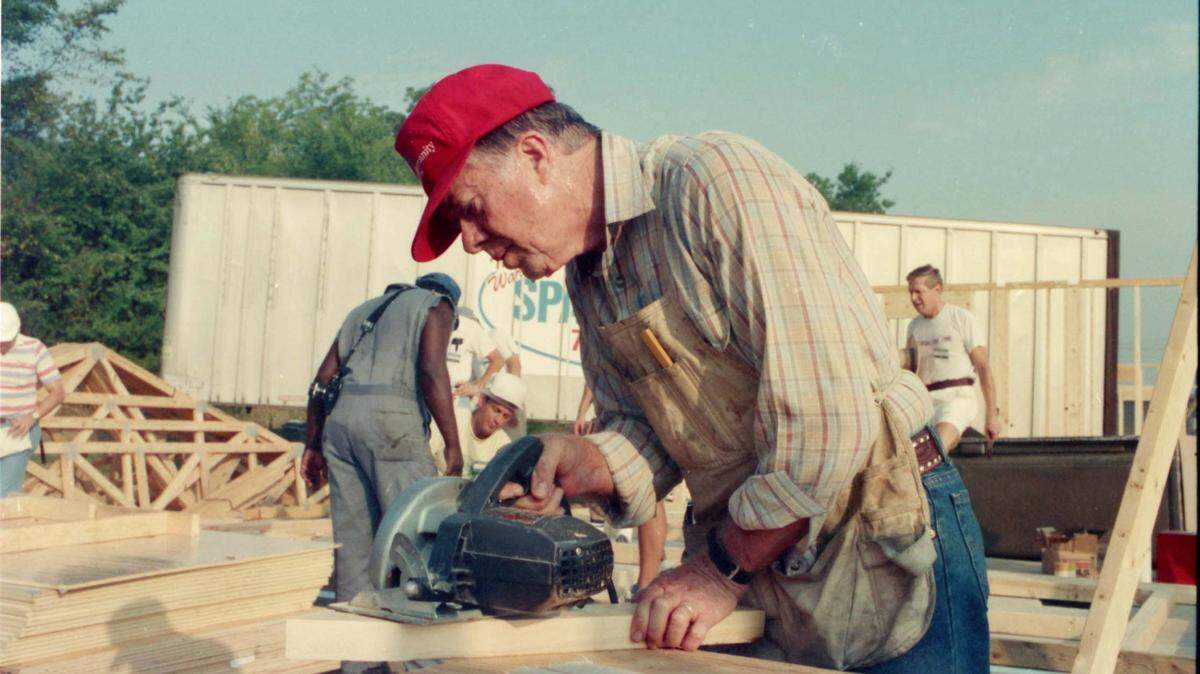
When Adelaide Davis thinks of the time Jimmy Carter brought his Habitat for Humanity-sponsored “work project” to Charlotte back in July of 1987, she thinks first of air conditioning.
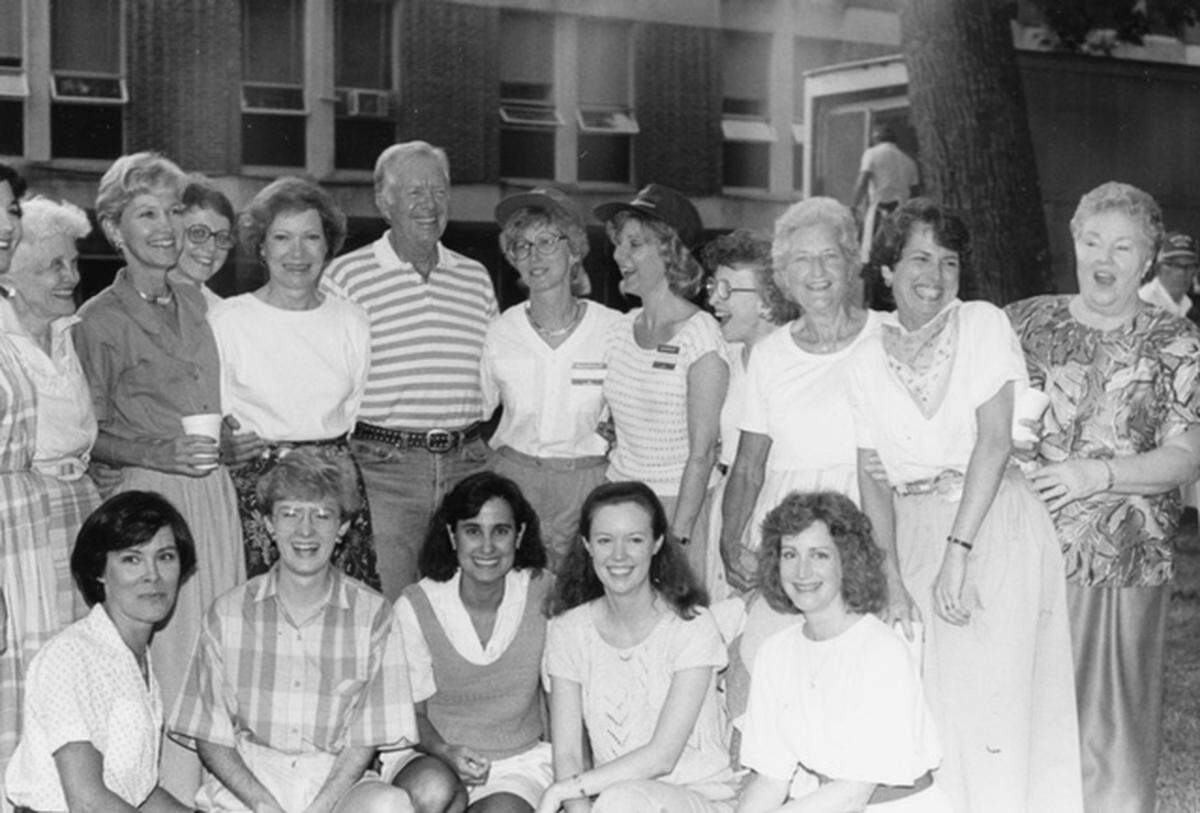
Of the fact that the daytime highs — as they often are in Charlotte in July — were in the 90s; of the fact that the former president and first lady were being housed with other volunteers in a dormitory at Queens College that lacked AC; and, most critically, of the fact that he refused an offer of window units.
“We offered them to the Carters, and Jimmy Carter said, ‘No, I’m not taking air conditioning if the rest of the volunteers don’t have air conditioning,’” recalls Davis, who was the local lodging coordinator for the project (and, then, Queens’ alumni director).
Elise Barksdale, meanwhile, thinks first of running.
Of being at a dinner at First Presbyterian Church when he announced that he and former first lady Rosalynn Carter and their Secret Service detail were going to jog from Fourth Ward to the work site at Optimist Park the next morning; of Carter saying anyone who wanted to join them was welcome; and, most critically, of her and another member of her church taking him up on the offer.
“He took turns running beside each one of us and talking to us, as did Rosalynn. I remember being very nervous about thinking what to talk about, but he made it as easy as possible; he came right down on my level (intellectually), which was just pretty far to come,” Barksdale jokes.
But hanging much higher in the sky above all of this was the project itself.
It was, by virtually any measure, a hugely ambitious undertaking: an attempt by the Charlotte affiliate of Habitat for Humanity (a household name today, but back then still a fledgling international religious organization) to build 14 houses for low-income families in just five days using $1.5 million in donations and about 300 volunteers, including the former president.
Bob Wilson was the Charlotte native who headed up the project for Carter and Habitat.
And if you ask him what he thinks of first and foremost when he reflects on the Jimmy Carter Work Project of 1987, his answer might surprise you. Because he doesn’t focus on what happened during those five days, but rather what happened after them.
“It’s the thing that really kick-started Habitat for Humanity,” Wilson says. “People say, ‘Well, President Carter did it.’ And you know what? Jimmy Carter did do it. But where did it happen? It happened in Charlotte, North Carolina. ... The momentum continued after Charlotte, and they’ve done incredible things since.
“Looking at it objectively, it was the people of Charlotte embracing this thing that really put Habitat on the map.”
Bob Hope, Miss America, and some presidential sweat
The Charlotte work project marked the fourth in four years for the Carters, after visits to New York City in 1984 and 1985, and to Chicago in 1986.
Each of the previous projects was considered a success, and the idea of a former U.S. president and a former first lady actually getting their hands dirty — sawing, hammering, tearing down plaster — certainly got the media’s attention.
For some reason, though, the concept didn’t quite seem to be clicking for the public yet.
Maybe it was because both times in Manhattan, Habitat and the Carters chose to focus on renovating abandoned tenements into apartments, meaning all of the work basically happened out of sight and therefore largely out of mind. Maybe it was because four straight days of rain in Chicago dampened enthusiasm for the Carters being there.
Whatever the case may have been in those other places, Charlotte definitely felt different.
Why Charlotte? Back then, Habitat — under the direction of co-founder Millard Fuller and nationally headquartered in Americus, Georgia — was still finding its footing and figuring things out.
There were just a handful of Habitat affiliates organizing projects like Charlotte’s, which had been under construction in Optimist Park long before the Carters rolled up their sleeves and got to work on the site. In fact, the former president and former first lady had paid a brief visit to the site on July 27, 1985, on their way to the inaugural Carter Work Project in New York. Jimmy Carter, however, reportedly had little say in picking the location; no, it was Fuller’s call, and he made it because he’d had good experiences working on poverty issues with groups from Charlotte in the past, as well as an affinity for the city’s progressiveness.
So when the Carters joined the army of volunteers to begin framing up houses here exactly two years after that brief pit stop, the end goal was similar to that in Manhattan and Chicago: to create instantly move-in-ready housing that would be sold to low-income families via interest-free mortgages to be repaid at a rate of about $150 a month.
But here, they would race to build this collection of vinyl-sided, three- to four-bedroom/one-bathroom houses in what was once one of the city’s most blighted neighborhoods — but in fairly plain view of the public (at North Caldwell and East 19th streets), with all kinds of great sight lines for news photographers. Here, Mother Nature welcomed them with sunny skies and that July heat, causing the then-62-year-old Carter to work himself into a sweat that glistened for the TV cameras.
Bob Hope flew into town to clown around with the Carters on camera, and to crack jokes for the media horde: At one point at the work site, the former president handed the comedian a saw, Hope worked with it for 30 seconds, then asked, “Well, when do we eat?”
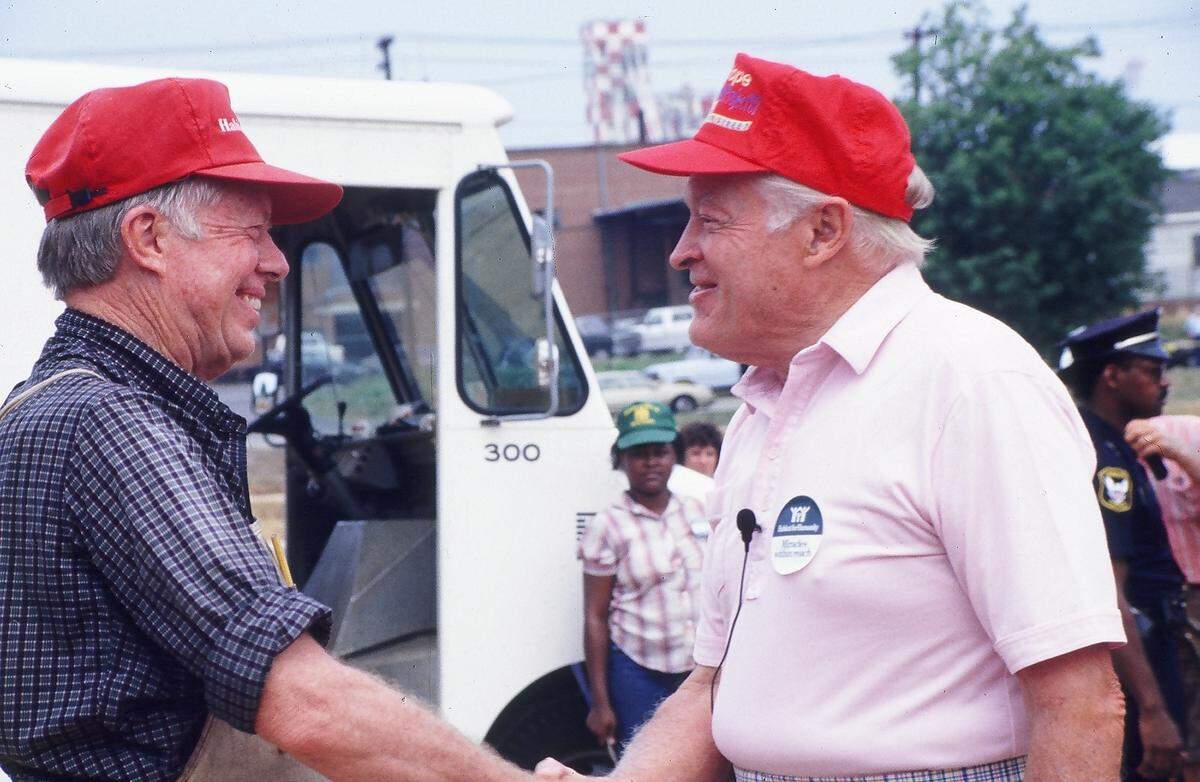
Hope brought along the reigning Miss America, Kellye Cash. Country songwriter Tom T. Hall showed up to volunteer, too.
And the city was enthralled. That week, The Charlotte Observer published 16 stories about the Jimmy Carter Work Project. In one, in which the former president is described as “smiling broadly — almost shyly, it appears — (while) holding flowers presented by a neighborhood leader,” a reporter notes that “several hundred people” gathered to greet him on the night he arrived.
Another reported that “Carter spent much of the day politely ignoring cameras thrust in his face, working intently on the house. ... Only reluctantly on three or four brief occasions did he break for interviews with the press. Each time, he sought to turn the questions from politics and other subjects back to Habitat and the mission at hand.”
“It is not an accident that we chose to come to Charlotte,” Carter said at the time. “There are 205 communities in the country with Habitat projects. We could have gone to any of them, but Charlotte, for us, is special.”
‘Just had to show ’em a new way to care’
Jimmy Carter, by that point, was already a sensation — America’s most accomplished former president, particularly as it pertains to his championing of human rights and his work for not just Habitat but a range of charitable causes.
But it was Habitat that was still just on the verge, but not quite a phenomenon.
And Wilson, the director of the Carter work project in 1987, believes that year’s blitz build was an extraordinarily pivotal moment both for Habitat and for Charlotte.
By the time the Carters left Charlotte, he says, “Habitat got it.” The organization had a new model for how to plan and execute a build, how to raise funds, how to recruit and utilize volunteers, how to generate enthusiasm on a local level, and how to capitalize on Carter’s strengths as a participant in it all.
The following year, Habitat expanded its annual Carter work project to encompass two separate locations: one a renovation project in Philadelphia, the other a massive blitz-build that saw 20 houses constructed in Atlanta by roughly 1,000 volunteers — including, of course, former President Carter.
As for how the Carter work project of 1987 had emboldened Charlotte?
“We didn’t have to teach ’em how to care,” says Wilson, explaining that Charlotte already was wired that way, being in the South. “We just had to show ’em a new way to care. ... That’s one of the reasons that the Charlotte project was so successful. Didn’t have a damn thing to do with the organization, sure didn’t have anything to do with the director. It had to do with the fact that the community was willing to embrace a new idea because the community gave a rat’s a-- about poor people.”
%20Jimmy%20Carter-LeRoy.jpg "HFHI Charlotte, NC 7-26-87 (38) Jimmy Carter-LeRoy.jpg")
During the two years after the Carter build here, the Charlotte affiliate of Habitat raised more than $1.2 million through corporate, church, individual and civic donations. By the fall of 1990, it had built 100 houses; more, at the time, than any of the nation’s 523 other programs.
In all likelihood, those things never would have happened if Jimmy Carter hadn’t come to town, and refused an AC unit, and gone for a jog, and — most critically — picked up a hammer and started swinging it.
”It showed us what we could do,” says Hugh McColl, a longtime supporter of Habitat who was CEO of Charlotte-based North Carolina National Bank in 1990, when it pledged $100,000 to Habitat over the next three years.
After being a key part of the success of the Carter work project, during which McColl led fundraising efforts and worked side-by-side with Carter, “we (Habitat) raised our goals … not only actually, but psychologically,” he says, which “made us think we could accomplish a great deal more. That we could build a lot more houses. ... So I do think it awakened the art of the possible in our thinking. ... Because we saw we could do it. And we found there were a lot of people in the city that wanted to participate.”
“You could argue it woke up a whole new group of volunteers to do good work in the city. And it’s continued,” McColl says, “to this day.”
-
In October, for the first time since 1987, the Jimmy and Rosalynn Carter Work Project will return to Charlotte, to build 23 homes in The Meadows at Plato Price in west Charlotte. The $10.6 million community development is expected to be completed by 2025, and will be Habitat’s largest housing development to date. Country-music stars Garth Brooks and Trisha Yearwood are expected to be among the volunteers.
This story was originally published March 7, 2023 at 6:00 AM.