A rare deformity left this Charlotte girl’s heart exposed. But then they found a fix.
From pretty much the day her daughter Aria was born — on March 23, 2021, smack in the middle of the pandemic — Heather Horne was convinced something wasn’t quite right with her new baby girl.
All Horne had to do was watch her infant’s chest when she was crying.
Every time, Aria’s chest wall would bulge outwards, incongruously, creating a visible “puffing” effect; and every time, it made Horne anxious and confused. “I was just like, Is she crying really hard? I asked the doctors and nurses about it, and they were just like, ‘Mmm, yeah, I don’t know.’ They acted like it was not a big deal at all; they didn’t say anything. So I just was like, Huh. Then maybe it’s not a big deal. Maybe I’m just trippin’.”
At Aria’s one-week appointment, her pediatrician referred her to an ear, nose and throat specialist, who surmised that Aria had a swollen lymph node or neck mass. The ENT specialist referred her to an orthopedic doctor, who Horne says theorized, based on X-rays, that Aria’s clavicle was broken during the birthing process.
But Aria seemed otherwise completely fine. She didn’t seem to be in any pain. So her mom, skeptical of those two diagnoses, sought a second opinion.
In the meantime, Horne went down a rabbit hole on the internet.
“I didn’t really know what to put in, though,” says the 33-year-old Charlotte resident, who has three other children ages 5, 8 and 14, “’cause if you put in ‘neck mass on a newborn baby,’ so many different things pop up — tumor, cancer. When I started putting in ‘chest puffing in and out while baby crying,’ I started finding stuff. ... If it had the words external cleft, or sternal deformity, or any of those things ... if there’s any of that on Google, I read it.
“That’s when I came across the sternal cleft.”
It was quite clearly very uncommon. Rare enough, in fact, that Horne says when she presented the possibility to the second orthopedic doctor, he said he wasn’t aware of it and needed to do his own research.
The next time they spoke, Horne says, he told her: “I think you’re right.”
Just how rare is it, exactly? According to the National Institutes of Health, the incidence rate is one case per 100,000 live births, and represents less than 1% of all chest wall deformities. As for the best way to deal with the anomaly? Surgery, which ideally would be performed by someone who’s done it before.
And as luck would have it, someone like that happens to work in Charlotte.
’I’m gonna be Iron Girl — and I’m gonna fly!’
Thomas Maxey, a pediatric surgeon for Atrium Health Levine Children’s HEARTest Yard Congenital Heart Center, was able to quickly confirm Aria’s diagnosis.
The simplest way to explain a sternal cleft is that it’s the result of a failure of the breastbone to fuse at an early stage of embryological development, often around the seventh or eighth week of a pregnancy. Sometimes it’s a partial failure that might not yield a noticeable deformity. But Aria’s case, Maxey explains, was “pretty extreme.”
Aria’s breastbone, he says, “was really only fused at the bottom, so you could literally see her heart and great vessels (i.e. the aorta, pulmonary trunk, pulmonary veins and vena cava) beating out of the top of her chest — which is a little shocking, if you see that.”
On its own, a sternal cleft is not life-threatening. However, Maxey continues, “Your chest wall is there to protect what we call the viscera in your chest — your lungs, and your heart, and the great vessels. That’s the purpose of your chest plate. And that plate was not there. If she ever had a penetrating injury, it would go through her heart, which was exposed right under the skin.” For that reason, he recommended a surgery he’d done twice before in the past 10 years — twice more than many if not most peers.
He also advised Heather and her husband Quay to wait three years, to allow Aria’s body to grow a little bit first.
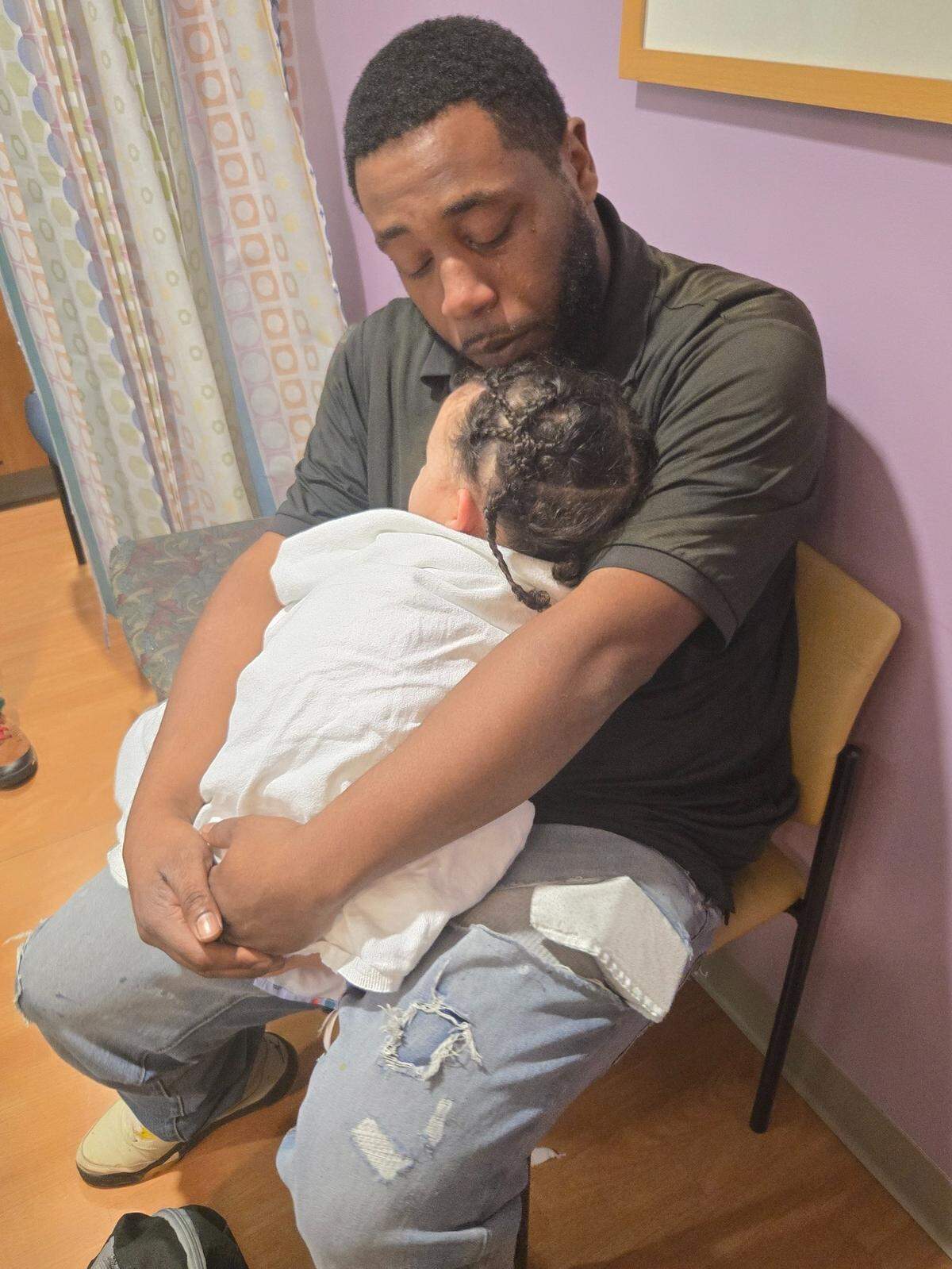
It wasn’t easy. Knowing that their daughter’s most vital organs were lacking full protection, the Hornes tried to be extra-cautious without keeping her in a bubble. Meanwhile, worse in some respects was the specter of a type of open-heart surgery looming for so long. Just thinking about it filled Heather with dread. She says she had multiple panic attacks during that time.
But it became increasingly clear that Aria would benefit from the procedure; in addition to the unusual bulging — or “puffing” — of her chest when she cried too hard, it also happened when she laughed too hard. And both things caused her to complain of neck pain.
“I think that,” Heather Horne says, “was one of the biggest reasons we knew we wanted to go through with this.”
The surgical technique, in a nutshell, would involve Maxey “harvesting” cartilage from where Aria’s lower ribs connect to her breastbone and using it to fill the gap of the sternal cleft (i.e. where the bone is split apart because it didn’t fuse). A wire mesh would be put in place to hold the edges of the cleft together while grafts took hold. The harvested cartilage would, eventually, grow back.
As the day of the surgery neared this fall, Horne tried her best to explain this to her 3-1/2-year-old in understandable terms.
“Feel Mommy right here,” she told Aria, placing her hand above her heart. “You see I have this bone? Well, you were born special. You were born without bone, and the doctor is gonna put something in you to protect your heart. He’s gonna turn you into Iron Girl.’”
“And Aria was like, ‘Yay, I’m gonna be Iron Girl — and I’m gonna fly!’” Horne says. “But you could tell she just was confused.”
’They knew what I needed in that moment’
Horne spent almost the entire 2.5-hour duration of Aria’s Nov. 4 surgery inside the chapel room on the second floor of Levine Children’s Hospital.
She says she went there in part because it was empty, and she wanted to be alone because she couldn’t stop crying. But she also found comfort in both dropping to her knees in prayer — even though she’s not very religious — and in reading what other parents had written in the chapel’s prayer journal.
“It felt like other moms were talking to me,” Horne says. “There were other moms, not in the exact same situation, but, like, a mom in there who wrote, ‘My daughter is getting a heart transplant right now.’ Some of them had even come back to add an update, like, ‘I want you to know that the surgery went okay, and yours will, too.’
“I expected it to just look like people only talking to God,” she continues, “but it was more so people communicating with each other, as if they knew what I needed in that moment. That kept me sane, kept me stable, reading their stories, knowing I wasn’t alone.”
The procedure went as smoothly as it possibly could have, Maxey says.
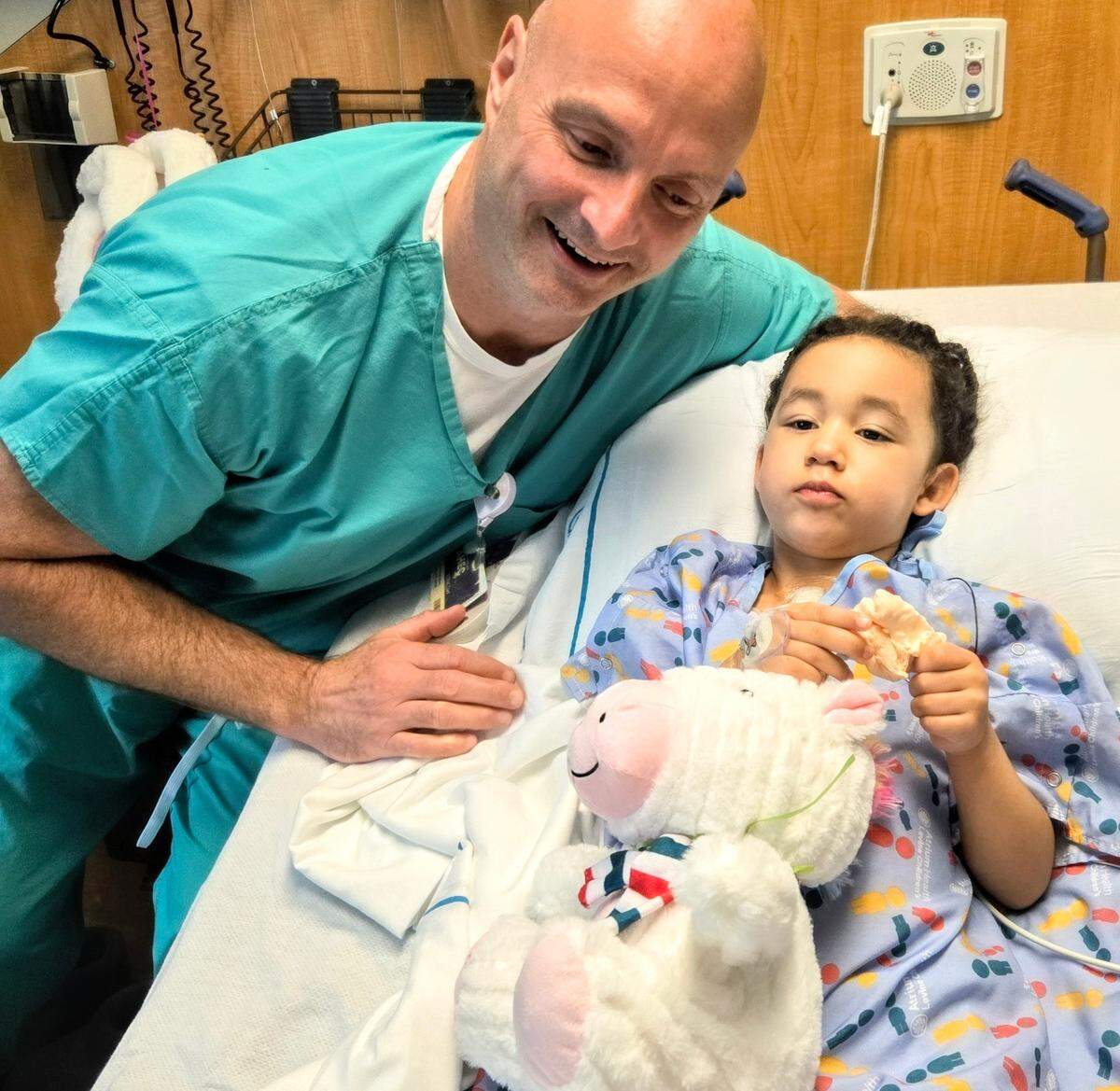
Now, though, as new cartilage grows and solidifies where it needs to inside of her body, Aria really will have to live in a bit of a bubble — for the next six months.
“She can’t do playgrounds, monkey bars, slides, trampolines, swings, swimming pools,” Horne says. “We have to make sure she’s not running or jumping off anything. They don’t want her pushing or pulling anything. She’s not supposed to lift anything over a pound. That’s the hardest part, because she’s a wild and energetic 3-year-old.”
Crying is still somewhat painful for Aria, too, so her parents are trying to carefully navigate how to avoid upsetting her while also not spoiling her.
On top of all that, there’s the financial burden, rendered heavier because Heather Horne quit her job so she could be home all day to supervise Aria. “Like a lot of other people, we’re kind of living paycheck to paycheck in this economy. ... We really don’t have a lot of family to support us.”
Horne’s younger sister did start a GoFundMe for the family, “but nobody’s donated at all. We have zero dollars,” Heather says, laughing. “I think everyone we know is just broke right now.”
But there is, of course, a bright side: By the time Aria turns 4 in March, crying will presumably — finally — no longer hurt.
And much, much better yet? Neither will laughing.
This story was originally published December 3, 2024 at 5:00 AM.