After a heart attack and a dramatic rescue, a wake-up call: ‘You’re NOT doing this race’
Days after barely surviving a heart attack on an indoor pool deck in south Charlotte, Val Kovalenko was already fantasizing about a Hollywood-movie-style comeback.
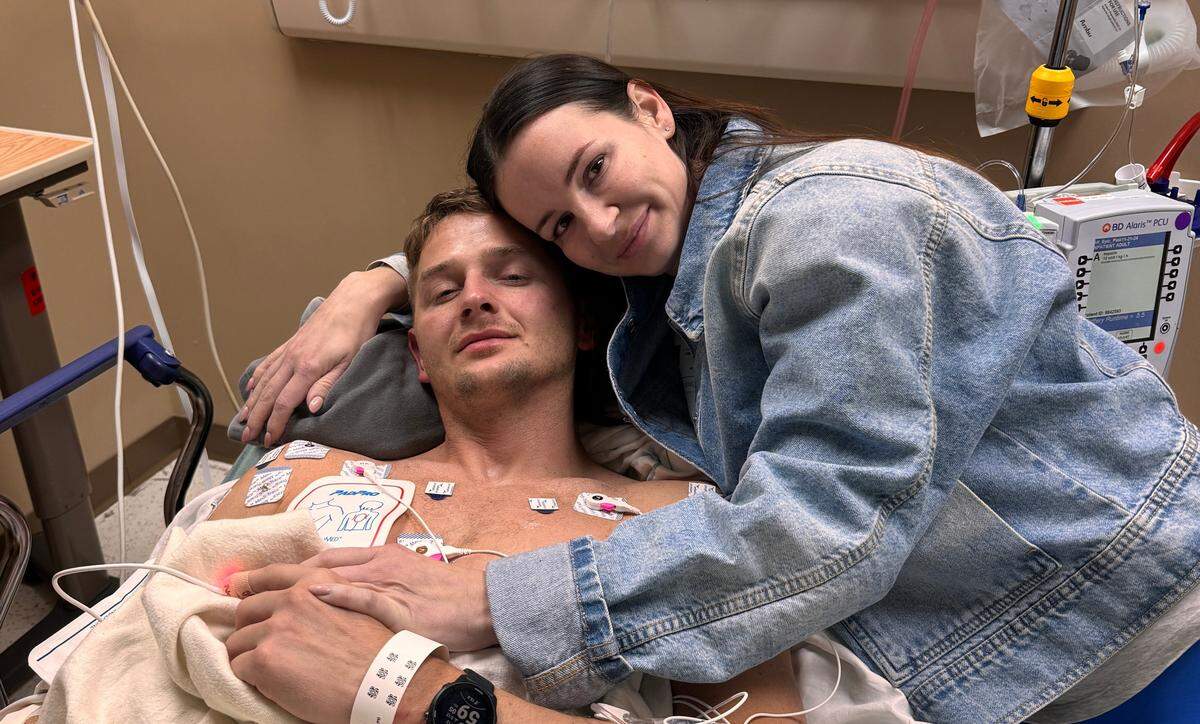
Yes, Val’s heart stopped beating the morning of Dec. 13 and had needed — among other things — an electric shock to restart it.
Yes, he’d subsequently had a stent put in to treat the 95% blockage of a critical artery to his heart.
But the Waxhaw home builder and father of five didn’t want to give up on what he felt would be perhaps the crowning achievement of his lifetime: Ultraman Florida, a three-day endurance race that covers 6.2 miles of swimming, 263 miles of biking and 52.4 miles of running. He had been preparing for the event for nearly 12 months, and was holding onto the hope that he could recover from his ordeal quickly enough to make it to the start line in Claremont, Fla., later this winter.
In fact, when Val and his wife Tanya showed up for his follow-up appointment at Atrium Health’s Sanger Heart & Vascular Institute a week out from his near-death experience, physically, he felt good. So good that he thought there was a chance the physician’s assistant he was seeing — Michelle Ross — would tell him he could still do his Ultraman.
He was dead wrong.
“She was going through and explaining everything to me,” recalls Val, 39, “and she starts talking about the cardiac rehab program, that you have to be there for three months. I’m thinking, Wait, three months? That’s gonna interfere with my race. So I asked her, ‘Soooo, I know it might sound crazy, but do you think there’s a chance that I’ll be able to do my race on February 14th?’ And she looked at me like —”
“I mean, she got angry,” Tanya interjects.
As Ross herself describes it, “He was insistent. ‘I feel fine. I’m gonna do it.’ He said that to me a couple times, and I finally was like, ‘NO. You’re NOT doing this.’”
Understand, the specialist in interventional cardiology stressed to Val, that your heart needs to heal. Understand, she said in no uncertain terms, that if you try to keep training or attempt to do the race, you could easily go into cardiac arrest again. And if you’re out there training alone, or out there on the race course alone?, she told him, you won’t survive.
“He only made it,” Ross says, “because people were right there with the right equipment and responded quickly.”
More specifically, Val may have made it only because among the people who were right there that day were a woman who’s been a nurse for almost 30 years and a retired U.S. Army Special Forces combat medic.
‘I felt there was more that I could do’
Pretty much from the time he was a teenager — when his family of 11 left behind their impoverished existence in Ukraine for the promise of a better life in the United States — Val had been driven to be not just an achiever, but an overachiever.
In business, at first. After graduating from high school in his adopted hometown of Vancouver, Wash. (and marrying high-school sweetheart Tanya, a native of Moldova), he got certified as a flooring installer and launched a flooring business that found success. Then, after moving with Tanya and their growing family to Charlotte in 2011, he started a home-remodeling company. It, too, flourished.
Over the next several years, he gradually shifted his focus to custom-home building, and by 2023, his Koval Builders was constructing about a hundred houses a year.
“At that point, it seemed like I had everything to be happy,” Val recalls, speaking in his Ukrainian-accent English. “But I wasn’t really experiencing happiness. I wasn’t really fully satisfied with everything I had. I got into a depression mode. ... And my wife and I were sitting out in the backyard, and I was like, ‘What is the purpose of life?’ I was searching for the purpose. ‘How can I find a purpose?’”
“I felt there was more that I could do,” he continues. “So I set out on this journey to achieve some type of big physical achievement.”
This is a condensed summary of the rapid series of events that unfolded between late summer and early fall of 2023, but basically: After hearing a friend mention the word “triathlon,” Val consulted Google to find it referred to a sport involving swimming, biking and running; he had never swam, so he began lessons; he saw a bike for sale on Facebook and made an offer before checking to see if it was his size; the seller turned out to be a triathlon coach, who listened to Val explain he was a first-timer who wanted to get trained up in just three months for an “Ironman 70.3” event (1.2-mile swim, 56-mile ride, 13.1-mile run) and then told Val: “You’re going to fail.”
Val proved him wrong by completing his goal race that December, then took the even more outrageous leap of signing up for the Ultraman event.
Over the next year, he became obsessed with training for this 321-mile race. Not everyone was thrilled.
“First of all, it took a lot of time,” Tanya says, matter-of-factly, of his three-, four- and sometimes even five-hour-a-day workouts. “And it’s not just time, it’s where your head is at. ... I don’t mind people working out. I work out. But that’s not my life. I don’t make it my priority. To me, it seemed like that dedication towards that sport was a little too much. ... It was almost unhealthy.”
Val understood Tanya’s reservations. He needed this, though, he explained to her. So “for the sake of family peace,” Tanya says, she somewhat grudgingly consented.
Neither of them had any idea at the time that a bomb was ticking inside his chest.
Little warning signs, big achievements
Before he got into triathlons, Val considered himself “pretty chunky” and paid only a moderate amount of attention to his diet. After taking up the sport, he dedicated himself to (mostly) clean eating and began to steadily shed weight.
Because he “wanted to maximize what I could do as an athlete,” he says, at the start of 2024 he also scheduled a battery of medical tests that yielded a couple of surprises. One was a CT scan that revealed a calcium score of 42, indicating there was likely some plaque buildup in one of his coronary arteries. The other was a cardiac MRI that confirmed a small amount of blockage in the same artery.
Although Val had no family history of heart disease, the physician expressed concern, and told Val the issue needed to be monitored over time. Val never followed up.
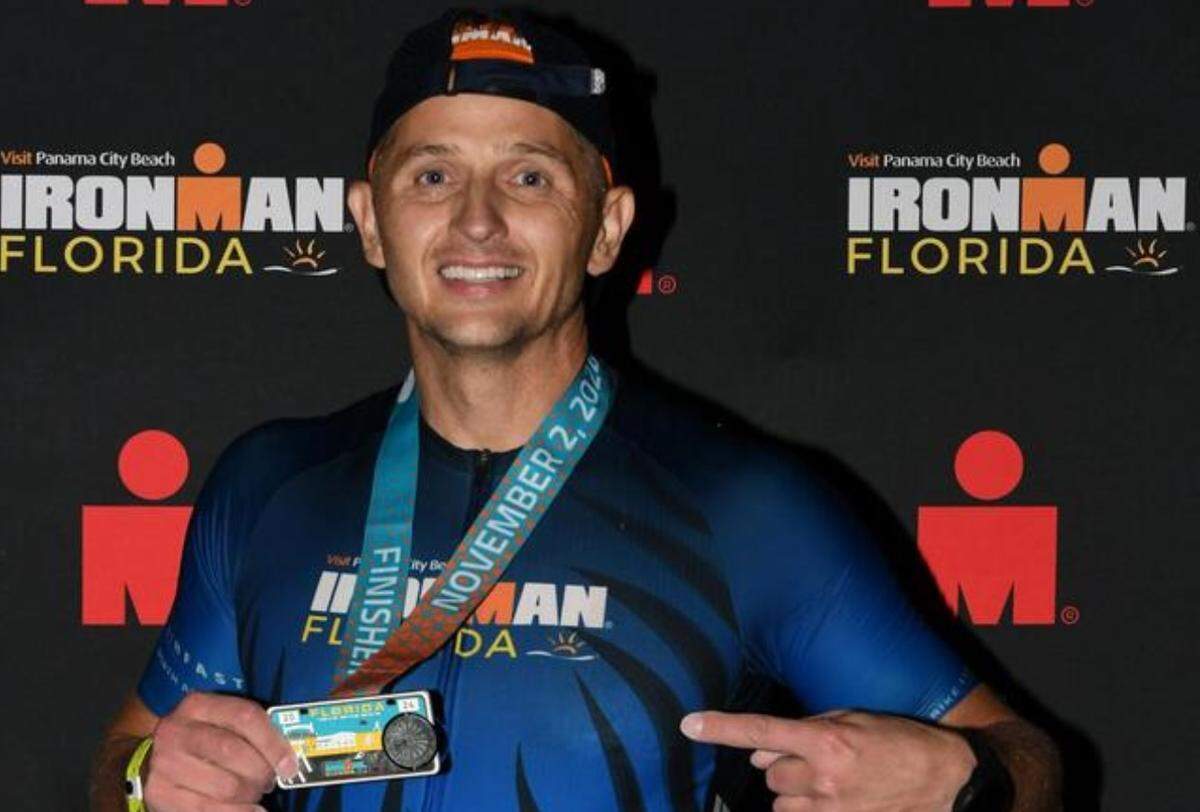
He ran a marathon in Wilmington in February, completed a second “70.3” triathlon in Tennessee in May then a third in New York in October, leading to his final tune-up race for the Ultraman: an Ironman in Florida (2.4-mile swim, 112-mile ride, 26.2-mile run) this past November.
And generally, Val felt great for most of that year. He’d almost entirely forgotten about the results of that CT scan and that MRI.
The day before the Florida Ironman, however, he started feeling a pain that extended from his right palm up through his whole arm and into that side of his chest. It bothered him throughout the race, enough that upon returning to Charlotte he went to see another doctor — who ultimately thought it might just be muscle tightness, and recommended Val spend more time stretching that arm.
For the next several weeks, Val felt the same pain at the start of every workout. Breaks and stretching did seem to help, in that mixing in some of both for the first 30 minutes or so made the pain go away for the rest of the workout.
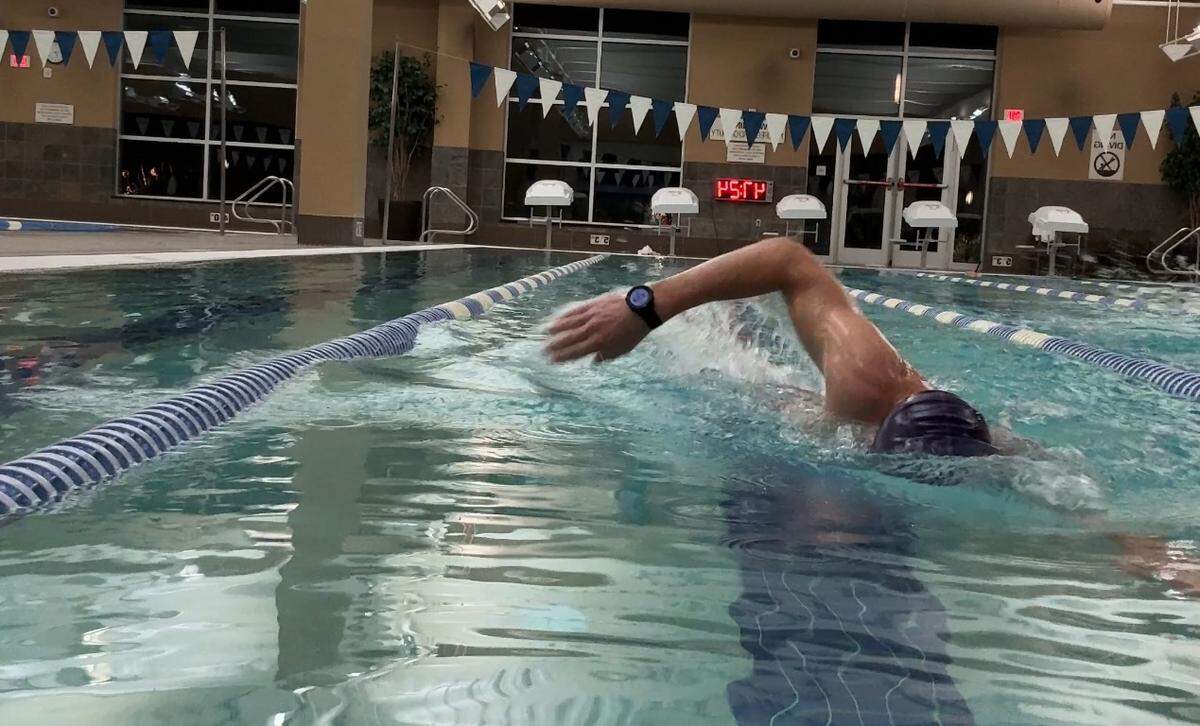
But on Dec. 13, toward the end of a long training swim, the pain suddenly returned. Seconds later, the world went black.
‘I trust him. We’ve got this. Let’s go.’
There’s a scenario in which Val could have arrived at Life Time on that morning at 5, which was when he normally showed up at the pool on Fridays. Instead, he took a rare opportunity to sleep in, got wet two hours later than usual, and was still doing laps after 9 a.m.
There’s a scenario in which Jennifer Carter could have been a no-show for her 9 a.m. water aerobics class, since she left home behind schedule that morning and almost decided to bail. Instead, she opted to stay on track exercise-wise, and slipped into the pool at 9:04.
And there’s a scenario in which Chip Hulbert wouldn’t have been there at all: The 60-year-old part-time trainer at Life Time hadn’t taught a water boot camp class on Friday there in years; but he happened to be available to fill in to lead the 8 a.m. class, so he did — and after it ended at 9, he had stayed behind to chat with one of his clients.
Yet there they all happened to be, in the same place at the same time.
For Val’s part, he remembers being in the final interval of his planned 4,000-yard training swim. He remembers the pain coming and going in the first 30 minutes of the workout, and remembers the surprise of its abrupt return with just a few laps to go. He remembers feeling dizzy and lightheaded, and remembers thinking to himself, When I get to the other side of the pool, I’ll stop, and I’ll stretch. He remembers suddenly feeling like he couldn’t breathe, his vision blurring, and finally just a general, overwhelming sense of helplessness.
What Val does not remember is ever reaching the other side of the pool, because he never did.
Chip had been aware of this stranger’s presence in the pool near his class and noted that his stroke looked strong, so when he looked up from the conversation with his client to see the man suddenly “kind of flopping around,” Chip excused himself.
It took him only a matter of seconds to realize something was wrong. Chip jumped into the water next to the man without hesitating.
Meanwhile, a few seconds later, on the opposite pool deck, Jennifer noticed her instructor had turned her attention away from the water aerobics class. From her spot in the warm pool, Jennifer’s view of the far side of the cold pool was obstructed by a large concrete support column, but she could see a man lying on the deck.
In the same way Chip had known something was off, she did, too. Jennifer scrambled out of the water without hesitating.
When she got over to that side of the pool, she observed the fallen man was “very gray” and unresponsive, and that a Life Time trainer — who she sensed knew what he was doing — was assessing the swimmer’s airway to see if he’d taken in water and checking the man’s arm for a pulse. As she moved to take her own pulse reading of the unconscious man’s neck, Jennifer identified herself as a nurse. The trainer replied by saying he had been in the Special Forces.
Recalls Jennifer: “And I was like, Okay, he knows what to do. I trust him. We’ve got this. Let’s go.”
A textbook display of teamwork
Jennifer and Chip immediately agreed that the swimmer Chip had pulled from the water was flatlining.
Chip announced that he was going to start performing CPR by administering a cycle of chest compressions. Jennifer announced that when he reached the end of the cycle, she was going to administer the two rescue breaths.
While Chip was doing the chest compressions, Jennifer called out for someone to fetch Life Time’s closest automated external defibrillator (AED), a device designed to analyze the heart’s rhythm and deliver an electric shock to heart attack victims in an effort to restore a normal rhythm. She also called for towels, aware of the importance of drying off the area of the body where the AED’s pads were going to be placed.
After the AED was brought to them and the man’s skin was dry, they administered the shock via the AED. Then Chip and Jennifer continued in their respective roles through five full cycles of CPR over the course of more than 10 minutes. Right before EMTs arrived on the scene, the duo read the swimmer’s pulse again. Thirty beats per minute. He was starting to come around.
It was virtually textbook. If it had seemed to bystanders like this might be something Jennifer and Chip had done before, well, that’s because it was. Neither panicked for a second. And afterward, both tried to give more credit to the other than to themselves.
Says Chip: “Jennifer was like, ‘Sorry, I didn’t mean to yell.’ I’m like, ‘You weren’t yelling. You were a nurse. You were doing what nurses do. You gave commands. That’s what nurses do in a situation like this.’ You’ve got to give that ‘command’ voice so people pay attention. And she was very good at taking charge of the situation and making sure that everything worked smoothly, so that we could work well as a team.”
Says Jennifer, who is 54: “Chip had a big task. It’s very hard to give compressions, and it’s hard to give compressions for a long period of time. ... I hope it never happens again, but I will be really, really crushed if (it does, and) he is not there. It really just went as smoothly as possible because of him.”
By the end of the weekend, they had both learned the identity of the man they saved — Val — and found out that he was recovering well. By the end of the year, Chip and Jennifer had met both Val and Tanya, who — understandably — couldn’t thank them enough.
“I know they were sent there by God,” Tanya says. “There’s no way that they should have been there at that time of day. So, I’m forever grateful.” “I told them,” Val adds, “that they’re welcome to all of our holidays. They’re welcome here at any point, at any time. ... They became our family.”
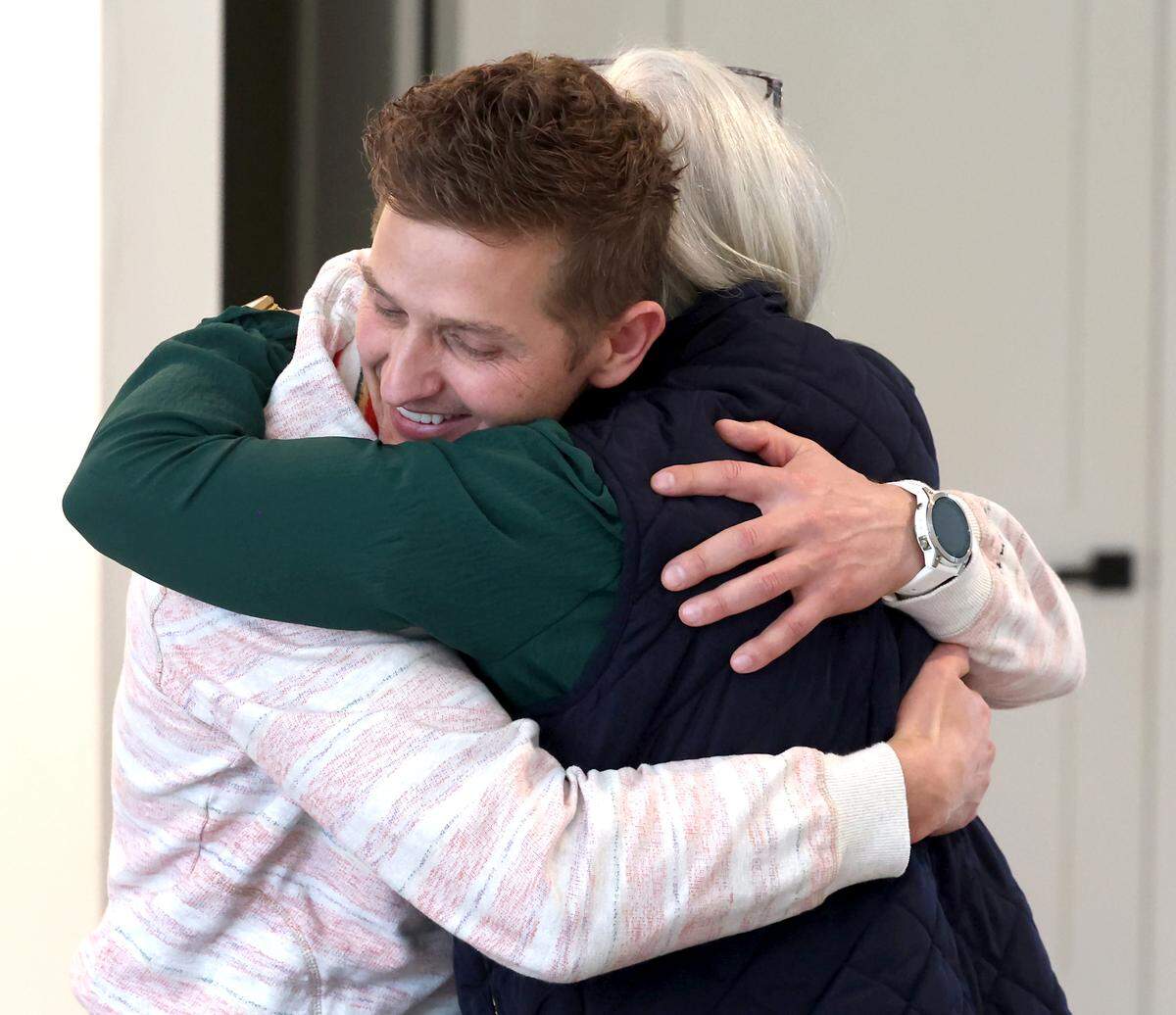
And if there’s one thing that Val Kovalenko has been thinking about above all else in the wake of this whole ordeal, it’s the importance of just that: family.
‘Was this the right thing for me to do?’
Which brings us back to his follow-up appointment with physician’s assistant Michelle Ross, a week after his heart attack.
“You need to have a healthy respect,” she told Val, “because you would have died if people weren’t there. So you absolutely need to cancel your race. You’re not doing it. I’m not saying you won’t make it there someday, but for right now, that’s just not an option.”
It was a devastating blow to Val, initially, but he seemed to be starting to get it. He got it even more soon after that, during a phone call with his brother, Vadim — an accomplished marathoner himself and someone whose opinion Val has always respected immensely. Val told his brother what Ross had said, and dropped a hint that he hadn’t quite let go of the idea of still doing the race.
Vadim didn’t hold back: Don’t be an idiot, Val. You think people will be in awe if you try to race in less than two months? They won’t. They’ll respect you much more if you don’t do it. Take this time to recover. Spend the time with your wife and your kids.
By the time he hung up the phone, Val says, a switch in his brain had been flipped.
Asked if he can appreciate now that Tanya had been feeling that the pursuit of his goal of doing the Ultraman race might have been “almost unhealthy” for both him and for his family, he replies quickly.
“Yeah, I do,” Val says, nodding, as he sits with her in the living room of the Waxhaw home where they’ve raised their son and four daughters (ranging in age from 10 to 19) over the past 4-1/2 years. “I love the sport. I love the feeling that it gives you. ... It’s nice to be able to challenge yourself. But when it consumes you, it’s hard to see yourself at that moment. I didn’t see myself. It’s hard to stop at that point.”
He pauses. He nods again. He looks at Tanya, who’s nodding her head slowly, too. They both smile.
Because of his heart attack, and in no small part because Chip and Jennifer saved his life, “I got a chance to stop and look at it from a different perspective,” Val continues. To consider, “‘Was this the right thing for me to do?’ And I do believe that as of right now — when my kids are growing up and they need my attention, and I’m just taking that away from them and putting it into sport — it’s unfair.
“So my mindset has shifted to what’s really the priority. Because when I was experiencing this unimaginable experience where my body was leaving this world, I didn’t think about any of my accomplishments, any of my big triathlons. I didn’t think about my business. I found that when everything gets stripped away, what does really matter to me is my connection with God, and with my family.”
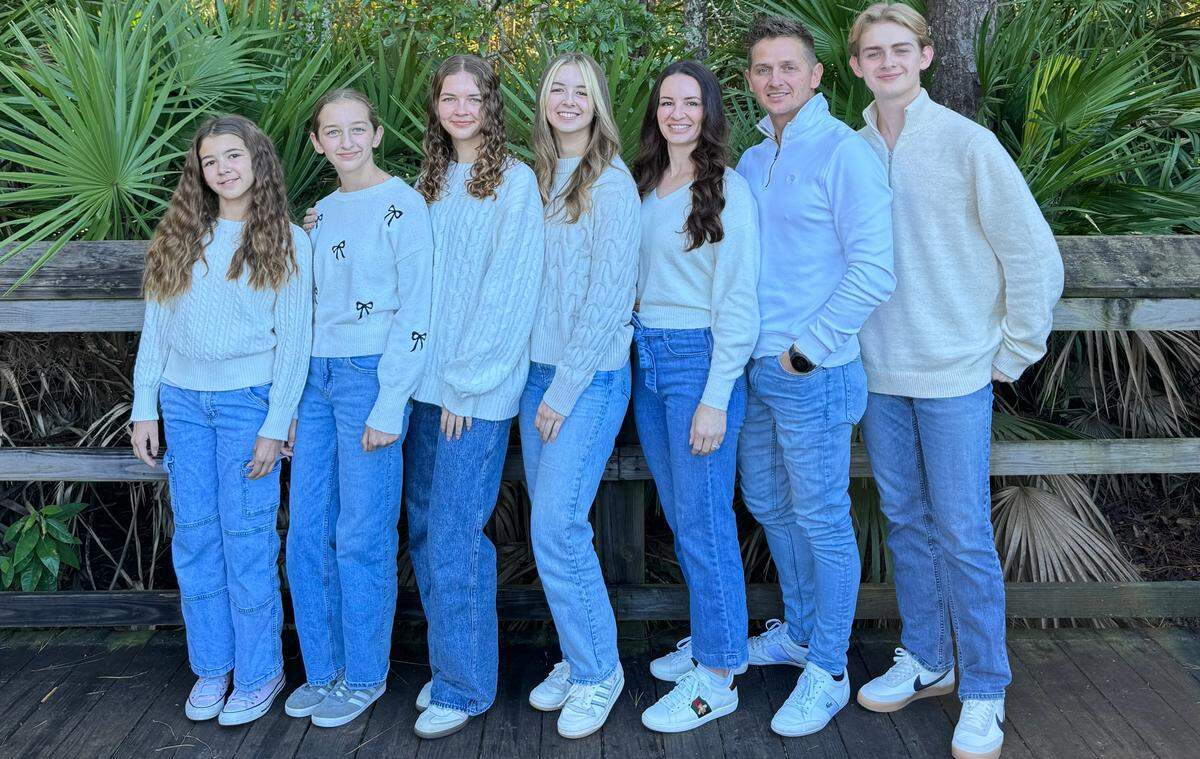
Val still wants to tackle the 321-mile Ultraman. Eventually. Once his kids are a bit older, and if his health allows. But for now, he’s just happy to have recently been cleared to do the Feb. 8 “Cupid’s Cup” race that benefits Atrium Health’s cardiac rehab programs.
It’s a 5K.
This story was originally published January 15, 2025 at 5:00 AM.