
A win-win: As caregiving costs rise, North Carolina students help fill the gap
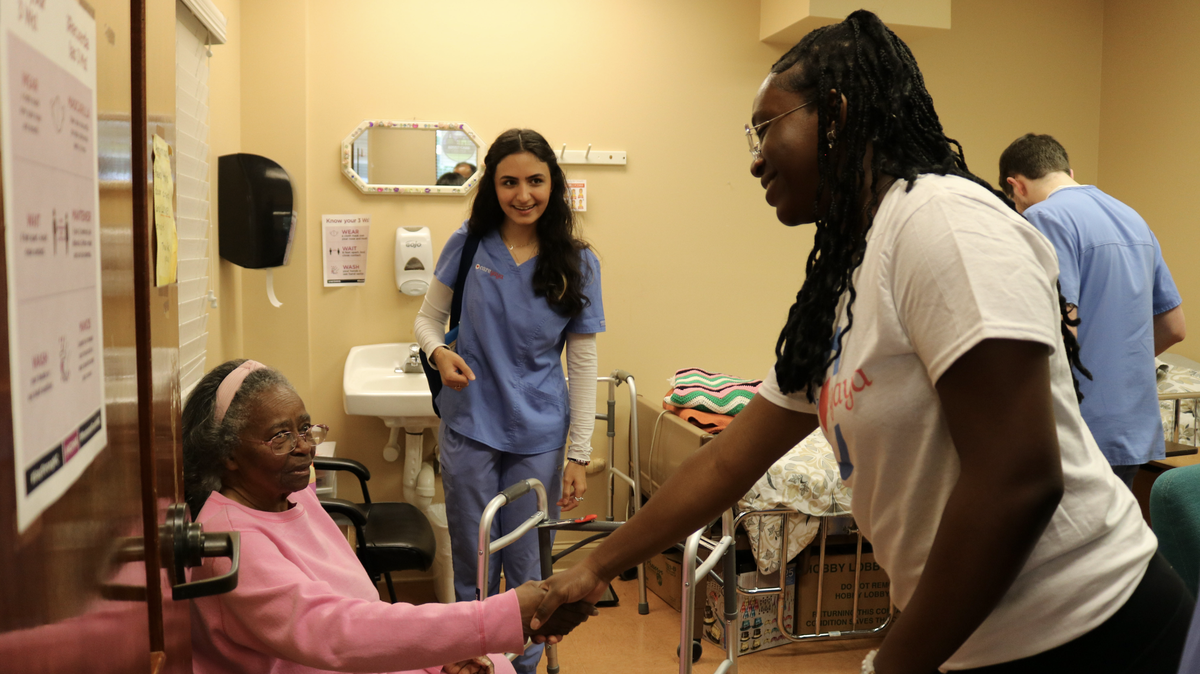
In late 2024, after her mother-in-law fell and broke her femur following knee surgery, Holly Robinson hunted for care that wouldn’t break the bank. But initial estimates, she said, were bleak.
Quotes from private care agencies ranged between $32 and $36 an hour. Respite care options through Harnett County had a waiting list over a year long. Robinson went with the private care option for a few weeks, but her mother-in-law, Cora, needed a full day of care five days a week, and she knew that wasn’t sustainable.
“I was really worried that I wouldn’t be able to return to work,” Robinson, an educator in Wake County, said. “I needed to continue to work. Because I’m about eight and a half years from retirement, and I need my benefits that I get to cover our health insurance. So it really wasn’t an option for me to quit work, but that may have been our last resort... And I don’t know how that would have turned out financially for us either.”
It wasn’t until her co-worker told her about a program called CareYaya that her family found a manageable option.
CareYaya, a social enterprise founded in 2022 by North Carolina native Neal Shah, employs college students in North Carolina and across the country as caregivers for seniors. Students are paid and are able to count their work hours and clinical experience on medical school applications while providing families affordable care.
North Carolina, for years, has been experiencing a caregiver shortage. This has resulted in family members stepping away from work and facing other financial hardships to take care of their loved ones, increased cost in care and long waiting lists for in-home aides and nursing home facilities. This is occurring as advocates expect a rapid population increase in individuals over the age of 85 over the next 25 years.
Students are filling the gap. But sustainable solutions will require strong public-private partnerships and innovative solutions, advocates say.
“Right now, the care industry is extreme in profit squeezing and is not thinking about impact. And I think there’s a way to do both,” Shah said. “I think you can kind of create a scale impact, reduce the profits, and actually innovate enough to lower the cost that in the long term, you can build even a bigger care economy. And I just thought that no one was playing that game. So that was kind of the opportunity.”
Innovation born amid lived experience
CareYaya was born out of personal experience.
Shah found himself as a caregiver for his grandfather who suffered from dementia and, years later, his wife who had cancer.
Shah and his family were paying top-dollar for in-home care but not getting high quality performance. His family began asking around and putting up flyers at church to find dependable caregivers for his grandfather that they could pay directly. While they had some success with health care students, his mother ultimately left her career to take care of her father full-time.
“It had a tremendous amount of strain and impact on her. Because she was already in her 50s and it took so many years. She was never able to return to the workforce. So it was kind of eye-opening to me...”
For his wife, Shah recalls caregivers showing up hours late or not coming at all. It got so bad that Shah ended up following the footsteps of his mother — leaving his career as an investment fund manager to become his wife’s full-time caregiver.
“I personally think you can’t even blame the workers,” he said. “The care industry is not paying well. So a lot of these people are doing second jobs, third jobs elsewhere. Many of them are single moms. They are under so much stress, and they’re getting so underpaid that they are not able to reliably show up.”
On average, caregivers in North Carolina make about $14 an hour, according to Ziprecruiter. Meanwhile, the cost of care is increasing. According to Genworth and Carescout, the average cost for an in-home health aide was $77,792 in 2024 — a 3% increase from the previous year. An average private nursing home room was $127,750 on average.
From his own experience, the experiences shared with him from others and his own research, Shah wanted to create something that provided families with dependable and affordable care.
“The care industry is not innovating,” Shah said. “I kind of gained a sense of purpose and meaning, you know, through doing the care work. I was like, ‘OK, I can do something here and make a positive impact on people.’”
Best of both worlds for aspiring medical students
Through an app, CareYaya connects families to student caregivers. Students must apply and go through a selective screening process — only 20% are accepted, according to the website. According to Shah, about 5,000 students participate in the program in North Carolina. About 50,000 students participate across 10 states and 43 universities.
Families read through student bios and book sessions of up to 8 hours. In most North Carolina markets, families pay about $17 an hour. According to Caring.com, the average cost in North Carolina is about $23. But some families like Robinson's are quoted much more.
Dianella Montes de Oca, a recent graduate of University of North Carolina at Charlotte, heard about CareYaya through her school’s career portal. Initially a biology major, she was looking for opportunities to get clinical experience.
While the opportunity to help elderly families initially attracted her, the bonds and insights she had through the experience stuck with her.
“I’m a very shy person. I had always kind of struggled with making those connections with strangers specifically. And I knew that if I was about to go into a field in clinical practice I would be interacting with a lot of people, and I really had to solidify that,” Montes de Oca said. “So that was one of the biggest things — forming those relationships with strangers. (But) I went from strangers to seeing them as my family members. I have some patients that were like ‘Call me your grandma. Call me Your grandpa.’ Because it really got to that point like we were spending so much quality time together and just building a lot of great memories together.”
Montes de Oca said the medical programs she’s seen required at least 500 clinical hours. Working with CareYaya for two years she was able to double that — securing over 1000 clinical hours.
“As a college student, the money definitely helped with everything that I needed to buy along the way. And then I’m gaining clinical experience at the same time. So it was like the best of both worlds. I was still, you know, finding time to do my school work, because it’s such a flexible type of job,” she said.
Everyone come to the table
One advocate welcomes new and innovative solutions like CareYaya.
“We’ve got to look at what we can do to address that need that’s only going to get bigger,” said Mary Bethel, board chair of the North Carolina Coalition on Aging. “We’ve already got a workforce shortage. How can we keep people in the field? How can we attract people to the field?”
But while innovation like CareYaya is important, more work must be done to ensure long-lasting solutions, she said. This requires participation from the private sector and government.
One example is All Ages, All Stages — North Carolina’s multisector plan on aging which both Bethel and Shah helped create. People from multiple sectors came together to address the state’s growing senior population.
But Bethel and Shah say some providers find health care to be over-regulated with requirements, paperwork and other documentation that can stifle the innovation needed to produce more creative solutions. This makes it even more important for everyone to have a seat at the table, Bethel said.
“We have to be creative and innovative in what we do. But we’ve got to, you know, ensure that people are protected and supported,” Bethel said.
This story was originally published January 28, 2026 at 5:25 AM.