
After a long pandemic, are you ready to return to the office? Here’s what Charlotte says
For numerous Charlotte workers, the days of crowded cubicles and packed parking decks may be looming on the horizon.
After more than 18 months of mostly-empty office buildings, many big Charlotte employers are planning to bring the majority of their workers back to the office this fall.
The Observer recently asked readers how they felt about going back to the office. We heard from over 75 people.
You gave us your thoughts just as the region saw rising rates of COVID-19 due to the highly contagious delta variant of COVID-19.
As of Thursday, Mecklenburg recorded its highest seven-day average for daily new cases since early-February.
Both Wells Fargo and Truist announced recently they would postpone plans to bring workers back to offices until October. And Duke Energy and Lowe’s are implementing mask requirements for all employees indoors, regardless of vaccination status.
Amid these moves, some people told the Observer they are “desperate” to sit at their desk again. Others will miss the convenience of working from home, or are concerned about the continued spread of the coronavirus.
Here’s a closer look at the responses we got.
‘Desperate to be back’
In the Observer’s survey, Ellie Haag said she was “desperate to be back among people rather than alone in my apartment.”
A program assistant at UNC Charlotte’s office of International Programs, Haag began teleworking in March 2020 as the COVID-19 shutdowns began.
Her lone companion was her cat, Wolfie.
“It was awful because it was just me in my apartment every day,” Haag said in an interview. “I was really wanting that person-to-person interaction, that’s what I missed.”
And Zoom meetings didn’t do the trick.
She started going to the office once a week in November, even though nobody else was there. She needed “a sense of purpose,” a reason to get dressed in the morning.
“My living room is not a professional environment for working,” Haag said. “I feel better and more productive in an office.”
Since May, Haag and other staff at UNCC have been working five days a week at the office, and she couldn’t be happier. “It’s nice to have conversations with colleagues in the office,” Haag said. “I really enjoy it.”
‘Working from home is all I know’
Blake Morgan has never worked from his company’s office.
The South End resident was hired during pandemic shutdowns in June 2020 by Red Ventures, the internet marketing company headquartered in Fort Mill, S.C.
“Working from home is all I know. I’ll basically be starting from scratch,” he said of going to the office.
The 23-year-old finished the last few months of college virtually, too, at UNC Chapel Hill.
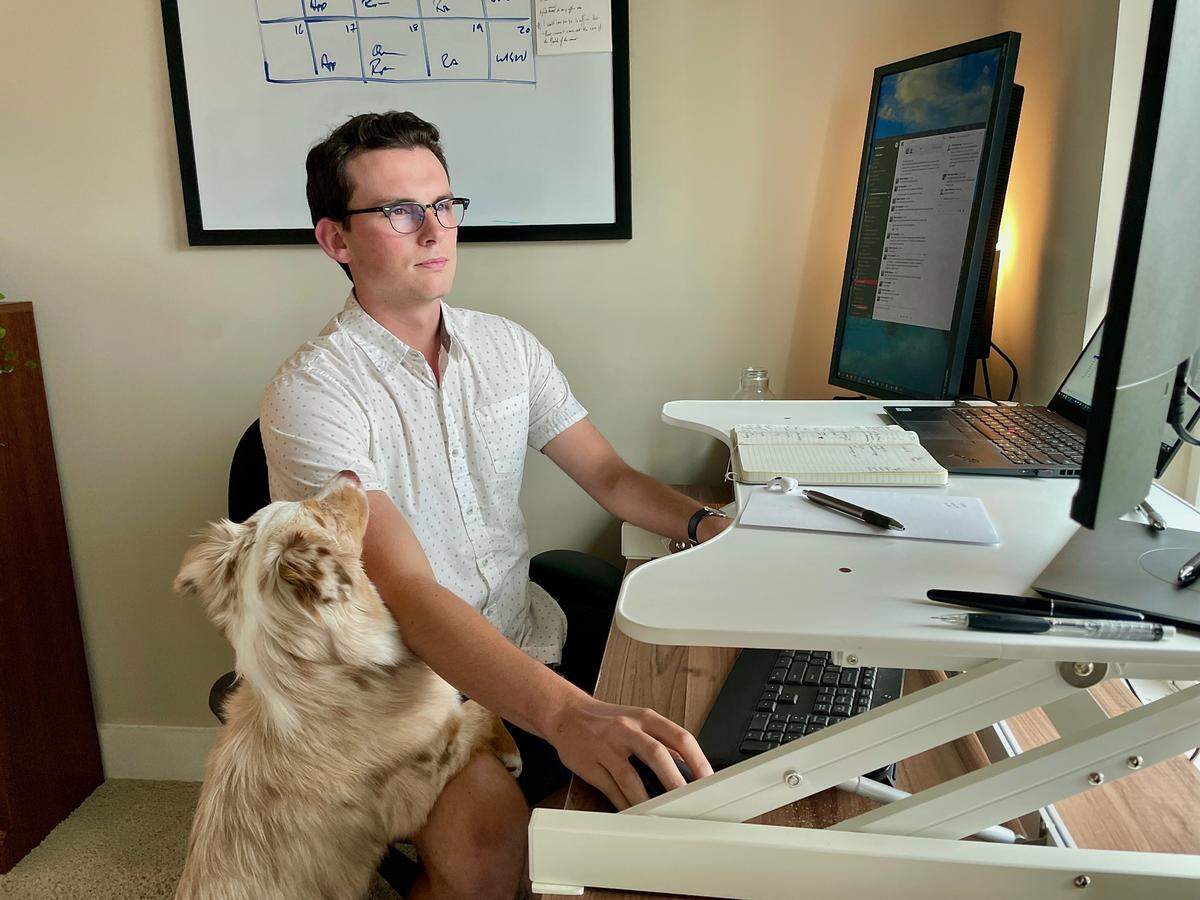
His first day on the job in his new career was sitting at a desk in his apartment’s guest bedroom. “It made it not seem as real early on,” Morgan said. “It has been super isolating. I haven’t left my apartment for the majority of this whole deal.”
One reason he wanted to work for Red Ventures was because of its campus, which features a full-sized basketball court, bowling alley, beer taps, fitness center and restaurants.
The company said it will open the Fort Mill office to employees on a voluntary basis but workers on campus during certain hours must be vaccinated. Red Ventures will not require workers to return to the office through the end of the year.
Morgan said he looks forward to meeting co-workers in person but likes the proposed hybrid model — a mix of in-office and at-home work schedule. “The social aspect is going to be huge but the tangible work doesn’t have to be done in the office,” he said.
Morgan, who is vaccinated but doesn’t want to see a shutdown again as cases rise, just when he’s finally been able to explore Charlotte.
“I don’t want to put in-office collaboration in front of the health of my co-workers, their families or the greater community,” Morgan said.
‘I get more done at home’
Susan Valenti has worked for uptown banks in Charlotte for more than three decades, first for Wachovia and now in Wells Fargo’s corporate risk department. Before the pandemic, she made the daily drive from Cotswold into uptown, a trip that took anywhere from 20 minutes to an hour to reach the office, depending on the traffic.
Now, she treasures the convenience of working remotely. “I love not having to commute,” she said. “If I sleep in late, I’m It doesn’t matter. I can just come in and start (work) in whatever I’m wearing.”
She also feels more productive.
And the arrangement has “definitely” benefited her work-life balance, Valenti said. Instead of the break room or the water cooler, she’ll spend a 10-minute break playing with her dog or sitting on the porch.
“Even if it’s just a short time, you feel rejuvenated (in a way) that you can’t really do in the office,” she said.
Wells Fargo plans to bring workers back to the office beginning in October. The bank previously stated that it would require employers to work in-person a minimum of three days a week.
There are some drawbacks to working from home. Valenti misses seeing her coworkers, and it can be difficult to form relationships with new colleagues that she’s never met in person. “It’s not that I don’t want to go back to the office,” she said. “But I get more done at home.”
‘Always have our guard up’
Since retiring as an architecture and urban design professor at UNCC in 2014, David Walters has been taking his art more seriously.
Walters and his wife, Linda Luise Brown, have an art studio at C3Lab in South End. But they both took a break from the studio as the coronavirus pandemic struck North Carolina.
“Everybody was so scared,” he said. “There was no real science out there to let us know what to expect.”
And the owners of C3Lab were “very conscientious,” he said — limiting hours and occupancy at the studio.
Walters and his wife got their vaccines last year.
After that, he and his wife, along with others at the collaborative studio, gradually returned to the building, with full masking and other precautions like regular hand-washing. He said he feels “moderately safe” working in-person at C3Lab.
Still, he added: “We are, like most sensible people, horrified at the number of people who are not vaccinated or who are rejecting it, because they put everyone in danger.”
For the most part, Walters is avoiding crowded public areas.
“That level of proximity and intimacy with strangers — for us, that may never come back,” he said. “We will probably always have our guard up to a certain extent.”
In recent weeks, with the uptick of COVID-19 cases due to the delta variant, Walters said he and his wife bring masks with them to the studio.
They don’t wear masks in their private office space, but don them during group meetings. Most people at the collaborative studio facility bring masks too, he said.
“Everybody is wary,” Walters added.
Cautious about coronavirus risks
Tim Stewart, a Matthews-based consultant at a Ballantyne financial services firm, said he’s wary of heading back to the office given the state of the pandemic.
He’s especially concerned about using shared spaces at work, he said, where “there’s a 50-50 chance that the person in that seat before you was unvaccinated.”
Only 50% of Mecklenburg County residents are fully vaccinated. As of Friday, Mecklenburg is notching 576 new cases each day on average, an 86% increase over the last 14 days, according to an Observer analysis.
Stewart, 67, has received the vaccine but continues to take precautions to avoid exposure to the virus. He wears a mask, avoids restaurants and times his grocery trips to spend as little time inside as possible.
“I haven’t been in a (public) building for more than 15 minutes in 18 months,” he said.
Stewart wasn’t the only respondent to the survey who expressed concern about vaccination rates and COVID cases.
Several vaccinated employees shared concerns about mingling with unvaccinated coworkers. One is worried they will bring the virus home to their 15 month-old son.
“My biggest concerns center around colleagues, ensuring they’re taking similar precautions related to staving off COVID,” an uptown worker shared. “I know we’re all excited to be back together in some capacity, but it doesn’t mean the virus isn’t a genuine threat to my health or the health of my family.”
As for Stewart, he said the city needs to make a lot more progress in controlling the spread of the virus before he would feel comfortable going into work.
Prior to his current job, Stewart was a Charlotte-Mecklenburg Police officer for nearly three decades.
“I’ve had my share of high risk in my lifetime,” he said. “I don’t think I deserve to put my health on the line.”
This story was originally published August 16, 2021 at 6:30 AM.