
Atrium Health details plans for $1.5 billion ‘innovation district’ around med school

Atrium Health provided new details Tuesday on plans for its billion-dollar “innovation district” surrounding the city’s future medical school, including the hospital system’s request for $75 million from the city and county.
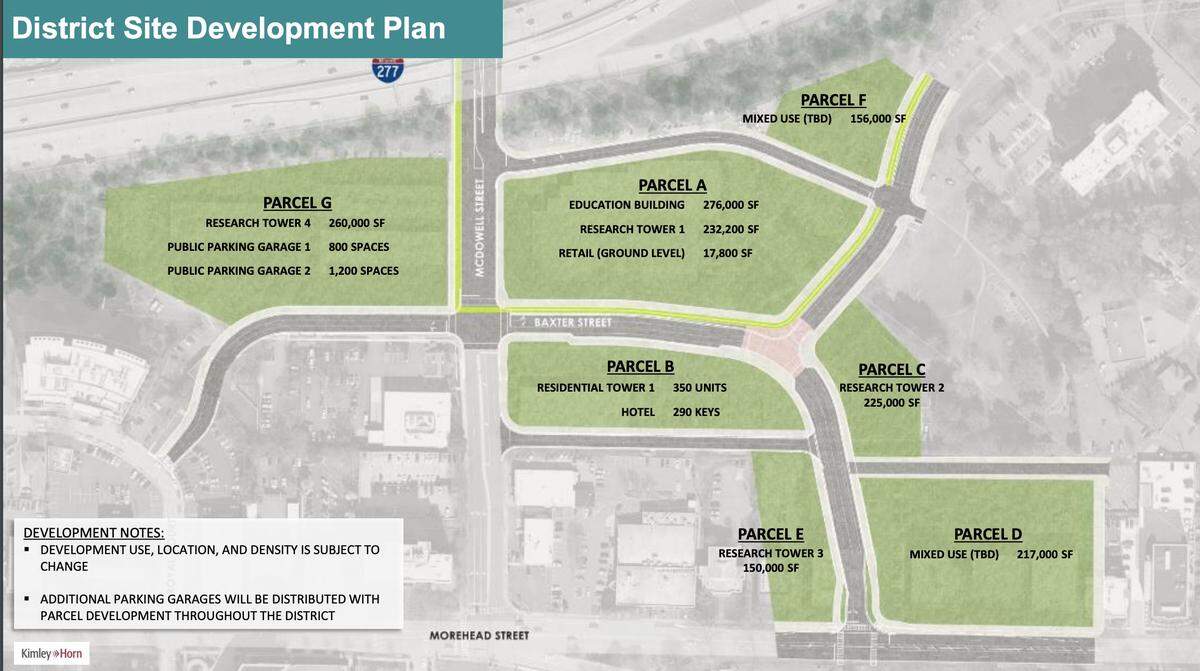
Plans for the district include a mix of research facilities, residential buildings and retail shops surrounding the med school. The district will be located near the intersection of McDowell and Baxter streets.
In October, Atrium Health officially combined with Wake Forest Baptist Health, including Wake Forest School of Medicine, paving the way for the partnership to bring a campus of the medical school to Charlotte.
The $75 million from the city of Charlotte and Mecklenburg County could go to create an 800-space parking deck, 4,358 feet of new or improved roads, four new intersections and other infrastructure work, including relocation and upgrades of sanitary and water lines, according to a county presentation Tuesday at the board of commissioners meeting.
The county’s funding share — roughly $38 million — would come from a tax increment grant. The county would provide a 90% reimbursement on Atrium’s county taxes for a number of years — up to $38 million. That amount will likely be paid out over almost 13 years, according to the county.
Some commissioners, though, expressed reservations about committing taxpayer dollars to the project.
Mecklenburg estimates that by the fifth year after the end of the grant, the county would have received nearly $44 million in retained taxes generated from the area. The city’s share of the grant includes $36 million in tax increment grants and capital funds.
The innovation district project is also expected to create 1,853 jobs in 2025, according to a county impact analysis.
Plans for the innovation district
In Atrium’s presentation, the hospital system outlined a development plan for the innovation district site that includes:
▪ Four research towers
▪ An education building
▪ Two public parking lots with a combined 2,000 spaces (and plans for other parking garages throughout the district)
▪ A residential tower with 350 units
▪ A hotel
▪ 1.4 acres of open space in front of the educational building
▪ Other mixed-use lots, along with 17,800 square feet of ground level retail
In September, Atrium Health, the city’s largest hospital system, said it planned to invest more than $1.1 billion in creating the innovation district. In total, the district will be supported by $1.5 billion in private investments, according to Atrium.
Charlotte is the nation’s largest city without a four-year medical school, according to Atrium Health. The school is scheduled to open in 2024.
“We will be training future physicians that will care for you, your family, your neighbors and your loved ones, right here in Charlotte,” Atrium CEO Gene Woods said to commissioners. “So our best and brightest students will not have to leave town go to another place for medical school. They’ll be able to stay here when they graduate. They’ll be able to practice here in Charlotte.”
Community involvement in the district
Atrium Health considered 10 sites for the district, Woods told commissioners — including one in South Carolina and others in rural areas of North Carolina.
But the site in Charlotte, near the Cherry and Dilworth neighborhoods, was chosen for many reasons, including its proximity to Atrium’s main campus and to light rail, he said. And it was chosen in part because it was around industrial spaces, Woods said. “We will not displace a single person,” he said.
Woods said members of his team spent three hours walking with resident’s of Charlotte’s Cherry neighborhood, hearing about the community and the displacement of residents from the former Brooklyn neighborhood — once the city’s largest Black neighborhood.
Atrium plans to form an advisory council of community members from those areas, Woods said.
The community advisory council would include five to six neighborhood representatives and members of grassroots organizations, according to Atrium. And four to five members will be from institutional partners, including academic institutions, workforce development programs and developers.
Affordable housing
As part of the innovation district, Atrium announced it plans to donate 14 acres in NoDa to Inlivian, Charlotte’s housing authority. The land is next to 14 acres Inlivian owns.
Together, the 28 acres will be home to around 400 units of affordable housing with a combination of rental units and for-sale homes, an athletic field and small park.
The 14 acres Atrium plans to donate are valued at about $25 million, Woods said Tuesday.
On the innovation district site, Atrium has said it plans for 5% of housing built in phase 1 to be priced for what it calls “affordable and workforce” housing, with most priced for households earning up to 50% of the area median income, or $29,500 for individuals and $42,100 for a family of four.
Woods said he shares commissioners’ passion about affordable housing. ”That’s where I grew up,” he said. “I spent a lot of time in affordable housing myself.”
Affordable housing typically describes units priced for households earning up to 80% of the area median income, while workforce housing is priced for households earning 80-120% of the area median income.
Charlotte desperately lacks affordable housing, particularly in fast-growing areas like NoDa.
New fund for minority businesses
Also at the county meeting, Woods announced that Atrium will set aside at least $5 million in a new business incubation fund for minority-owned businesses.
The hospital system is also committing to supporting minority business owners and small businesses, Woods said. And Atrium is working with Johnson C. Smith University, Charlotte’s only historically-Black college, to design a new pre-medicine program.
JCSU is receiving millions of dollars from Charlotte corporations and philanthropic groups, in the city’s new $250 million initiative for racial equity. Atrium is contributing $6.1 million to the initiative.
In March, Atrium announced plans for a scholarship fund, the Bishop George E. Battle, Jr. Scholarship Fund. The fund aims to allow students from disadvantaged and low-income communities to have equal opportunities to pursue careers in health sciences, Woods said at the time.
Atrium is investing $5 million, and hopes to receive matching money from the community to create a $10 million fund.
Commissioners’ concerns, praise
Commissioners largely praised the idea of an innovation district Tuesday, but many voiced their reservations on contributing public funds toward the project.
“I love the project,” Commissioner Laura Meier said. But she added, “I do question why we’re using taxpayer dollars.”
Commissioner Pat Cotham said she’s excited about the district. And a medical school would help boost health care in Mecklenburg County and the state, she said.
Cotham said she likes that county funds will make the project possible. “Economic development is part of our job,” she said.
Commissioner Mark Jerrell wants Atrium to consider how to spread the positive impact of the development to other areas of Mecklenburg, beyond the medical school’s immediate neighborhood.
And he’s concerned about residential displacement in areas surrounding the new development. “How do we put guardrails in place to protect those folks as well?” he asked.
What’s next for med school, innovation district?
Construction on Atrium Health’s medical school is expected to begin by early 2022.
If the county agrees to provide the grant for the surrounding innovation district, the money will be provided through an agreement with the city. The county can’t directly fund infrastructure, according to the county commissioners’ presentation.
Commissioners are scheduled to vote on an interlocal agreement with the city on Nov. 16, authorizing county manager Dena Diorio to agree to an amount up to $38,356,477.
The city has not yet voted on the funds, but previously said it would likely hold a vote in November.
Observer reporter Lauren Lindstrom contributed to this article.
This story was originally published November 9, 2021 at 4:31 PM.
.jpg)