These car lots cluster in Charlotte’s poorer neighborhoods — that’s no coincidence
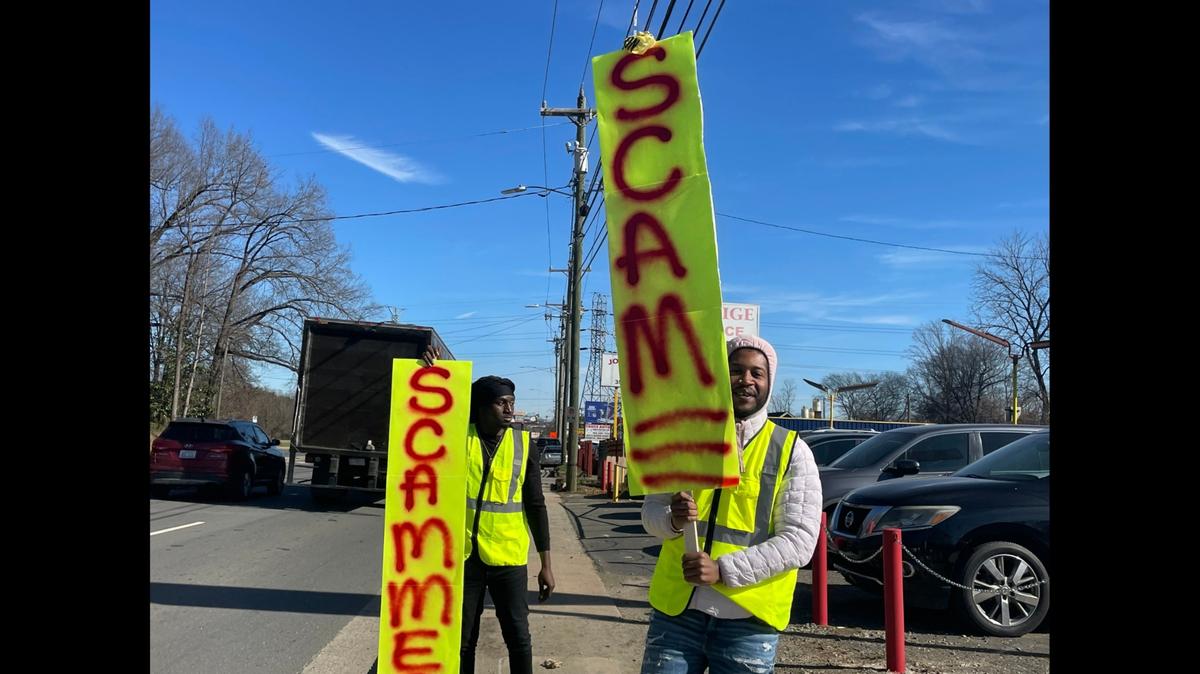
There’s only a thin strip of sidewalk separating the 1 Stop Auto Sales car lot from the busy six-lane North Tryon Street that connects some of Charlotte’s lowest-income neighborhoods. Steven Mackey Jr. paced it back and forth for days.
Mackey, 31, and his partner, Christian Edwards, stood outside the business for hours a day in mid- to late-January, carrying neon yellow signs that read “SCAMMER” and shouting the same message as cars drove past.
Mackey’s car was repossessed by the buy-here, pay-here dealer early last month. Mackey says he was sold a faulty vehicle that was unexpectedly repossessed despite his willingness to continue making payments. The dealership says it abided by the terms of its contract.
Customer-business disputes can happen at any car dealership — but there’s a long-standing trend of potential problems with those catering to buyers with no credit, bad credit or limited financial means, experts say.
“They sell you the car, but they don’t expect you to pay it off,” said Ed Mierzwinski, senior director of the federal consumer program at the Public Interest Research Group. “They’re not trying to help you, they’re trying to simply maintain their revenue stream.”
When reached by The Charlotte Observer via phone, a man at 1 Stop Auto Sales who Mackey said sold him the car told a news reporter that he couldn’t talk about the situation publicly due to the business’s privacy policy.
In response to Mackey’s recent public protesting, the business wrote on its Facebook page: “We are a Buy Here Pay Here car dealership. We do not charge interest, nor do we verify credit... In which case you fail to make (payments)... or your account becomes past due on your regular payments, your contract is in default and your vehicle will be repossessed without notice... Repair issues are no excuse for missed payment.”
Though faulty new cars are protected by lemon laws in North Carolina, used cars in the state are sold “as is.” That means that, without a warranty or similar contract, you’re buying a car defects and all.
But beyond vehicle quality issues, Mackey’s experience points to to the broader economic equity issues oft-cited in debate over the buy-here, pay-here business model.
1 Stop isn’t the only dealership on North Tryon that offers used cars for low-credit buyers. The street is lined with car lots catering to these customers: “Easy approval,” one advertises. “No credit check,” another says.
These dealerships offer low-income buyers a seemingly more affordable way to buy a vehicle in car-dependent Charlotte. But experts told The Charlotte Observer that it often comes with a higher risk of shady loans, repossession and sometimes scams that can leave vulnerable customers even worse off than before.
The risks have been known to North Carolina officials for nearly a decade. In 2014, then-N.C. Attorney General Roy Cooper and the U.S. Department of Justice filed a complaint against two used car dealerships in Charlotte that they alleged specifically targeted Black borrowers with predatory car loans. The named dealerships — which didn’t include 1 Stop Auto Sales — settled in 2015 for $225,000 in compensation to harmed consumers.
‘Repossession Mills’
The Observer counted 13 used car dealerships along a 3-mile stretch of North Tryon Street. Of those, seven advertise themselves as “buy-here, pay here” or as catering specifically to customers with low or no credit.
The businesses are clustered on a strip of thoroughfare that begins near the Hidden Valley neighborhood and runs down to NoDa.
These kinds of dealerships can be rife with risks for buyers, said John Van Alst, a staff attorney for the National Consumer Law Center. It’s no coincidence they’re often located in low-income areas.
Some lend directly to customers. Others work with outside lenders but have many of the same features like limited credit checks, high interest rates and strict repossession policies.
Not every used car or low-budget dealership uses those methods or takes advantage of customers, Van Alst noted.
But consumer advocates warn buyers to be on high alert when dealing with potential subprime auto lenders. That includes buy-here, pay-here dealerships as well as a number of auto financiers that lend to buyers from multiple lots, he said.
Dealerships will often direct “prime” car buyers — those with higher credit scores, viewed as more likely to pay back a car loan — to loan arrangements with banks or credit union, Mierzwinski explained. And franchised auto dealers (for major car companies like Chevrolet or BMW) are subject to some policing by manufacturers through their franchise agreements.
But subprime customers — those with a poor credit history — are more likely to see their financing come from an auto finance company that caters specifically to low-credit borrowers.
In the case of a buy here pay here, the financing comes in-house directly from the dealership.
“A lot of these are organized in such a way that they’re unaffected by the success or failure of the consumer’s ability to make payments,” Van Alst said. “Sometimes they’re even structured so that the creditor is better off when the consumer fails.”
Subprime auto lenders and buy-here, pay-here dealerships address a need in the market: a car, used or new, is a costly purchase that got a lot more expensive in the last few years, Mierzwinski said. In Charlotte and many other cities, it’s nearly impossible to get by without a vehicle.
“In most parts of the country, you need a car to get to work even if you’re poor,” he said. “You’re stuck, because in our transportation, most of the (public) money goes into roads and not public transit.”
But buy here, pay here dealerships can employ business models or methods that disadvantage the consumer, said Rosemary Shahan, the president and founder of Consumers for Auto Reliability and Safety. Some sell cars that are in poor condition, knowing it may break down. Others offer loans with large down payments or exorbitant interest rates, expecting customers to fall behind.
Those kinds of tactics can help build a business model that relies on repossessions, Van Alst said.
“It’s what we call a ‘repossession mill,’” he said. “They use the cars that they repossess from current or past customers for inventory.”
The impact on consumers can be severe, Shahan said.
“The repossession stays on your credit report for seven years. A lot of people lose their jobs, because they can’t drive to work,” she said. “The consequences for people when deals go sour can be devastating.”
‘It doesn’t excuse the business model’
For Mackey, it means he’s out about $4,000 and down to just one car between him and his partner, he said.
“I have a vehicle, so we will be OK,” Edwards said. “But it won’t be the same for someone else.”
Mackey went to 1 Stop because he knew the owner from another dealership in Charlotte, he said, and because he needed a seller that could work with his low credit. Student debt from paying culinary school tuition has dragged down his score.
But shortly after he bought his Ford Explorer, he said, the car showed signs of a mechanical problem. The engine would make a knocking sound, he said. At first, he says, the dealership worked with him to find a technician and make repairs. But the issue reoccurred shortly afterward, Mackey said, eventually rendering the car undriveable.
Mackey said he was given conflicting information over how and when he could make a payment. And when he went to the car dealership in mid-January to make a payment in cash and confront the owners about the situation, he says, his car was repossessed from the parking lot of his apartment complex.
He’s posted multiple times about his experience with 1 Stop Auto on Facebook and TikTok, calling the business a scam and sharing pictures of his protesting outside the dealership.
Through those posts, he said, he’s heard from other car buyers with similar experiences at other car lots in Charlotte. One message was from a young single mother who said she lost $7,000 on two repossessed cars, Edwards said.
Mackey wants to keep other buyers from suffering a similar loss.
“I’m not arguing with the terms (of my agreement). I signed my contract. I’ve pretty much counted my losses,” he said. “But it doesn’t excuse the business model … you come into our community, and you take from us. I don’t take kindly to it.”
This story was originally published February 13, 2023 at 6:00 AM.