Nearly a quarter of Charlotte’s offices are vacant. Will the trend get worse in 2025?
The biggest concern for Charlotte’s office market in 2025 will continue to be high vacancy rates. It’s prompting property owners and city officials to begin thinking about effects and solutions.
The Charlotte metro’s office vacancy rate ended the year around 24.6%, according to a report from Cushman & Wakefield, which includes suburban areas such as Matthews. That’s a little lower than record high numbers the city saw mid-2024 but the rate sat between 22% to 24% all of last year.
The national average hit 20% at the end of 2024, according to Moody’s Analytics.
There’s about 840,000 square feet of office space in construction, according to the report. So while construction has decreased, there’s still an expectation that the market will eventually right itself, the report adds. Less new space means there’s more demand for existing space.
But that demand will be slow moving, said Yongqiang Chu, director of the Childress Klein Center for Real Estate at UNC Charlotte Belk College of Business.
“The office market has been very weak since COVID and the market will be soft for at least several years,” Chu said. “Employers have reduced their demand for office space…Growth is a possible solution. Charlotte is still growing and companies are still moving to this area but it will take a while for that growth to affect the demand side.”
The likelihood of a long-term soft office market has reignited conversations among city leaders questioning whether short-term solutions should be created.
Causes, solutions and effects
Besides low demand, one of the major causes of high vacancy rates is the construction boom in 2018 and 2019. Many of those office buildings opened during or after COVID and ended up with no tenants, including 110 East, a 24-story tower in South End that opened last year, and Escent Research Park, a 159,000 square foot university-area campus that opened in 2021.
Another factor influencing the vacancy rate is employers moving to nicer, newer buildings with more amenities.
That shift leaves some buildings, including older space in Uptown, with fewer occupants.
“It’s internal shuffling,” Chu said. “The Uptown buildings are relatively old without much amenities and that’s why they are losing out to the new buildings in South End or Ballantyne.”
Uptown buildings are trying to keep up.
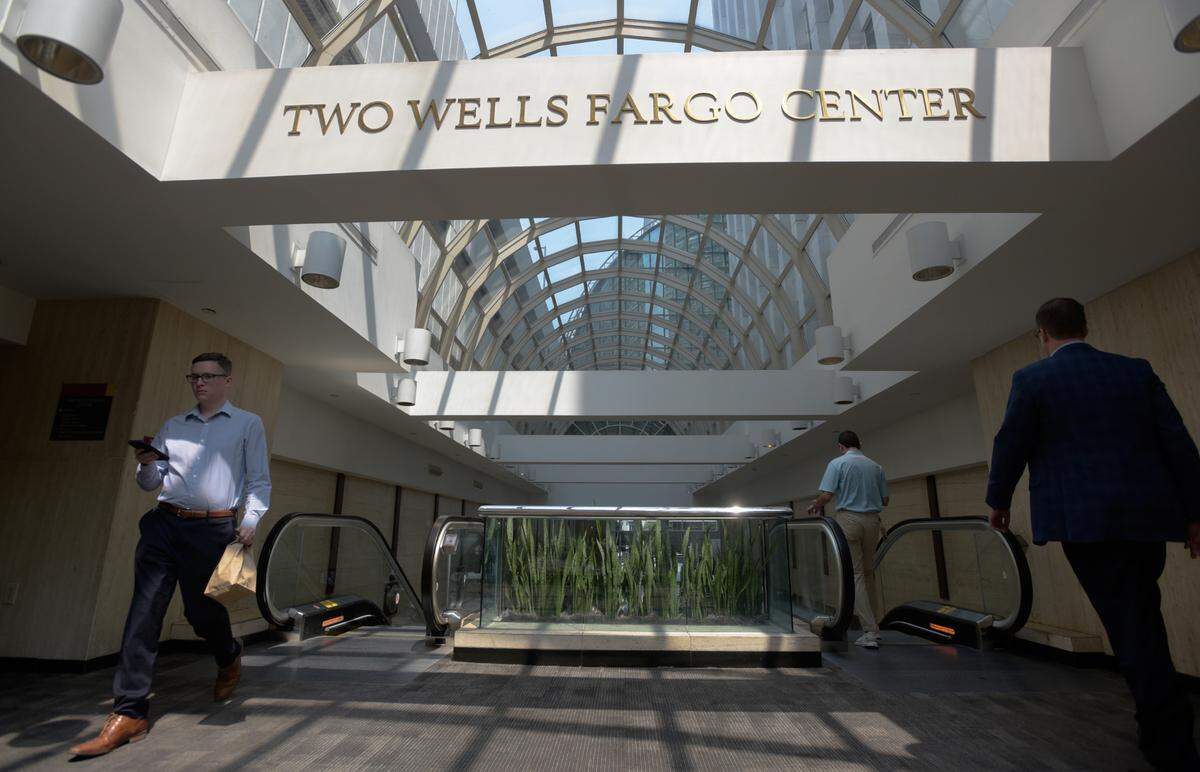
Spaces like the Wells Fargo’s skyscraper at 550 S. Tryon St and One Independence Center at 101 N. Tryon St. have already made millions of dollars in changes to their spaces to attract tenants.
Cousins Properties just announced it would renovate 550 South, the former NASCAR Plaza building on S. Caldwell Street, also seeking to entice tenants.
Some owners are going the conversion route, including the 100-year-old Johnston Building on Tryon Street that’s set to become a hotel and the former Duke Energy headquarters on South Church Street, which will be redeveloped into housing and retail space.
But some buildings are falling behind, leading to low sales and foreclosures.
In December, 121 W. Trade St. sold for about $32 million, which is significantly less than its last transaction price of $71.6 million, CBJ reported. The building was about 51% leased when it sold, according to seller representative CBRE, and is the longtime home of the Charlotte City Club.
Also in December, 200 North College, which housed a branch of Wake Forest University, sold for $32.9 million, after the original owners defaulted on the loan, as reported by The Charlotte Ledger.
Another building, 400 South Tryon, is set to be auctioned off on Jan. 10, CBJ reported. The foreclosed loan has an outstanding balance of more than $90 million.
Why does this matter?
Chu said the city could see more properties selling for lowered prices or falling into foreclosure.
“About a year ago, 30% of Uptown office buildings were in delinquency and that means they missed a payment already,” Chu said. “When default actually happens, there’s different outcomes depending on who the lenders are.”
Chu adds that this will be a problem for small banks though he doesn’t think it will threaten the whole system, like the Great Recession
As for property owners, there’s revenue loss.
Early 2024 vacancy rates show a revenue loss of $462.2 million, according to a report from Switch On Business, an insight firm, and reported by the Charlotte Business Journal.
If property values follow suit, it could lead to a loss in commercial property taxes.
Charlotte, as with most cities, relies mainly on residential property tax. But just under 20% of the city’s general revenue comes from commercial property taxes, according to a report from the Urban-Brookings Tax Policy Center, a nonpartisan public policy institute.
About 30% of the city’s general revenue comes from residential property, the report adds. The center looked at 47 cities with data collected between 2013 through 2022. Charlotte made the top 25 in cities dependent on its commercial and residential property taxes.
If the city needs more funding because of a decrease in commercial property taxes, it may need more residential property tax, Chu predicts, though it would be a far away solution.
“Property taxes are the biggest revenue item,” Chu said. “If you have one chunk of your revenue item decreasing, then you have to make it up somewhere else…Because housing prices have increased quite a lot, I’m not sure how much they need to actually raise the property tax rate, but [the city] definitely could collect more property tax from the residential side to make up for the decreases on the commercial side.”
Though, Chu adds, this solution is not in the immediate future.
Will the city get involved?
Office vacancies and the market have been on the radar of the City Council’s jobs and economic development committee for over a year.
The topic returned last week with some suggestions on how the city could be a partner in helping the market.
Some possibilities include partnering with developers, owners, county and other economic leaders on a study to better understand the issue, zoning code changes and incentives like a demolition fund for buildings that are not worth saving.
One of the main questions: should the city get involved?
“This is bigger than just the city” said Malcolm Graham, committee chair. “It’s a community approach of a lot of stakeholders…We all have to work together to come up with a community response versus a city response.”
Council member Ed Driggs agreed, noting that the city needs to gauge what the “public interest” would be.
“At all times, we need to say where is the impact in the public domain,” Driggs said.
Chu said the city should consider how the zoning code could help these buildings, especially ones considering conversions.
“In development, a large chunk of effort and cost is related to rezoning,” Chu said. “If the city can make that efficient and faster, it will help.”
Easing the zoning from strictly office space to a more flexible use, especially for buildings like the Escent property, may entice a tenant to utilize the space, said Tracy Dodson, assistant city manager and head of the economic development division.
She added that office conversions into residential spaces are going to be a small but important segue for some of these buildings and the zoning code should reflect that.
The committee didn’t vote on implementations, but office vacancies aren’t going away.
This story was originally published January 13, 2025 at 6:00 AM.