How reinvesting a certain way could bolster the future of Charlotte’s downtown districts
Revitalizing and converting older buildings into office spaces filled with amenities or residential quarters for permanent or hospitality uses will be a key focus for Charlotte’s uptown, midtown and South End districts.
That’s according to Charlotte Center City Partners’ annual State of the Center City report, which was released Thursday and looks at how the area is growing. Center City Partners is a nonprofit focused on promoting growth in the downtown districts of uptown Charlotte, midtown and South End.
About $1.7 billion will be invested into reimagining aging spaces this year with the goal of transforming the area from a business-centric district into a destination district.
“You need a good blend of work, live, play, and one of the things that the pandemic taught us is that if you’re over indexed in any one of those sectors you have a vulnerability,” said James LaBar, the senior vice president of economic development for the center city group.
“A number of downtowns across the country are dealing with older office buildings and questioning what do you do with them,” LaBar said. “I think everyone’s really attuned to what makes existing office more valuable, it’s probably not more office. It’s office being surrounded by a mixture of uses.”
Office vacancy concerns
One of the questions center city organization has asked, according to LaBar, is what is the community doing about the office vacancy rates.
Throughout last year, office vacancies sat between 22% and 24%, and had hit a record high of 24.7% in July.
The Charlotte metro’s office vacancy rate ended the year at around 24.6%, according to a report from Cushman & Wakefield, which includes suburban areas such as Matthews. In Charlotte alone, the rate was 22.4%, according to a report from JLL.
The high rates stem from low demand, the construction boom in 2018 and 2019, and aging buildings that no longer appeal to tenants.
But all that is expected to change this year. Construction on new office spaces has slowed, which will increase demand in existing spaces.
And, to the center city group’s point, renovating or reusing aging spaces is rapidly increasing.
New life in old buildings around Charlotte
Buildings like the Wells Fargo’s skyscraper at 550 S. Tryon St., One Independence Center at 101 N. Tryon St. and One South at 101 S. Tryon have spent millions of dollars on changing their spaces to attract tenants.
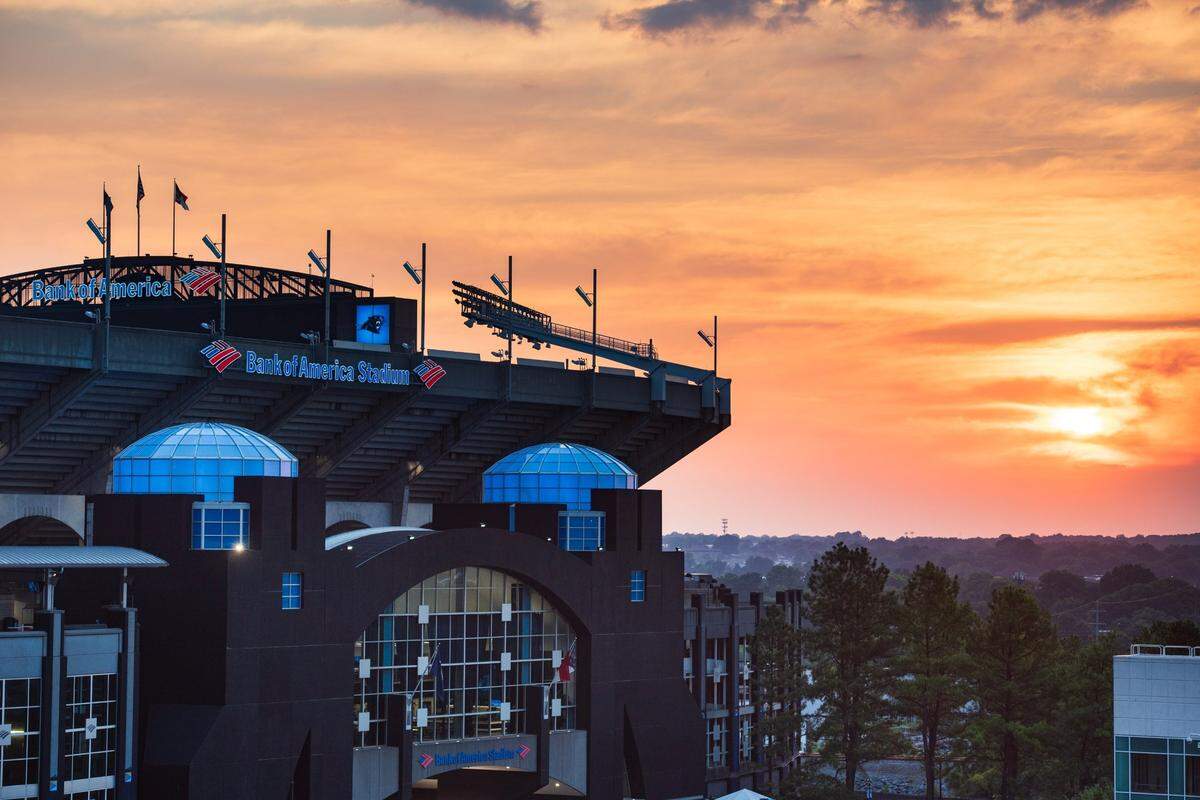
And new renovations are coming. Cousins Properties is modernizing 550 South, the former NASCAR Plaza building on S. Caldwell Street. Also, part of the $1.7 billion investment is going toward upgrading Bank of America Stadium and the Spectrum Center.
There’s also the conversions.
The 100-year-old Johnston Building on Tryon Street will be the Beckworth Hotel and have about 245 rooms and space for retail. Blume Studios from Blumenthal Arts opened in a 1.5-acre warehouse in the Iron District.
And 200 N. College Street, which housed a branch of Wake Forest University, will be converted into residential and retail space.
The mix of renovating office spaces, coupled with newer spaces to live and have fun are helping businesses bring workers back to the office. It’s also providing a space for Charlotteans and visitors to explore.
“One of the things we’ve found about people coming back together is a combination of mandates and magnets,” LaBar said. “With employers requiring people to come into the office a certain number of days per week, what we have found to be most helpful is coupling those mandates with really attractive places to work… Make work more rewarding and surround offices with other uses that create a magnetic effect.”
New developments in Charlotte
While there’s a focus on older spaces, attention is still being given to new developments.
About $3.7 billion is being invested in new developments, which are either under construction or set to break ground in 2026.
The projects will ultimately bring about 7,110 apartments, 2.2 million feet of office space, 338,800 square feet of retail and 1,630 hotel rooms to the downtown districts in the upcoming years.
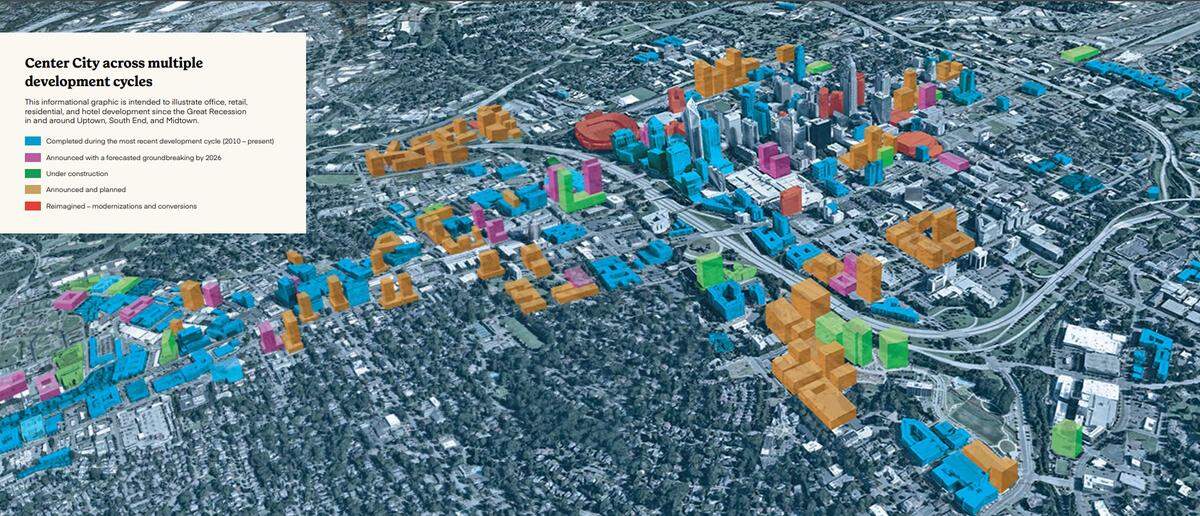
However, there’s a decrease in product from previous years. To be exact, it’s about $700 million less in developments than last year and about half the total in 2023.
That stems from two factors, LaBar said. Many projects were completed last year, including 110 East and over 2,000 apartments in South End. Plus, construction is slowing.
“The way that you get into the pipeline is something starts, something breaks ground and because of high monetary costs, we don’t have the same number of starts happening,” LaBar said.
That is not necessarily worrying his group because the investment in renovations and adaptive reuses is creating a balance, LaBar said.
Looking ahead for development
Some of the big new developments the center city group is looking forward to seeing grow are the Iron District, The Pearl and the North Tryon Tech Hub.
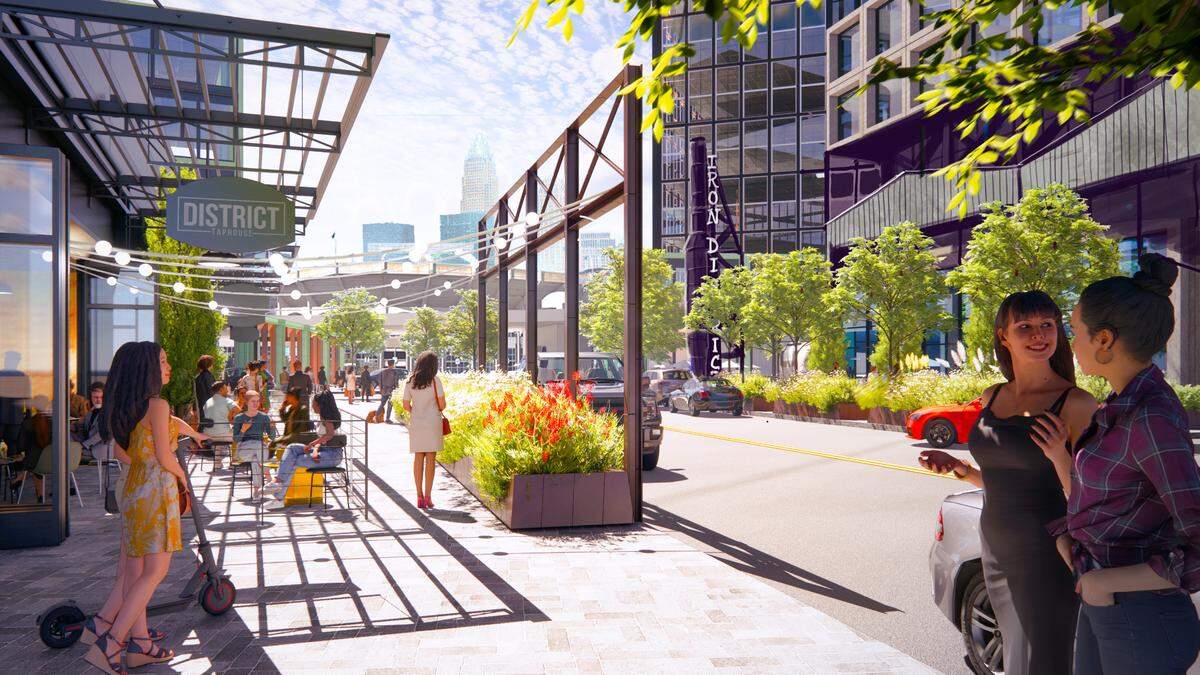
The Iron District, is a mixed-used project on the former Charlotte Pipe & Foundry Company site in uptown and South End. About 12 acres of the 55.5 acre site will be developed by Trammell Crow Co.
Initial plans call for 500 residential units, a 150-room hotel, 100,000 square feet of retail space, 150,000 square feet of Class A office space and over 1,200 parking spaces.
While the Iron District will be more focused on creating a walkable neighborhood, Pearl and Tryon Tech will be the enticing pieces for job and talent growth.
Charlotte’s first four-year medical school, the new Wake Forest University School of Medicine-Charlotte, is already under construction at The Pearl. The new campus will be located on 20 acres at the corner of South McDowell and Baxter streets.
Affordable housing is also planned for the site. It will also be the headquarters for Advocate Health, the parent company of Atrium Health.
The Tech Hub, in partnership with UNC Charlotte, will be a place where startups, established businesses and students can collaborate on innovation work sector including AI, fintech and cybersecurity.
Overall, the goal is to give people a number of reasons to head downtown. Both for old and new residents.
“You need that balance,” LaBar said. “If you can take the light rail, car or bus, get off and get out and experience that mixture of uses, those are the places the talent of tomorrow wants to be.”
Correction: This story was updated to show the number of projects coming to uptown and South End. An earlier version had incorrect numbers.
This story was originally published February 3, 2025 at 6:06 AM.