‘It’s a real concern.’ Trump cuts to clean air grants worry Charlotte communities
Sean Langley is proud to be a resident of the McCrorey Heights neighborhood.
Stepping outside his Oaklawn Avenue home, Langley picked up litter outside his house. Besides the carelessness of a few trifling litterbugs, the streets are clean with manicured lawns. But it’s a different story for the air and the pollution residents can’t see from vehicles on Interstates 77 and 277.
“Smell the air, it’s really thick,” he said walking through the community in Charlotte’s West End. As Langley neared the Brookshire Freeway, a couple children riding their bikes laughed and smiled with excitement.
“Those aren’t my kids,” Langley said. “But they live in this neighborhood and I care about them just like I care about my own.” And like any parent, he’s concerned about their health. “If the kids have asthma, they are directly affected by the pollution,” he added.
Residents fear that federal spending cuts from the Trump Administration, billionaire Elon Musk’s Department of Government Efficiency group and the Environmental Protection Agency will harm their neighborhood.
Organizations like CleanAIRE NC are worried too. The Charlotte-based nonprofit installed air monitors in McCrorey Heights in 2024 through a $75,000 EPA grant awarded in 2021. But a $500,000 EPA grant last year to help with similar efforts in north Mecklenburg County has been frozen by the feds.
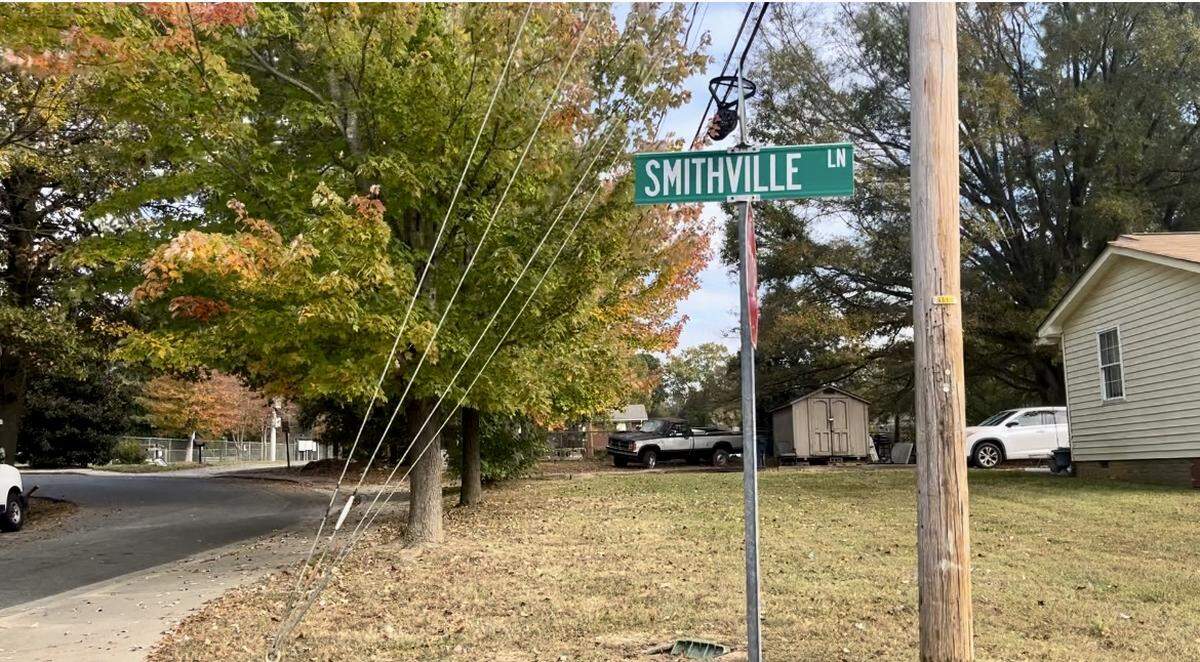
That grant was for monitoring air quality in four communities which have higher pollution exposures because of energy plants near them: Smithville in Cornelius; Huntington Green and Pottstown in Huntersville; and West Davidson in Davidson.
“We’re able to track the air quality, and it’s not good,” said Langley, president of the McCrorey Heights neighborhood association.
In 2017, CleanAIRE began installing monitors in several Historic West End neighborhoods. Along with McCrorey Heights, this included Washington Heights, Northwood Estates, Hoskins Road and Oaklawn Park.
So far, CleanAIRE plans to continue with monitoring air quality in the neighborhoods. But the funding freeze has stalled plans for its other regional plans.
McCrorey Heights residents are also asking the state for a sound barrier along the highway, which borders the historically Black neighborhood. In the late-1960s, the city and the state removed homes along the highway. A wall was placed for a portion of the area, but doesn’t cover the entire freeway, leaving the neighborhood vulnerable to debris and loud noise.
Langley is worried that cuts to EPA grants and other federal funding may hinder progress for a new barrier, especially with the highway being state-owned property.
“(The DOGE cuts) have ramifications not just at the national level,” he said, “but also at the local level as well.”
EPA slashes funding
The EPA and DOGE have so far canceled hundreds of grants nationwide.
In the most recent round of cuts announced mid-March, more than 400 grants totaling $1.7 billion were slashed, according to an EPA news release.
“Working hand-in-hand with DOGE to rein in wasteful federal spending, EPA has saved more than $2 billion in taxpayer money,” EPA Administrator Lee Zeldin stated. “It is our commitment at EPA to be exceptional stewards of tax dollars.”
But not everyone feels that way about the cuts.
“People cannot have a good quality of life if they do not have health, and their health is tied to the environments that are around them,” said Andrew Whelan, a CleanAIRE spokesman. ”Everyone deserves to breathe clean air”
The Environmental Protection Network also expressed concern with the EPA cuts. Founded in 2017, the Washington, D.C., organization includes more than 600 former EPA workers from Democratic and Republican administrations.
The network recently spoke out against job and grant cuts stemming from the elimination of the EPA’s Office of Environmental Justice and External Civil Rights. That office was tasked with protecting communities from pollution and climate change.
EPN volunteer Stan Meiburg is also concerned.
He was the acting EPA deputy administrator during the Obama administration. Meiburg worked with the EPA for almost 40 years, and currently is executive director of The Sabin Center for Environment and Sustainability at Wake Forest University.
“These are cuts that are going to have the potential to really adversely affect the health and welfare of people throughout the (Charlotte) metropolitan area,” he told The Charlotte Observer. “And in a time when environmental quality is so important to everyone, I think regardless of the party, it’s a real concern.”
Charlotte is close to not attaining ozone air quality standards, Meiburg added.
If that happens Charlotte would be classified as a non-attainment area for not meeting EPA’s National Ambient Air Quality Standards. After that status, state and local governments would have to make plans to reduce air pollutant emissions.
“Charlotte’s worked hard to try to meet that standard in recent years,” he said. “And if the cuts result in backing off of enforcement or other actions that make air pollution go up, that will have an impact on the city and on the metropolitan area.”
Cleaning the air around Charlotte
Despite its EPA grant being frozen, CleanAIRE does not have plans to cut jobs and is seeking funding elsewhere to support its staff of 17. The nonprofit had expenses of $1.3 million and reported revenues of $1.1 million, according to its 2023 annual report. From that total, grants comprised 67% of its funding.
The grant was from the EPA’s Environmental Justice Collaborative, which is now in jeopardy, according to Whelan. The Clinton-era initiative ‘s goal was to address problems in minority and low-income populations.
Along with education efforts, the grant allows CleanAIRE to add sensors to collect data about pollutants that can impact health.
In north Mecklenburg County, CleanAIRE was testing equipment that would have been installed when the grant was terminated. This will impact the organization’s ability to install monitors.
Funding freezes have created instability and made it nearly impossible for groups like CleanAIRE to execute long-term projects, according to Whelan.
“It can damage our relationships with community partners, and ultimately harm the people that we’re trying to serve,” he said. “This project is a commitment that we’ve made to the people on the ground in north Mecklenburg County, who deserve clean air and a healthy environment.”
CleanAIRE joined two other nonprofits to file a lawsuit in federal court to try to stop the Trump administration’s freeze on federal funding and critical programs. The Southern Environmental Law Center and the Public Rights Project filed the suit in the U.S. District Court in Charleston.
Lisa Mayhew-Jones, executive director of the Smithville Community Coalition, also questioned how federal leaders can back out of agreements with funding freezes.
“You have the overseers of your health and that’s what the EPA supposedly is,” she said. “To have funds cut for that type of thing really speaks volumes as to if people really care about humanity and what’s put out in our air.”
DOGE cuts impact the Charlotte region
The Smithville Community Coalition helped CleanAIRE get the grant to study air quality in north Mecklenburg County.
The coalition was founded in 1968 before the historically Black neighborhood joined the town of Cornelius in the early 1980s. Its mission is to create a revitalization plan for the community. This includes expanding affordable and workforce housing. There are about 60 homes in Smithville, with an estimated 120 people living in them, according to Mayhew-Jones.
The CleanAIRE collaboration led to a community healthcare worker educating the public with plans to put air quality devices in people’s homes. Monitors have not been placed in Smithville homes yet, but the coalition was working to do that.
CleanAIRE has installed some in Huntersville’s Pottstown community. Plans are underway for Smithville, but cuts from the Trump administration may put those plans in jeopardy, according to Mayhew-Jones.
“The community is going to suffer without having these studies done,” she said. “That’s the saddest part to me.”
The coalition is also trying to check if lead paint is in homes. But funding for testing and removal nationally has been pulled by the Trump administration too, according to Mayhew-Jones and published reports.
“I know some people don’t think about the environment and the health of people, but pulling back these funds can cause issues for folks,” Mayhew-Jones said. “We have a lot of seniors with fixed incomes. That means more health challenges and more health costs without being able to do these studies and have clean air.”
Concerns over health disparities
Under the Biden administration, environmental organizations like CleanAIRE saw historic investments for marginalized communities, according to Daisha Wall, community science manager for CleanAIRE. She’s concerned about losing that momentum.
“I also worry that health disparities could worsen,” Wall said “Air pollution and other types of environmental pollution is directly linked to asthma, heart disease and other serious health conditions. Without continued monitoring and mitigation efforts, already overburdened communities may face worsening health outcomes.”
Wall has helped neighborhoods like McCrorey Heights set up air monitors, which use sensors to measure air quality. Laser-based technology detects airborne particles which are transmitted via WiFi to an online map for public access.
CleanAIRE has deployed 312 sensors statewide, including 102 in communities impacted by pollution from highways, industry, quarries, landfills and concentrated animal feeding operations
Historically, researchers and institutions have collected data about communities, but don’t involve them in decision-making, Wall said. “At CleanAIRE, we are committed to community-led air monitoring, ensuring that residents are not just the sources of data, but the owners, interpreters and beneficiaries of that information,” Wall said.
Ron Ross, president of the Northwood Estates neighborhood association, was one of CleanAIRE’s original “AirKeepers,” volunteers who monitor air quality with the devices. He also was instrumental in the effort for the Beatties Ford Road corridor.
Like McCrorey Heights, his neighborhood was impacted by freeway construction. There are also a lot of industrial facilities with diesel trucks nearby.
The DOGE cuts are disheartening, Ross said. But he’ll continue to make his voice heard when it comes to environmental issues in his community.
“We have to continue to reach out to our local government and (elected officials) to let them know that we’re not happy,” he said.
Wall said the shift in funding plans is frustrating after CleanAIRE had made progress. She feels its work with community members should be strengthened, not dismantled.
“If this funding dries up, it will be yet another example of how environmental justice is treated as an afterthought rather than a priority,” Wall said. “At this moment, it’s crucial for community organizations, policymakers and advocates to push back and find ways to maintain these critical programs.
“The health and future of front-line communities depend on it.”
This story was originally published April 7, 2025 at 5:30 AM.