2 historically Black Charlotte communities move closer to national recognition
Two of northwest Charlotte’s historically Black neighborhoods, McCrorey Heights and Oaklawn Park, are on their way to becoming recognized nationally.
And residents hope that the designation stops or changes highway development plans that would significantly alter the neighborhoods.
On Monday, Charlotte City Council formally accepted a $21,500 federal grant that will help push forward nominations for the neighborhoods to be placed on the National Register of Historic Places.
The Underrepresented Communities Grant is from the National Park Service and is funded through the Historic Preservation Fund. The grant was created in 2014 to help underrepresented communities fund and develop their National Register of Historic Places nomination.
The register is a federal list of places, buildings and objects that are significant to American history. There are over 100 entries on the register in Charlotte including Billingsville School, Latta Arcade and the Wesley Heights Historic District.
Last year, Charlotte was one of 19 cities to receive the grant to help McCrorey Heights and Oaklawn Park create their nominations. The funding will go toward researching and documenting the neighborhoods’ histories.
“McCrorey Heights is one of the most iconic, historically Black neighborhoods in all of America. Every single home has a storied history,” Sean Langley said at Monday’s council meeting. He’s the president of the McCrorey Heights neighborhood association.
“McCrorey Heights was home to educators, including five college presidents, civil rights lawyers, medical doctors, theologians that all have collectively worked to dismantle the walls of segregation in public spaces here in Charlotte.”
Civil rights leaders and Black history in Charlotte
Both McCrorey Heights and Oaklawn Park were neighborhoods built for Black Charlotteans during times of segregation.
McCrorey Heights is the oldest. It was founded in 1912 by the Rev. H.L. McCrorey, the second Black man to serve as president of Johnson C. Smith University.
Oaklawn Park was built by white developer Charles Ervin, beginning in 1955. Ervin was one of the largest builders at the time and one of the few to build homes for Black families. But he was also known for barring Black homebuyers from buying in white subdivisions through deed restrictions.
Both neighborhoods thrived and were home to prolific Black and civil rights leaders. Civil-rights attorney Charles Bell and Dorothy Counts-Scoggins, one of the first Black students admitted to Harry P. Harding High School during integration, both lived in McCrorey Heights.
Mary T. Harper, who co-founded the Harvey B. Gantt Center for African-American Arts + Culture, and Dr. C.W. Williams, a physician who led desegregation efforts in Charlotte medical facilities, lived in Oaklawn Park.
The Johnson family, owners of The Charlotte Post, have lived in both neighborhoods.
McCrorey Heights and Oaklawn Park preservation
The register nomination is all about honoring and recognizing the neighborhoods’ histories. But there’s also a preservation desire behind being added to the register.
Preservation hasn’t been an easy feat for either neighborhood.
Both became local historic districts, McCrorey Heights in 2023 and Oaklawn Park in 2021, to help slow gentrification.
But the local designation can’t stop one of the biggest problem in both neighborhoods: Charlotte highways, particularly Interstate 77 and Interstate 277/Brookshire Freeway.
Using eminent domain in the late 1960s, more than 240 families were displaced in the West End to make way for I-77 and the Brookshire.
Specifically, the Brookshire Freeway took homes from McCrorey Heights and I-77 splintered Oaklawn Park.
History is in the process of repeating itself with the state’s latest proposed I-77 expansion plan. Dubbed the I-77 South Express Lanes plan, the 11-mile, $3.2 billion project would add toll lanes from the Brookshire Freeway exit to the South Carolina border.
The project has been in the works since 2007. And in 2013, an environmental assessment of the project noted that three homes in Oaklawn Park would need to be relocated. The report said McCrorey Heights would not be affected.
But in late October, proposed maps of the toll lane project show eight homes being impacted in McCrorey Heights and over 15 homes in Oaklawn Park.
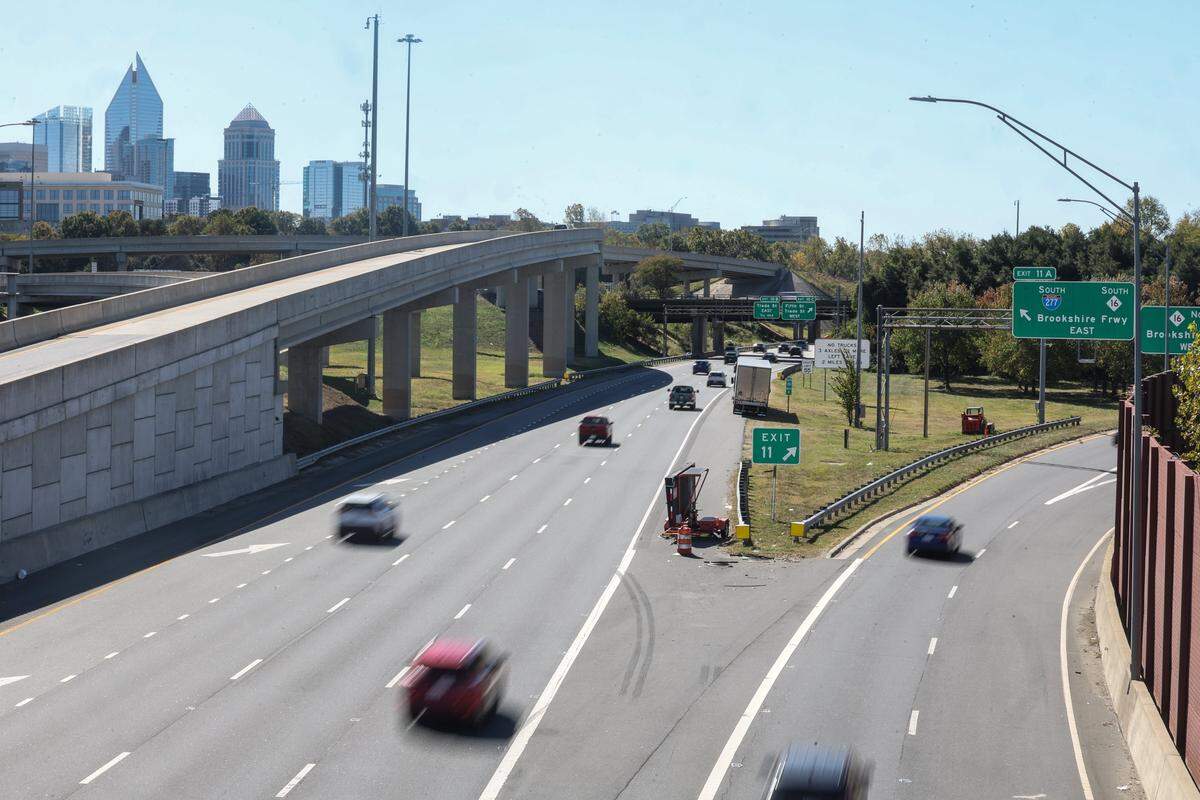
The map designs are preliminary, and the project is still in the early development stages. But residents, including Langley, say their neighborhoods are in danger no matter what design is chosen.
“The options destroy our quality of life,” Langley said Monday. “They decrease our property value and cause unnecessary harm.”
Next steps for register nominations
The grant funding will be used to hire a research consultant. Through a request process, Susan Mayer with SVM Historical Consulting and Nick Linville with Linville Historical Consulting will compile the research on the neighborhoods, according to a city representative
Public meetings will be held in the McCrorey Heights and Oaklawn Park communities in December and January. And the Charlotte Historic District Commission will host a public hearing Jan. 14.
The nominations will be presented to the North Carolina National Register Advisory Committee on Feb. 12.
If approved by the National Park Service, that doesn’t prevent NCDOT from demolishing homes for the sake of a highway and Charlotte’s growth.
But it does slow the process and puts more eyes on the proposed destruction.
That’s something both McCrorey Heights and Oaklawn Park want.
“If this (city council) is really serious about helping us become a national historic designation,” Langley said, “We can’t also at the same time have NCDOT unjustly causing harm to our neighborhood.”