Charlotte leaders praise transportation referendum as catalyst for growth, jobs
While speaking to the audience Tuesday at the Charlotte Regional Business Alliance’s Economic Outlook event, CEO Robert McCutcheon said the region is on fire — in a good way.
“We’ve seen major, record-breaking growth and thousands of new jobs,” McCutcheon said. “And the pipeline ahead is even stronger, with over 7,000 jobs and $1.4 billion in potential investment on the table. These aren’t just numbers. They represent opportunity for families, innovation for business, and prosperity for our entire community.”
Charlotte business leaders are looking forward to more growth in the area. They emphasized efforts such as a $25 million Mecklenburg County transportation referendum, approved by voters in November, that will help boost the economic forecast.
“Today’s program isn’t just about the forecast, it’s really about the future,” McCutcheon said. “It’s about asking the big questions. What’s next? How do we lead? And how do we make sure everyone in our community shares in the prosperity that we create?”
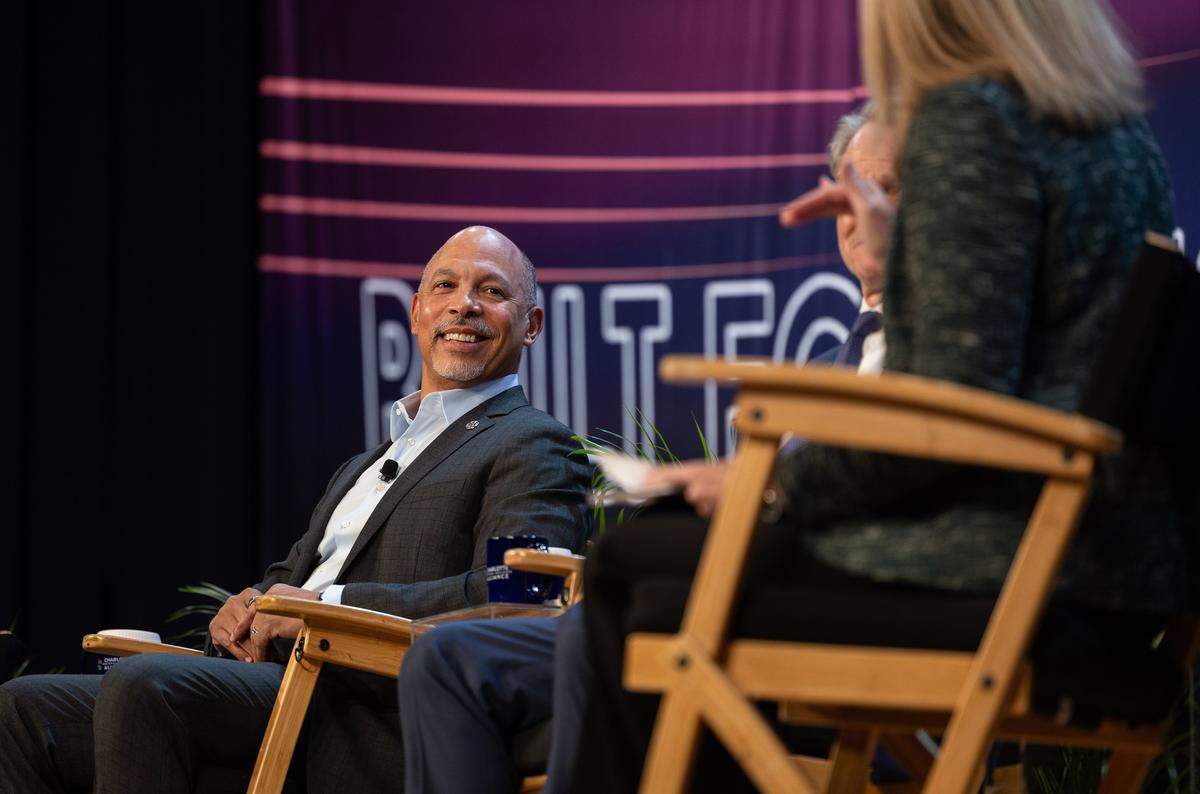
This year’s panel for the annual event, held at the Charlotte Convention Center, featured Palmer Brown, CEO of Compass Group, a food service giant; Brian Moynihan, chair of the board and CEO of Bank of America; and Gene Woods, president and CEO of Advocate Health. CLT Strategic Advisor Andrea Smith served as the moderator.
Here are some of the topics business leaders discussed:
Embracing tech
As technology continues to evolve, major companies are taking advantage of new opportunities, especially with AI.
For instance, Advocate Health uses an ambient listening system for doctors that translates audio into notes, saving them time at the end of the day. Advocate is also deploying AI cameras to predict patient falls, which occur about a million times each year.
Bank of America is also benefiting from technology and AI, through programs such as its “Erica” virtual financial assistant app. It helps customers manage accounts and find answers to their questions. Twenty million people used it 200 million times last quarter, according to Moynihan. This replaced interactions equivalent to about 11,000 employees.
Compass is also using technology in several areas: customer-facing tools like mobile ordering and high-tech arena, and staff tools behind the scenes, such as work schedules and menu planning. Brown said only about a quarter of their sales come from mobile apps because most people still enjoy talking to staff and experiencing the sights and smells of food in person.
Filling gaps
With a shortage of 22,000 physicians and nearly 400,000 nurses, Woods emphasized the importance of training the next generation. He spoke about 1,000 public school students who visited The Pearl district for a STEM festival.
Advocate is also expanding mental health services to 21 hospitals in rural areas, which Woods called “deserts” in terms of services. This year, the company increased virtual care, with 100,000 patients using the service.
Compass considers unit managers their most important employees. With 10,000 locations nationwide, they replace about 1,000 managers each year and need 500 more for company growth. The company uses AI and technology to help new managers learn faster, since it usually takes two to three years to become fully experienced in the role.
Getting around town
The CEOs showed strong support for the transportation referendum and also played pivotal roles, according to Smith.
On Election Day, Mecklenburg County voted 52.1% to 47.9% to approve a 1% sales tax rate increase. It’s projected to bring in more than $19 billion in new revenue over the next 30 years, for road, rail, and bus projects. This includes the Red Line commuter rail to the Lake Norman area and increased bus frequency on multiple routes.
They stressed that transportation is important for economic mobility and to keep the Charlotte region competitive.
Woods served as co-chair for the transportation initiative. From a healthcare perspective, Woods noted that 4 million patients nationally miss a doctor’s appointment because they lack transportation.
But he also thinks this will be the largest economic development initiative for the Charlotte region, which will come with job opportunities.
“There are some jobs that will be available next year, some five years from now, some 10 years from now,” Woods said. “This is a long project. How do we make sure this lifts up all parts of our community?”
Moynihan also emphasized the need for new Bank of America hires having affordable places to live and easy mobility.
Brown, who grew up in the region in Albemarle, saw how decisions made decades ago have shaped the area. He recalled that Compass’s decision to locate its North American headquarters in Charlotte 30 years ago was influenced by infrastructure and Charlotte’s nonstop flights to London.
“If it weren’t for that decision to make infrastructural improvements at the airport and the airlines making that commitment, Compass would probably not be in Charlotte,” Brown said.
More jobs, more growth
Since July 1, there have been 15 announced projects, bringing more than 4,500 jobs, according to CLT Alliance Chairman David Longo.
Former Duke Energy leader honored
Lynn Good, former chair and CEO of Duke Energy, was recognized as the 2025 Citizen of the Carolinas. She retired in April after serving the Charlotte-based energy giant for more than two decades, including nearly a dozen years as CEO.
Good became Duke Energy’s leader in July 2013 after the company merged with former rival Progress Energy. Prior to her CEO role, Good was the chief financial officer for Duke Energy.
More on CLT Alliance
The organization advocates for business in Charlotte’s 14-county bi-state region. It was formed in 2018 through a merger between the Charlotte Chamber of Commerce and the Charlotte Regional Partnership. CLT Alliance works to promote and advance the Charlotte region.
This story was originally published December 3, 2025 at 5:56 AM.