
Wells Fargo to pay $3 billion in settlement with feds over ‘staggering’ illegal conduct
Federal prosecutors and the Securities and Exchange Commission announced a settlement with Wells Fargo for $3 billion Friday, closing the long-running federal probes into the bank’s sham sales practices.
The bank will enter into a deferred prosecution agreement and, as part of the settlement, pay a $500 million penalty that regulators will distribute to investors.
In delivering one of the largest fines for a U.S. bank since the 2008 financial crisis, the settlement is a turning point in one of the darkest chapters in the bank’s history. What had once been known as a staid, safe bank, the scandal turned Wells Fargo into a paragon of financial greed for the modern era.
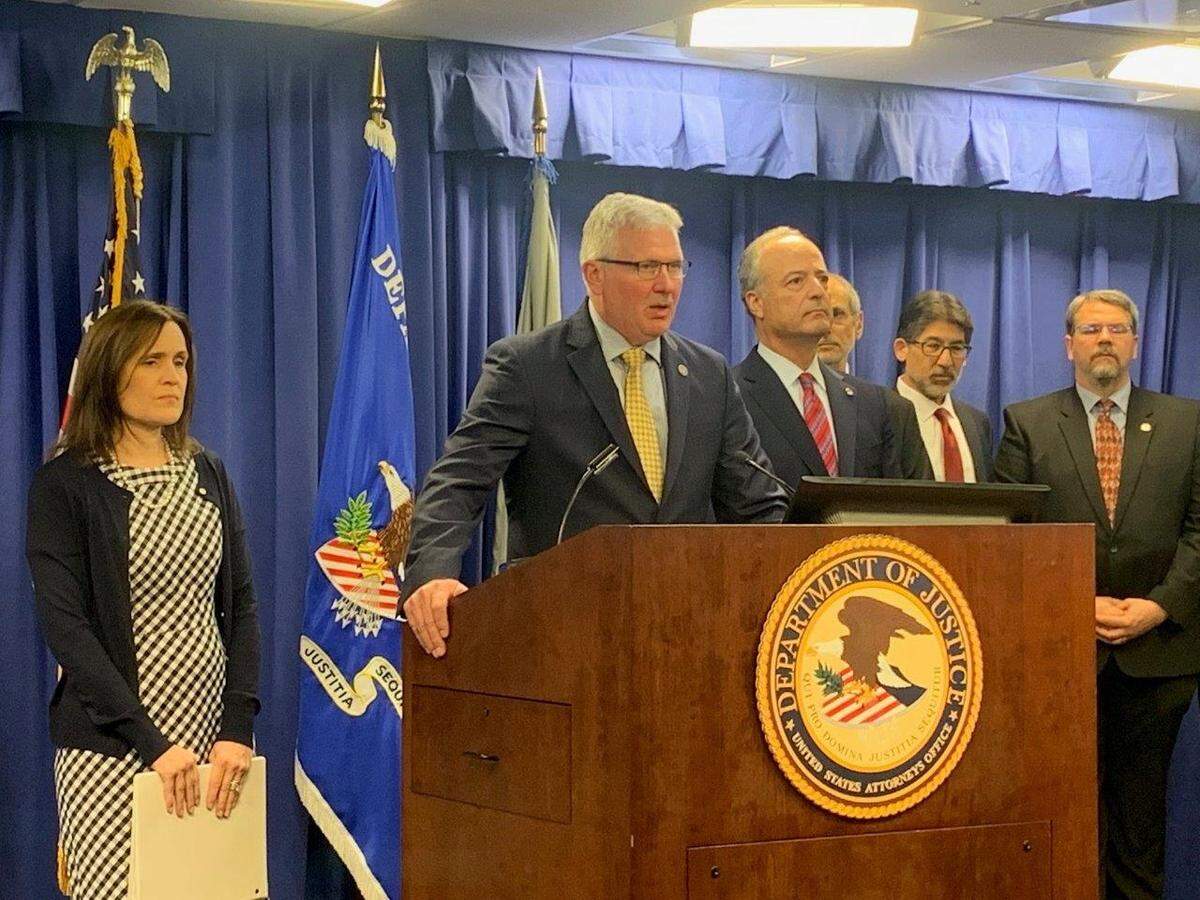
“Today, Wells Fargo has admitted to, and accepted responsibility for, a series of consequential failures,” said Charlotte’s U.S. Attorney Andrew Murray, whose office led the investigation into the bank alongside federal prosecutors in Los Angeles, where the settlement was announced.
Murray called the settlement figure appropriate “given the staggering size, scope and duration of Wells Fargo’s illicit conduct.” The bank, he said, succumbed “to the pernicious forces of greed.”
Wells Fargo is one of the biggest employers in Charlotte with about 27,000 workers in the city, partially a result of the bank’s 2008 purchase of Wachovia. The bank is headquartered in San Francisco.
“The conduct at the core of today’s settlements — and the past culture that gave rise to it — are reprehensible and wholly inconsistent with the values on which Wells Fargo was built,” said Wells Fargo CEO Charlie Scharf in a statement. A former JP Morgan executive, Scharf was brought on as CEO in October with the explicit charge of getting the bank out from under the scandal.
While he said the bank has taken steps to improve its conduct, he added that “there’s still more work we must do to rebuild the trust we lost.”
Among Wells Fargo’s failures, Murray said, were, “a failure to fix a broken sales planning process that led to unscrupulous, and in many cases criminal, sales practices, a failure to disclose its misconduct to investors and perhaps most importantly, a failure to serve millions of its customers in Charlotte, and elsewhere, who trusted the bank to safeguard their money, their interests and their personal information.”
Millions of fake accounts
The settlement stems from what Wells Fargo employees did to meet sales goals that the bank set.
Employees in the consumer bank — ones you see in a branch working with customers — were given goals that management knew weren’t reasonable. The rationale was that if you set a high bar, even an unreasonably high one, employees would work harder to reach it.
If a worker didn’t reach those goals, by not selling enough products to enough people, there were repercussions. Employees were threatened with firing or actually fired. Managers went to extremes to shame and humiliate workers who didn’t make the goals.
So employees did whatever they could, creating fake accounts and manipulating bank systems.
From 2002 to late 2016, hundreds of thousands of Wells Fargo workers took part in opening millions of sham accounts in customers’ names, among other misconduct, regulators found in January. Management knew about what was going on, Wells Fargo agreed in the settlement, turned a blind eye to the practice and minimized the issue to the company’s board.
The misconduct was viewed as “merely the cost of doing business,” Wells Fargo acknowledged in the settlement.
It was a “complete and total failure of leadership,” U.S. Attorney Nick Hanna of Los Angeles said.
The resulting backlash from the revelation of those sales practices has derailed the bank for years. Repeatedly fined and censured, its share price has stagnated while its peers’ stock prices have soared. The bank cycled through three chief executives since the practices became widely known in 2016.
Scharf has repeatedly apologized for the sales practices, hoping that contrition will help finally put the scandal in the past.
“This bank is going to perform better in the future,” Wells Fargo’s new chief operating officer Scott Powell said in an interview with the Observer prior to Friday’s announcement.
Business as usual?
In addition to the $3 billion fine, the settlement includes a deferred prosecution agreement — essentially, Wells Fargo is being placed on probation. The bank has to follow certain conditions for three years, including full cooperation for continuing investigations.
Along those lines, Hanna gave the bank credit for changes it already made, including a new CEO, a new chief operating officer, a new head of the consumer bank and a reconstituted board of directors. Hanna said the bank also has installed better internal controls.
Most importantly, Wells “has offered a complete admission of wrongdoing and accepting full responsibility,” he said. In a sign that the punishment was not as harsh as it could have been, shares of the bank finished higher on the day, at $48.20
Some advocates of stronger Wall Street regulation weren’t satisfied with the fine, seen as too low for a bank that can make as much as $100 billion in revenue a year.
“This is large enough to make the press release sound good, but certainly not large enough to have a significant impact going forward and serve as a deterrent across the industry,” said Gregg Gelzinis, a policy analyst at the left-leaning Center for American Progress in Washington, D.C.
“Wells Fargo has done things that are over the top bad, even for Wall Street,” he said. “With this fine, we’re going to continue to have Wall Street treat this as business as usual.”
Regulators still monitoring
The settlement is the latest step to finally close the book on Wells Fargo’s misconduct scandal.
In January, the Office of the Comptroller of the Currency, Wells Fargo’s federal regulator, filed charges against or settled with eight former executives at the bank.
John Stumpf, Wells Fargo’s CEO for much of the period when the sales misconduct took place, can never work for a bank again and must pay a $17.5 million fine as a result of his settlement with the regulator.
The former head of Wells Fargo’s consumer bank, Carrie Tolstedt, a key player in the scandal, is fighting her charges. Regulators are seeking a $25 million fine from her and an industry ban.
The settlement announced Friday covered just the bank. Charges against former executives were not mentioned.
Despite the settlement, regulators are still closely watching the bank. Since February 2018, the Federal Reserve has restricted Wells Fargo from growing beyond its 2017 size, about $2 trillion in assets, as a punishment.
That cap will remain in place until Wells Fargo — still the country’s biggest mortgage and small-business lender — demonstrates to the Fed that it has fixed its oversight and risk management, proving there are sufficient safeguards to prevent another scandal like this from happening again.
But the Fed isn’t the only regulator left closely watching Wells.
In January, the bank said it has 12 outstanding public enforcement actions against it from a range of regulators, including five alone from the OCC.
And Congress, where both Democrats and Republicans have repeatedly lambasted and ridiculed Wells Fargo, appears poised to continue putting pressure on the bank.
Maxine Waters, chair of the House Financial Services Committee, announced three March hearings on Friday, all titled “Holding Wells Fargo Accountable,” that will examine the bank’s culture and management.
This story was originally published February 21, 2020 at 2:21 PM.