His journey to the top ranks of Bank of America in Charlotte helps drive his work
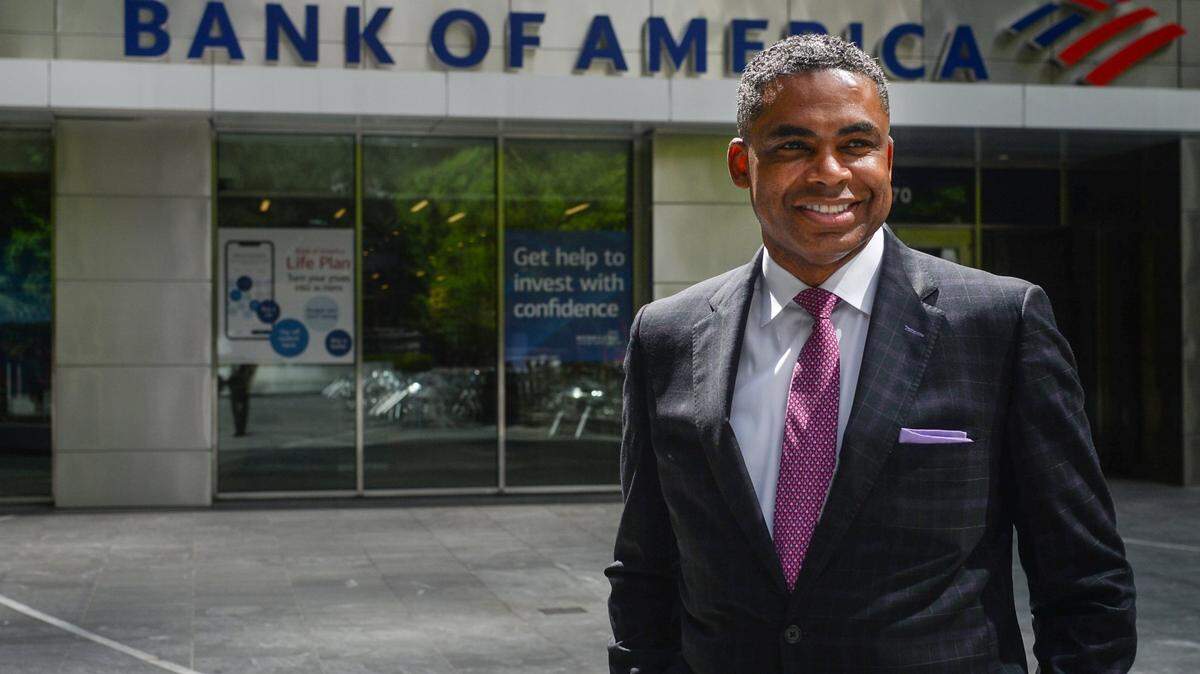
It’s hard to know where to begin when introducing Kieth Cockrell.
You could mention that he’s the Charlotte market president for Bank of America, rising to one of the bank’s top jobs in the city and coming from a working-class family in Long Island, N.Y.
That he’s the son of a single mother and was raised by his grandparents. That he’s the father of an Olympian, an NFL cornerback and a budding lawyer.
At Bank of America, Cockrell oversees eight business lines in the local market and has one of the most visible jobs at the bank in its headquarters city. His job includes broadening the bank’s local customer base and leading its efforts to help address the region’s social and economic issues.
And he’s got a vision for the bank and for Charlotte, inspired in large part by his own background.
Growing up with his grandparents
Cockrell was one of eight children. When his single mom put Kieth up for adoption, her parents took him in.
His grandmother worked in the housekeeping department at a hospital and his grandfather at a string of auto dealerships. Cockrell got his first lessons in finance at their kitchen table, watching his grandmother track the family’s weekly expenses on a torn piece of a brown paper bag.
She bought clothes and groceries at mom-and-pop shops and paid for nearly everything in cash. Like many households in the neighborhood, the closest thing to formal credit was a verbal IOU — something his grandmother always made good on. “Her word was her bond,” Cockrell said.
They weren’t a wealthy family, Cockrell said, but they were rich in other ways.
“We had a lot of love,” he said. He saw his siblings often, moving to live on the same block as his mother in the fifth grade. “There was never a lack of love or support.”
His grandparents stressed the importance of education, diligence and hard work. They sent him to music camp during the summer, signed him up for football and basketball teams, and got him boxing lessons when he ran into trouble with a local bully.
Looking back, Cockrell, 60, said they made significant sacrifices to make those things possible.
“Overtime, triple time, two jobs, three jobs — they did whatever they needed to do to ensure that my basic needs were met,” he said. “They were so nurturing of my interests. And despite the financial needs, they found ways to include me” in the activities he wanted to do.
They demanded the same hard work from Cockrell, especially when it came to school.
“It wasn’t a choice. My grandmother made it very clear that I did not bring home bad grades,” he said. It paid off. Cockrell eventually attended Columbia University.
He studied engineering, played football and started dating a classmate, Serena, who would later become his wife. It was their wedding that spurred him to formalize the untraditional spelling of his first name.
Cockrell had discovered at about age 12 that his name was spelled “Keith” on his birth certificate. He kept his own version, with the “i” before “e”: the spelling he had used his entire life.
But before applying for a marriage license, he rushed to formalize the change. Even close friends still misspell it from time to time. “I think other people are more sensitive about it than I am,” he laughed.
Goals and opportunities at BofA
After college, Cockrell spent 10 years at IBM, starting out as a systems engineer. He was recruited to Bank of America when the bank was one of his clients in the late 1980s, and has lived in Charlotte for the better part of the past two decades.
He served in more than 20 roles over nearly 30 years at the bank. Cockrell became market president this past May, after Charles Bowman stepped down from the role in preparation for his retirement next year.
The Charlotte market president’s job involves overseeing the bank’s market strategy and business lines in the region, such as wealth management, retail and business banking. The market president also works with the bank’s 16,000 employees in the city to connect its products and services with customers.
“(Cockrell’s) goal is to make this the best place to work and the bank of choice, and to be a community builder,” said Bowman, who held the position for more than 13 years. “He certainly has all the tools and opportunities to do that.”
Bowman and Cockrell have known each other for several years, he said.
At the beginning of the pandemic, the two made a habit of weekly early-morning phone calls. They’d sip coffee and talk life and business — partly to keep each other updated on things at the bank, partly to maintain their “personal sanity” during the chaos of the past year and a half, Bowman said.
Bowman called Cockrell a great asset for the bank and Charlotte. “His personal story is compelling,” Bowman said, adding that it helps Cockrell make an impact.
‘A sports family’
Cockrell isn’t the only one in his family who has made headlines for what they do.
Their oldest child Ross is a cornerback for the Tampa Bay Buccaneers and previously spent two seasons with the Carolina Panthers. Middle child Ciera captained Davidson College’s volleyball team and is attending law school at Howard University.

And the youngest, Anna, ran track in the Tokyo Olympics this summer for Team USA. She finished second in a 400-meter hurdles semifinal before being disqualified from the final race for stepping on a line.
“We are a sports family,” Cockrell said.
The Cockrell kids also inherited their parents’ commitment to education.
While Anna was competing in the Olympic trials, she and Ross operated something of an informal book club, re-reading Machiavelli’s “The Prince,” and calling each other to discuss their takeaways.
And when Ross was preparing to take the SATs, Serena had his siblings study for the test too, in solidarity, Anna told the Observer over the summer. “Sometimes it’s strange for me to hear our family described as sporty. Because I feel like so much of growing up was super nerdy stuff,” Anna said.
The Cockrells love talking politics and playing board games. But when they get together, it frequently leads to some type of competition, like basketball or table tennis.
At Thanksgiving this year, Kieth Cockrell will be particularly excited to get everyone in on a new game: pickleball, a racket sport that combines elements of table tennis, tennis and badminton.
Working for change
Looking back at his career path, Cockrell said he was initially drawn to Bank of America for its approach and commitment to diversity. That’s something he attributed to the influence of former CEO Hugh McColl.
Cockrell said he doesn’t feel that he ever experienced racial prejudice at the bank.
“I’m not trying to say that the industry has been stellar in this space,” Cockrell said. But he’s stayed at the bank so long because of its commitment to diversity, equity and inclusion.
“I’m very, very pleased with the progress we’ve made.”
In June 2020, Bank of America’s CEO Brian Moynihan announced the bank would pledge $1 billion to fight racial inequality in the U.S.. It was one of the largest commitments from a U.S. company on the issue.
But Black executives like Cockrell are still rare at major U.S. banks. At Bank of America, 81% of executive jobs are filled by white men and women, despite accounting for 64% of the U.S. workforce, USA Today reported this summer.
As part of his role in Charlotte, Cockrell is responsible for leading the bank’s efforts to address social and economic concerns in the city.
For one of his first initiatives, he organized the donation of 10,000 Chromebook laptops to Charlotte-Mecklenburg Schools students and families this summer, in partnership with Eliminate the Digital Divide, a Cornelius-based nonprofit working to close the digital divide in Charlotte.
Cockrell remains focused on several issues at the heart of inequity in Charlotte: education, affordable housing and workforce development among them. There’s still work to be done, at Bank of America and in its headquarters city, he said.
Charlotte is quickly growing, Cockrell said. “With that growth, it creates new sets of challenges.
“I hope that I’ve been a catalyst for change,” he said. “I want to bring everything that I have to this job: who I am, the relationships I’ve had, the things that I’ve learned. I don’t feel pressure... I feel extremely honored.”
This story was originally published October 13, 2021 at 6:35 AM.