Charlotte’s growth is making traffic unbearable. How do we get out of this mess?
Living in Atlanta, Taylor Jackson would spend up to two aggravating hours stewing in traffic trying to get to work.
She finally got so fed up she moved to Charlotte nearly a decade ago. But the traffic turmoil seems to be catching up with her.
Jackson, a 30-year-old small business owner, had to raise prices by about 30% at her cocktail catering company to account for travel time and related expenses due to traffic in Charlotte. “Traffic has been extremely crazy,” she said.
Her experience mirrors that of thousands of Charlotte drivers enduring lengthier travel times and frustrating traffic jams.
Before the pandemic, in 2019, more than 100 people moved to the Charlotte region every day, and it’s slowed only slightly since. The area is projected to add over 420,000 people in the next 20 years, according to the State Demographer of North Carolina. That’s a lot more cars on the road and bigger traffic headaches.
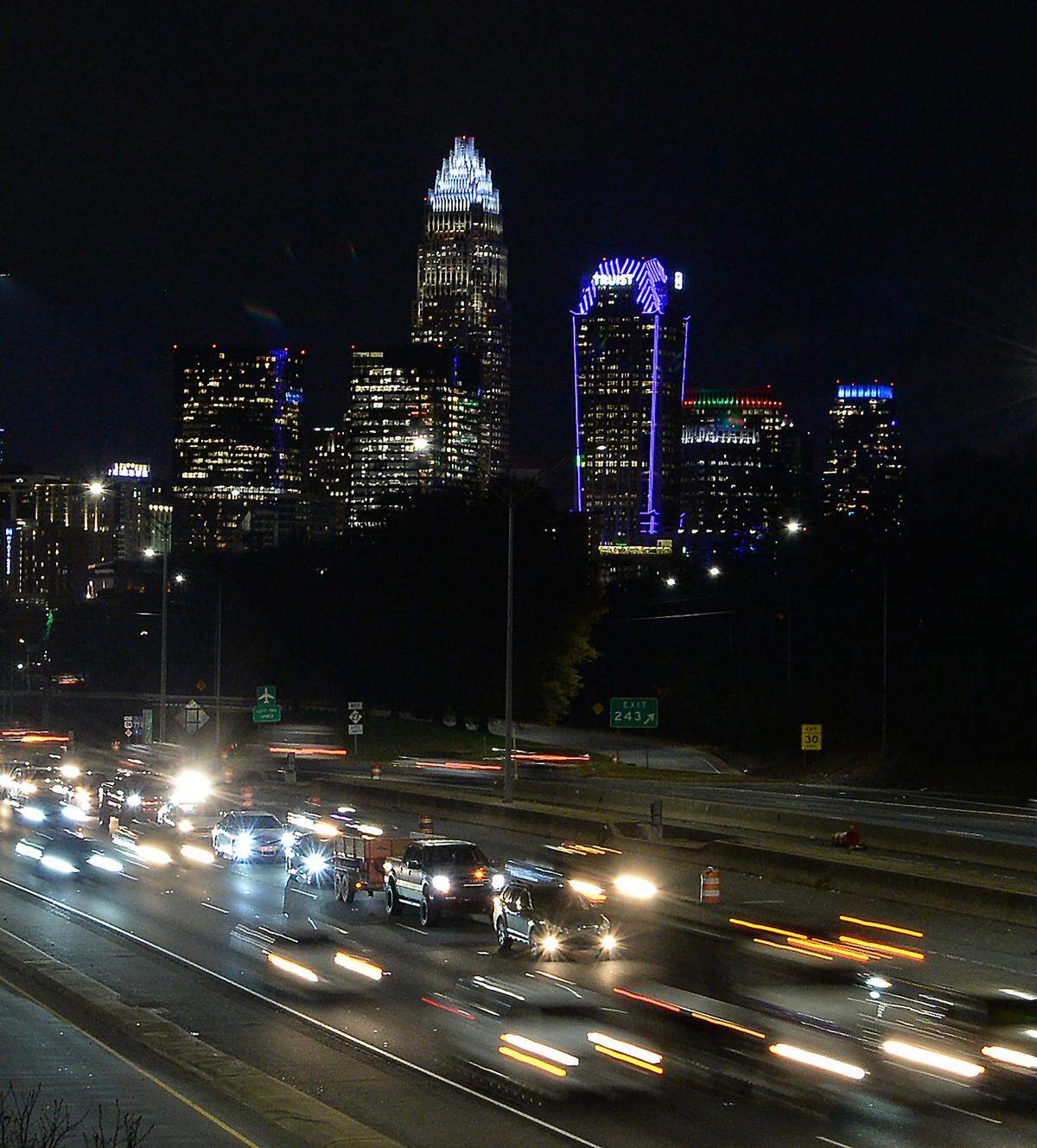
From Interstate 77 near the South Carolina border to the intersection of Brookshire Boulevard and Mt-Holly Huntersville Road, traffic often remains snarled in all corners of Charlotte.
Like other cities, Charlotte was designed years ago for people to get around by car.
Old farm roads that travel into the city from outlying areas create a hub-and-spoke framework, which led to those same roads becoming commuter paths that people use to get to work, said Shannon Binns, founder of the nonprofit Sustain Charlotte. Think of roads like Providence, Independence, Rozzelles Ferry.
On top of that, a highway like U.S. 74 can lead to dead-end streets and fewer ways for drivers to get around. Instead of having several ways of getting to the main street like Central Avenue, drivers have one or two, leading to a reduced grid.
“We designed a perfect system for congestion,” Binns said.
Help eventually might be at hand — but at a cost.
This time next year, Mecklenburg County residents could be at the ballot box to consider a measure that a 25-person task force appointed by Charlotte’s mayor says is needed to alleviate the region’s congestion woes.
The recommendation: a $13.5 billion “transformational mobility network” with more frequent bus routes, extended greenways, improved sidewalks, a new, 29-mile east-to-west light rail line and the long-awaited 25-mile commuter rail line to north Mecklenburg.
To fund the local portion, the Charlotte MOVES Task Force recommended a 1-cent, countywide sales tax hike. The group expects the tax to generate $6.6 billion over 30 years, and local leaders would seek out federal dollars for the remaining costs.
But big hurdles lie ahead. Chief among them is securing authorization from the Republican-controlled legislature to allow a sales tax referendum to appear on the ballot. Then voters would still need to approve it.
“Unfortunately, our investment in transportation infrastructure has not kept pace with the incredible population growth that our city and county have experienced over the last several decades,” said Binns, Sustain Charlotte’s executive director. His group advocates for alternatives to driving, including walking, biking and transit.
“It’s more cars going on the same set of roads,” Binns added.
The cost of doing nothing
When Jennifer Rendon lived off South Boulevard near Interstate 485 three years ago, running simple errands became a hassle. Traffic loomed everywhere. And frequent wrecks compounded the problem.
If she wanted to get to her kids’ football and basketball games, the senior order manager at Spectrum asked for time off from work to ensure she could get there in time.
“We just wanted to get out of that” high-traffic area, Rendon said. So she and her husband moved to south Gastonia, where they’re farther from the interstate. Her commute to the office near Arrowood Road is about 15 minutes longer, but the trade-off is fewer cars around their home.
The congestion Rendon and others deal with can be a sign of a strong economy. It means people are headed to jobs and the city or region is a destination. Still, there’s a point where traffic backups become unhealthy.

In fact, the Charlotte region stands to lose 126,000 jobs by 2050 if it doesn’t invest in transportation improvements, N.C. State and UNC Charlotte’s Urban Institute researchers found. Congestion can “drag” employment when companies need to compensate workers for inconvenient travel conditions or when that traffic leads to decreasing productivity, the study found.
The Charlotte region is already dragging.
Job losses start to mount when the average commuter faces 37 hours of congestion a year, the study noted. In the Charlotte region, the average commuter spent more than two full days in traffic in 2019. That put the area in the top 10% nationwide for extra time spent traveling because of congestion.
In Atlanta, the average commuter spent more than three days in traffic, seventh longest in the nation.
What will the referendum do?
If approved, the 1-cent sales tax increase would be expected to generate $220 million annually, according to the Charlotte MOVES task force. Mecklenburg residents and visitors would pay the tax, which would not be applied to groceries or medications.
The first window to get the referendum on the ballot is November 2022, said Kelly O’Brien, chief advocacy and strategy officer at the Charlotte Regional Business Alliance.
Revenue from the sales tax could immediately be used to help redesign the bus system, said John Lewis, CEO of Charlotte Area Transit System.
The money also would accelerate CATS’ Envision My Ride plan, which calls for 22 “high-frequency” routes that run every 15 minutes throughout the day. There are five such routes now.
Is everyone on board?
Not everyone on the City Council favors the $13.5 billion mobility plan.
Tariq Bokhari is one of two Republican members on the council. He said the plan led by Mayor Vi Lyles and City Manager Marcus Jones can’t go forward if legislative leaders aren’t involved. He described those heading the plan as treating the General Assembly like a “rubber stamp.”
O’Brien said her group is advocating on behalf of the plan. Part of that is meeting with each of the county’s six towns, asking what they want out of the plan and what the best mobility solution is for them.
Over the past year, her group has engaged with more than 100 elected officials, from the local, county and state levels, on what they want out of the plan. They are still working through having those conversations, O’Brien said.
Sustain Charlotte applauded the big plan for investing in the bus system, greenways and pedestrian improvements. But it remains concerned about the cost and long timeline of the rail projects. Binns also encouraged Charlotte and the surrounding towns to be transparent with voters about how the sales tax revenue would be spent for specific projects.
Equity concerns
Giving people more options to get around also addresses a growing equity issue in Charlotte, the task force found.
About 13,000 households in Charlotte lack access to a car. Most of those homes are inside the “crescent,” a band of lower-income, racially-mixed neighborhoods in west, north and east Charlotte. In the “wedge,” a collection of wealthier, whiter neighborhoods in south Charlotte, people tend to have cars and are closer to employment centers.
The task force found that the transit plan would put more people who live within the crescent closer to a variety of transportation options — called multimodal systems — like a bus or rail stop.
It said, for example, that 39% of low-wage jobs are served by existing high-frequency bus and transit lines, greenways and bike facilities. The new plan would mean 91% of those jobs would have such access.
Wanting more buses
Vivien Fullard is one of the many people who ride the bus in Charlotte.
About six years ago, she moved here from Pittsburgh, and lives in northwest Charlotte. Fullard works the overnight security shift at an uptown building and has never owned a car.
Buses rarely run late, she said. But Fullard said she’d benefit from new routes to help get around to the mall or grocery store on her days off.
“Charlotte is big,” Fullard said. “If they would expand (the bus system), it would give people the opportunity to see exactly what is out there.”
Charlotte’s transportation plan does call for adding 15 routes to areas outside of uptown, including in Mint Hill, Mooresville and Ballantyne. Over four years, CATS would buy 100 buses to help meet those goals, Lewis told the City Council in October.
Money would also go toward adding shelters and seats at bus stops and building 50 “mobility hubs” — or enhanced transit stops — intended to get people from the bus stop to their final destination more quickly.
CATS buses already carry the majority of public transit riders, meaning any solid system needs an efficient bus system as its backbone.
Since 2018, CATS has been working to reconfigure routes away from a hub-and-spoke model to a grid-like system. In some cases, riders face one-way travel of 90 minutes because they have to transfer in uptown.
The price of the Silver Line
The LYNX Silver Line is the plan’s most expensive project with a price tag of at least $8 billion.
The proposed east-to-west line would stretch from Union County through downtown Matthews and into uptown. There, people could transfer to the Blue Line or stay on the Silver Line before continuing west out by Charlotte Douglas International Airport and end in Gaston County.
The Silver Line stop by the airport wouldn’t drop riders off at the terminal, but at a “destination district” about a mile away at Wilkinson Boulevard. From there, a people mover would take riders to the airport terminal.
Charlotte already has spent $50 million on preliminary design and environmental work. That can help the city better compete for matching federal dollars, Lewis said.
Planners recommend building the line in two phases, with the eastern portion opening in 2036 and the western phase to Gaston County opening in 2039.
The portion running through Mecklenburg would cost about $8.1 billion, according to an update planners gave City Council in September.
For reference, the roughly 9-mile extension of the Blue Line from uptown to University City cost $1.1 billion. That was over twice as expensive as the original 9.7-mile Blue Line, which cost $462.7 million and opened in 2007.
Red Line still a priority
Whenever you’re talking about transit in northern Mecklenburg, you’ll likely hear about the highly elusive LYNX Red Line.
Cornelius Mayor Woody Washam envisions residents not just taking a train to Charlotte for work, but using it to get to a Panthers game, other events or the airport.
The long-awaited commuter train would run from Davidson south to the center of Charlotte. In 1998, voters approved a half-cent, countywide sales tax for light rail that helped fund improved services, including bus routes and the Blue Line.
Voters retained the sales tax in 2007 when county officials said the money would help build a rail line north to Lake Norman, Huntersville and beyond. That still hasn’t happened.
The Red Line is still a priority, O’Brien of the regional business alliance said. But Norfolk Southern Corp. remains a formidable hurdle. For years, the company has refused to share its tracks on the line that connects Winston-Salem and Charlotte — tracks that the Red Line would need to run on.
Playing catch-up to other cities
Charlotte’s plan also would add about 115 miles of greenway trails.
That includes a north-south trail from Charlotte to Mooresville and an east-west connection between the Catawba River near the U.S. National Whitewater Center and neighborhoods on the west side of Charlotte.
A rapid bus transit line traveling up Interstate 77 would be complete by 2030.
If approved, the multimodal plan would be a building block for a larger, regional plan called Connect Beyond. That effort is being led by Centralina Regional Council and covers a 12-county, two-state region.
The aim is to keep the region economically competitive for job growth and business expansion, as well as help people move around more efficiently, said Geraldine Gardner, Centralina’s executive director.
“Most big metros have airports connected by public transit,” Gardner said. “We’re trying to play catch-up and be competitive with our peers.”
On the move
Charlotte has plenty of work to do if it wants to get cars off the road.
According to a 2019 U.S. Census report, of an estimated 479,292 workers in Charlotte age 16 and older, 83% got to their jobs by car, truck or van. Roughly 75% drove alone while just 3% took public transportation.
Adding to the problem: census figures show that the number of people commuting into Charlotte has steadily grown. A decade ago, that number stood at 236,961. In 2019, it jumped to 318,575 — a 34% increase.
Binns is hopeful that, if passed, the $13.5 billion plan would bring more immediate returns on residents’ investment, like more bike-friendly streets and greenways. “It’s imperative to use the street space as efficiently as possible,” he said.
Still worried about traffic
For Taylor Jackson, the small business owner’s Nissan Maxima is her office. Since buying the car three years ago with 28,000 miles on it, she’s logged another couple hundred thousand miles.
Jackson has learned that trying to drive around the traffic here doesn’t make her trips any shorter. So she ends up sitting in traffic a lot, where she can answer emails or listen to a podcast.
The trends are not headed in her favor.

Vehicle traffic is projected to increase at a faster rate post-pandemic due in part to hesitancy among people to use public transportation, research cited in the N.C. State study showed.
Traffic on Interstate 277 around uptown jumped 12% from last year, following the peak of COVID-19, data from the N.C. Department of Transportation showed. There were similar increases on Interstates 85 and 77.
Jackson worries about the future of her business, Pour Mixology. If she has to keep raising prices, clients could go elsewhere.
Coming to Charlotte, Jackson wanted the feeling of a bigger city but not the traffic that comes with a massive one. If congestion keeps getting worse, she might need to leave.
Jackson hopes Charlotte doesn’t turn into Atlanta, with its wide highways clogged with cars she sought to get away from. “North Carolina is a beautiful state as a whole,” she said. “I just don’t want it to turn into concrete.”
This story was originally published December 19, 2021 at 6:00 AM.