The greater Charlotte area’s anticipated peak in coronavirus cases may not be until June 27 — marking the latest revised date for when local hospitals could see the greatest strain on resources, Mecklenburg County officials said Monday night.
The county’s model projects a demand for 2,060 hospital beds on June 27, assuming there is 45% social distancing among area residents.
A large surge in cases could leave Atrium Health and Novant Health without enough beds, staffing, supplies and ventilators to “care for everyone in our community and region,” Mecklenburg officials said.
If there’s only 30% social distancing, the region could reach its peak on June 16, requiring 2,899 hospital beds. And if there’s 60% social distancing, the peak could come as late as July 17, requiring 1,071 hospital beds.
The latest modeling incorporates demand on hospital resources from Mecklenburg, as well as surrounding N.C. and S.C. counties — a total population of about 2.3 million people, officials said.
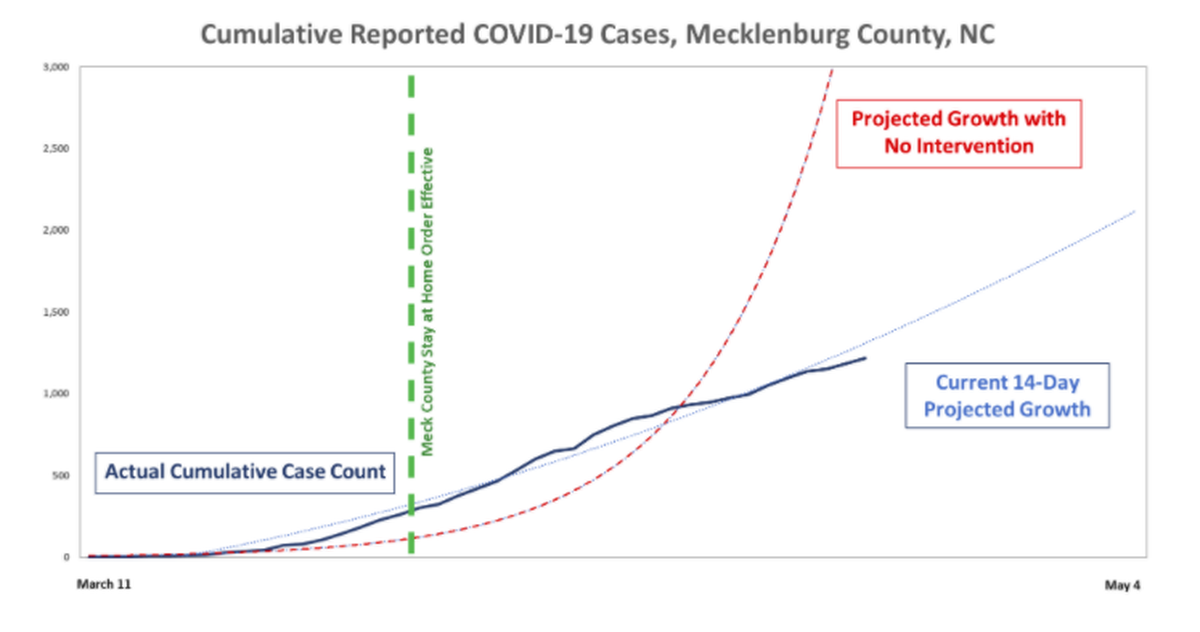
“There has not yet been a dramatic acceleration in new cases and the number of new cases each day is starting to trend downward,” Mecklenburg officials said in a news release Monday evening. “This suggests we continue to make progress toward ‘flattening the curve.’ We must continue social and physical distancing in our community to maintain this progress.”
Mecklenburg Public Health Director Gibbie Harris previously said a surge would hit the region between mid-April and mid-May. But last week, Harris announced a June 8 peak was more likely, based on modeling that showed residents had begun to flatten the curve amid social distancing restrictions.
In the projections released Monday, the greater Charlotte region would need 1,143 ICU beds on June 27, assuming 45% social distancing. Local hospitals would also need 515 ventilators.
But Mecklenburg officials say there are currently only 283 ICU beds and 243 ventilators in the county.
In a press briefing Monday, Harris emphasized that flattening the curve is not synonymous with reducing the total number of infections. And a peak in hospital demand doesn’t necessarily dictate when the stay-at-home order — effective through at least April 29 — could be lifted, Harris said.
“Flattening of the curve does not mean this goes away quicker,” Harris said. “It means we are positioning ourselves in this community to better be able to address the medical needs of the individuals who are infected.”
At least 1,255 county residents had tested positive for the virus and 32 had died as of late Tuesday.
Officials said earlier on Monday that Mecklenburg’s confirmed cases of the novel coronavirus may comprise “as little as 5-10%” of actual infections. That means the region could have at least 24,000 coronavirus cases.
Mecklenburg Deputy Health Director Dr. Raynard Washington told reporters the estimate is based on other U.S cities, such as New York, where coronavirus testing capacity has increased in recent weeks.
”The honest answer is we don’t actually know,” Washington said of the scope of the local outbreak. “There’s a lot more infections in our communities. “There are a lot of folks who have mild symptoms and are at home — we’re not testing those people.”
Mecklenburg has largely relied on the University of Pennsylvania’s model, which incorporates data on how susceptible people are to COVID-19, as well as the total of number infected and recovered individuals. But officials have warned that the forecasts, like predictions for hurricanes and other natural disasters, can be volatile.
Washington emphasized to reporters that UPenn’s model, as well as other projections, are not the “only source of information” county officials are relying on to predict a surge in cases that may overwhelm hospital systems.
Mecklenburg County officials say area residents are starting to make progress in “flattening the curve” through social distancing restrictions amid the coronavirus pandemic. Mecklenburg County
Racial disparities
Also Monday, Harris again acknowledged that black residents are disproportionately impacted by the coronavirus due to underlying health conditions, poor access to medical care, and a greater likelihood to work at front-line jobs where they may be exposed to the virus.
Black residents accounted for 48% of the 1,186 reported cases through Sunday. By comparison, they make up 32.9% of Mecklenburg County’s population, according to census estimates.
But coronavirus infections among Latino residents are also rising. Harris said that’s partly due to new mobile testing sites intended to serve the county’s minority communities.
The April 19 data, released Monday, shows white residents made up 30.4% of cases, with Hispanics at 14.5%, Asians at 3.2%, and Alaskan Natives or American Indians at less than 1%. In 3.8% of cases, race or ethnicity was not reported, officials said.
”As the number of tests conducted goes up, we expect to see positives go up,” Harris said of Latino residents. “I’m not terribly concerned about that at this point, other than making sure that all members of the community who need testing have access to it.”
Alison Kuznitz is a local government reporter for The Charlotte Observer, covering City Council and the Mecklenburg Board of County Commissioners. Since March, she has also reported on COVID-19 in North Carolina. She previously interned at The Boston Globe, The Hartford Courant and Hearst Connecticut Media Group, and is a Penn State graduate.Support my work with a digital subscription