
How much has COVID-19 spread in Charlotte since Phase 2 reopening? Here’s the data.
Fewer people in the Charlotte area are staying home and social distancing as the most recent health data show the coronavirus spreading further, infecting more people and leading to increased hospitalizations.
The health trends follow looser restrictions on public gatherings, in-person dining and an increase in travel. This has led to Mecklenburg elected officials considering a mandate that people wear masks in public and many companies extending work-from-home timelines.
It’s unclear whether North Carolina will proceed to Phase 3 of the state’s coronavirus reopening plan, initially scheduled to begin as early as June 26. A move to Phase 3 — or even to a possible “Phase 2.5” — could allow bars and gyms to reopen, ease capacity restrictions on restaurants and salon, and relax rules for large gatherings.
The decision, according to Gov. Roy Cooper and N.C. health officials, hinges on a set of key metrics used to measure the spread of the virus.
In Mecklenburg County, COVID-19 data so far shows the period following Phase 2 reopening brought an increase in hospitalizations, an increase in the number of people infected, and an increase in the percent of people tested who are found to have the virus. Data from the University of Maryland’s “social distancing index” shows people are staying home less and visiting stores and other locations more often.
Mecklenburg is one of nine North Carolina counties with especially concerning increases in COVID-19 cases, Cooper said earlier this week.
State Department of Health and Human Services secretary Mandy Cohen said last week COVID-19 cases were expected to rise as testing efforts increased. But simultaneous rises in hospitalizations and percentage of positive tests show the trend is not solely a result of increased testing, she said.
The Charlotte Observer has analyzed months worth of data from state and local health officials to find trends before and after reopening phase. To gauge the impact of phased reopening, health officials often look at trends over a 14-day period. That accounts for the incubation period of COVID-19 and the time it takes to access testing and get results.
Here’s what publicly-available data show on the impact of reopening and less social distancing so far.
Data on reopening impact
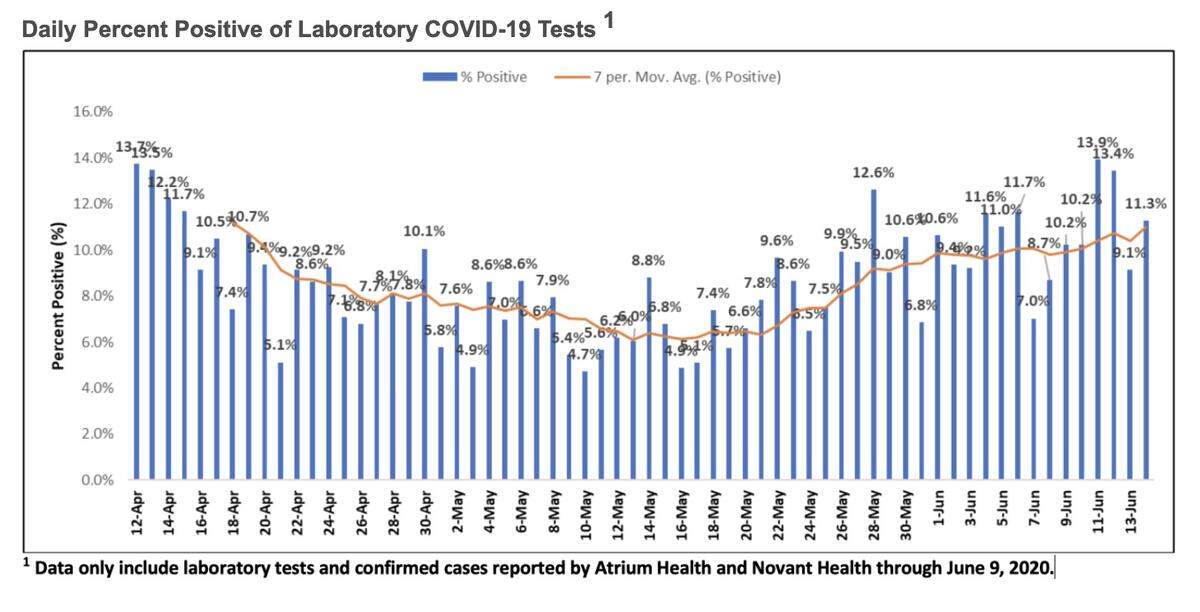
Percentage of positive coronavirus tests
▪ Before Phase 1 reopening: The weekly average of the percentage of positive coronavirus tests locally hit its high in mid-April. On April 12, 13.7% of people tested for COVID-19 were positive. (County data on the daily percent of positive tests goes back to March 31.)
In April, testing was limited to people in high-risk categories and people with severe COVID-19 symptoms. As state and federal criteria for who could be tested expanded, Mecklenburg health data shows the percent of positive people dropped in early to mid-May, to as low as 6.3%.
The improvement in this coronavirus metric corresponded with widespread restrictions on gatherings, travel and business activity. Social distancing and people wearing masks in public, health officials said, effectively served to slow the spread of the virus in Charlotte and the surrounding area.
▪ After Phase 1: The state moved into a modified Phase 1 on May 8, allowing restaurants and salons to reopen with limited capacity, but bars and gyms remained closed under the order. The effect of reopening on the spread of the virus, according to public health experts, began to be revealed in trend data within about two weeks.
Numbers from May 17 to May 24 show the percentage of positive tests had increased slightly, to an average of 7.4%.
▪ After Phase 2: The percentage of positive COVID-19 tests has continued to increase, according to county data. Between June 7 and June 14, an average of 11% of people tested were positive for COVID-19. The uptick comes even as more people have access to testing, including people who may be asymptomatic. In recent weeks, county health officials and health care providers nearly doubled the number of tests administered.
Average number of hospitalizations
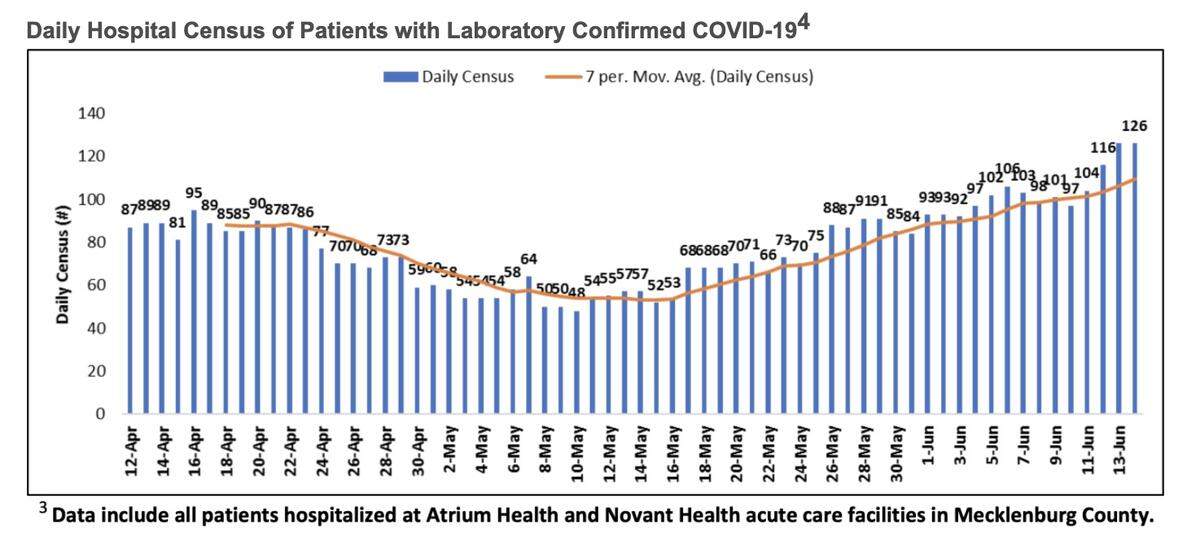
▪ Before Phase 1 reopening: The average number of people hospitalized due to COVID-19 in Mecklenburg County was trending down after hitting a high of 111 people on April 9. (County data on daily hospitalization goes back to April 6).
In the week before reopening, an average of 57 people were hospitalized in Mecklenburg with COVID-19, county data show.
▪ After Phase 1: Immediately following the state’s May 8 move into Phase One, hospitalization numbers were stable. But after the data began to include people possibly infected during reopening, hospitalizations began to increase.
Between May 18 and May 25, an average of 70 people were hospitalized with COVID-19. But that number was still lower than the number of people hospitalized in early April when coronavirus was spreading rapidly through the county.
▪ After Phase 2: Hospitalizations locally have quickly surpassed the previous high in April. The trend is worrying, according to state and local public health officials.
Mecklenburg hit a new high in its daily count of hospitalized COVID-19 patients with 116 on June 13. The next day, the number jumped to 126. Between Jun 7 and June 14, an average of 106 people with lab-confirmed COVID-19 were hospitalized in the county, which is an increase over a 14-day period.
Data on daily hospitalizations after June 14 has not yet been released. North Carolina data in recent weeks has shown a similar rise in hospitalizations across the state since Phase 2 reopening.
New lab-confirmed cases reported daily
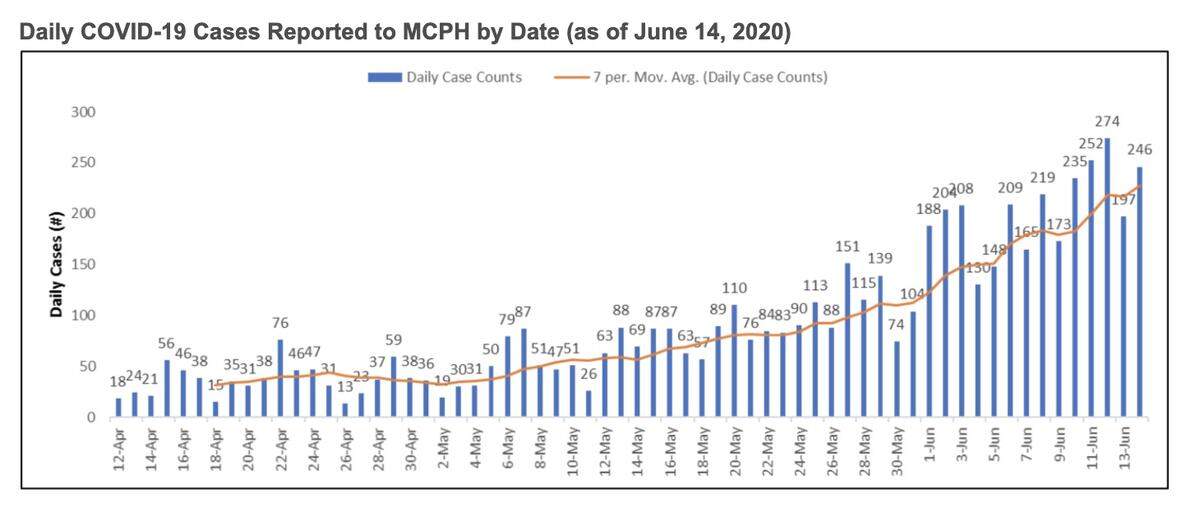
▪ Before Phase 1 reopening: The number of new cases identified each day had generally been on a slightly downward trajectory for the two weeks before reopening, according to a Charlotte Observer analysis of state and county data.
▪ After Phase 1: As Mecklenburg ramped up testing, the county saw an increase in lab-confirmed cases. But health officials say the documented increase in the percentage of positive tests shows this rising trend is not solely due to increased testing.
On May 20, Mecklenburg County Public Health reported its first single-day increase of more than 100 new cases.
▪ After Phase 2: The county’s daily tally of new COVID-19 cases shows increases of 100 or more every day in the first two weeks of June. Eight of those 14 days saw daily increases of 200 or more cases.
County health officials say even the growing case count and increased amount of testing does not capture “the true burden of COVID-19 in community” as many people who are infected have not been tested.
.jpg)