
Mecklenburg leaders fear COVID-19 lockdown is coming. Here’s what hospitals say.
Some elected officials fear another coronavirus-induced lockdown seems inevitable as the Charlotte region struggles to regain control of steadily rising case tallies and hospitalizations.
As Mecklenburg County commissioners warily look ahead to the start of the school year — and nervously anticipate data from July 4th celebrations that may have fueled new COVID-19 outbreaks — they forecast such a dire intervention is needed to avoid overwhelming hospitals.
“I feel like we’re just sitting here watching a train come toward us, and we’re just sitting on the track,” Commissioner Susan Rodriguez-McDowell told the Observer. “And we’re like, ‘Oh, maybe it will stop before it hits me, and maybe it won’t.’ It’s just a really weird feeling.”
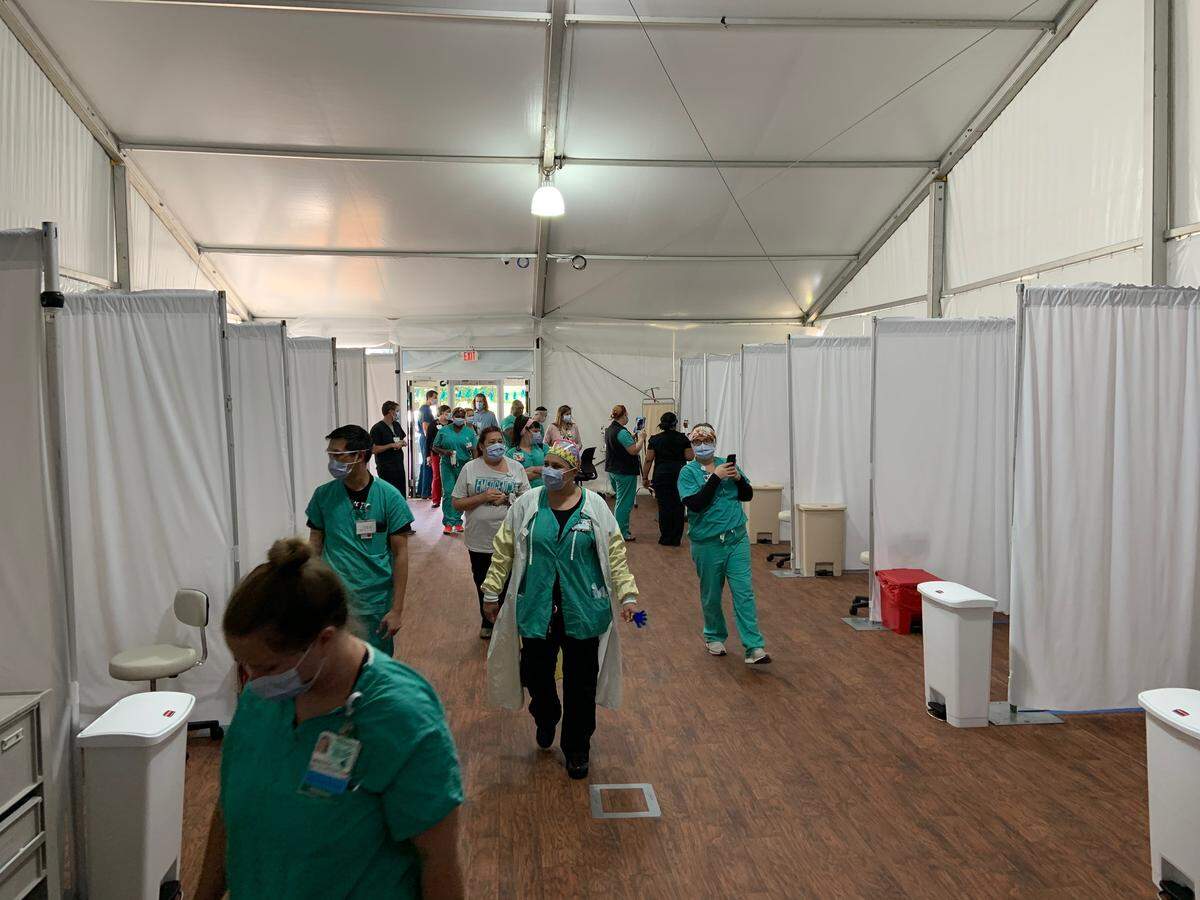
But not even assurances about hospital capacity, including available ventilators, from Mecklenburg Public Health Director Gibbie Harris this week could placate commissioners’ anxieties, as coronavirus infections surge across the country. About 20% of hospital beds and intensive-care beds are available, Mecklenburg officials said Friday in a joint statement with Atrium Health and Novant Health.
“Charlotte’s hospitals currently have the capacity to care for additional COVID-19 patients,” the statement said. “Our hope is that we don’t need to use our added beds and we’ll begin to see a reversal in these trends. It’s critical our communities continue to take COVID-19 seriously and follow recommended safety measures.”
In March, Mecklenburg leaders imposed a local stay-at-home order days before Gov. Roy Cooper issued a statewide directive, arguing there was no time to waste as COVID-19 alarmingly circulated in the community. Mecklenburg, lacking unanimous support from all six towns, let the stay-at-home order expire in late April and instead followed the governor’s lead.
Since that critical policy juncture, Commissioner Trevor Fuller said he and his colleagues have been standing on the sidelines, watching Cooper issue sweeping executive orders.
But not all of the governor’s mitigation tactics, Fuller said, reflect the unique factors — such as population density — that have made Mecklenburg a coronavirus hotspot since the pandemic hit North Carolina.
”I don’t feel like we’re leading,” Fuller told the Observer. “It’s clear we are reaching (hospital) capacity. Do we do nothing? I would call myself worried and alarmed in a way that I haven’t been since we first started.”
‘We’re retrogressing’
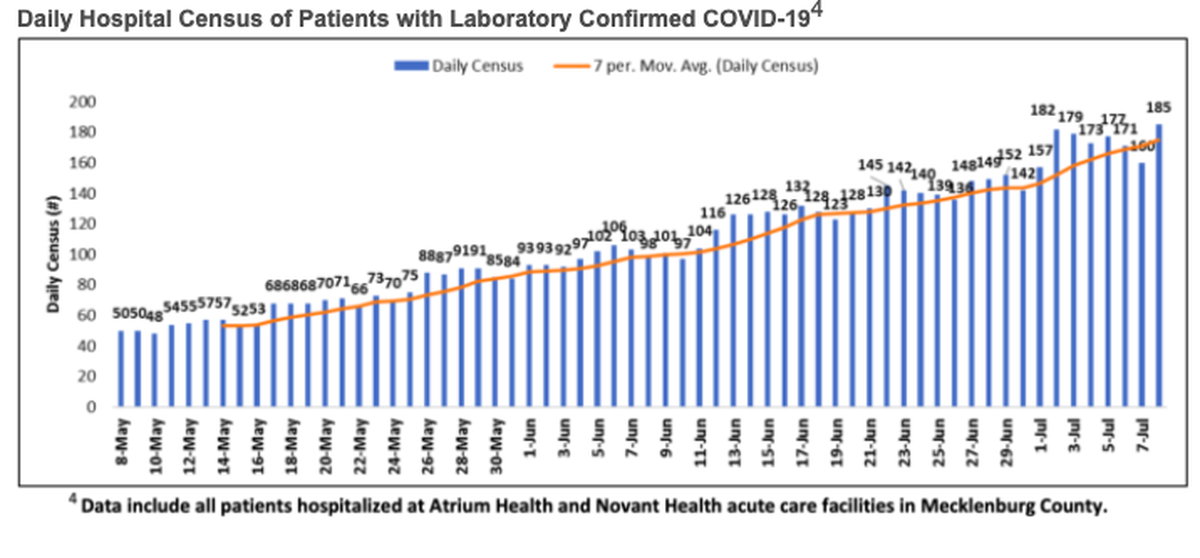
The average weekly number of coronavirus patients needing intensive-level hospital care in Mecklenburg has more than doubled since late May, when more restrictions were eased on businesses. In the past week, an average of 175 people were hospitalized in Mecklenburg’s acute care facilities, the latest county data released Friday shows.
Health experts warn rising hospitalizations lag behind rising new confirmed cases, which means it could take weeks for data to reflect the true scope and severity of the pandemic.
“We are particularly concerned about the Charlotte area and their hospital capacity,” Dr. Mandy Cohen, secretary of the state Department of Health and Human Services, told reporters Thursday. “At this point, there is not a need for further intervention, but we will continue to assess this decision.”
Harris says Atrium Health and Novant Health have developed better treatment options for coronavirus patients since March, as well as plans to ramp up surge capacity if necessary. There are currently no plans to postpone elective procedures to conserve hospital beds, officials said Friday.
“While today we are not concerned about our capacity or preparedness to manage COVID-19 cases, we do share the state’s concerns about the trends we’re seeing,” Mecklenburg, Atrium and Novant officials said in their joint statement Friday.
Still, Harris has not disclosed what volume of hospitalizations in Mecklenburg may trigger a stay-at-home order or other precautions.
“I think we’re at the point where we have to seriously examine a lockdown,” Commissioner Mark Jerrell told the Observer. “As a business owner, this is my worst-case scenario. But I don’t have a business if I don’t have healthy people. You can’t escape that fact.”
Huntersville Mayor John Aneralla said it would be unfair to shutter Mecklenburg’s economy, especially if businesses elsewhere in the state can stay open. Aneralla had opposed extending the county’s stay-at-home order in April, saying he was eager to relax restrictions for smaller retailers while adhering to certain health guidelines.
“We went into the stay-at-home order and pretty much decimated the economy,” Aneralla told the Observer this week. “I question why there’s such a panic right now ... we cannot afford to close down again.”
But as Commissioner Vilma Leake sees it, Mecklenburg’s initial reopening was premature.
Before Phase One of Cooper’s plan, for example, the average number of people hospitalized was trending downward — and so was the number of new cases identified each day. On July 8, Mecklenburg’s hospitalizations recorded a new single-day high of 185, according to county data.
“We opened up too early, because now we’re retrogressing — rather than progressing,” Leake told the Observer.
While Fuller said he supports Cooper’s data-based decisions to guide reopening, the county commissioner said he would have followed a different approach in May.
“If I had my druthers, I wouldn’t have opened,” Fuller said. “We need to resist what seems like this inexorable push to reopen quickly and sort of go back to, quote, ‘normal.’”
‘Bend the curve’
Mecklenburg might see new daily case totals of 600 by August, assuming officials don’t impose more restrictions to quell the virus’ spread, according to a COVID-19 model from PolicyLab at Children’s Hospital of Philadelphia.
That’s 170 cases above the county’s single-day record of new cases, 430, from July 3. But Dr. Gregory Tasian, a lead investigator for the model that incorporates county-level trends, said the jarring uptick should be seen as an opportunity for local officials to redirect the pandemic’s trajectory.
“If you’re having a high amount of disease activity, perhaps pausing (reopening) isn’t enough,” Tasian told the Observer. “You have to do something to bend the curve back — you have to do something different than what you’re currently doing.”
Recent projections from Harvard University researchers offer a blunter assessment for Mecklenburg’s local pandemic trajectory: A stay-at-home order should be required now, with the county reaching a “tipping point for uncontrolled spread.”
Other North Carolina counties — including Duplin, Hyde and Tyrrell — also saw “red” risk levels, indicating there were 25 or more new daily cases per 100,000 people, according to the Harvard research collaboration.
Coronavirus hotspots
If infection trends worsen, Charlotte could start to resemble other major U.S. cities where the coronavirus has wrought havoc on hospital resources, including in New York, said Commissioner Susan Harden.
“We need to do more,” Harden said. “What does this community want to do? Do we want to send our kids to school, or do we want to eat in restaurants?”
Harris, the county’s health director, acknowledged Tuesday she was concerned Mecklenburg’s trends may soon take a drastic turn for the worse, potentially resembling scenes out of San Antonio or Houston.
Texas saw recording-breaking numbers of deaths and hospitalizations Thursday, with Gov. Greg Abbott predicting the onslaught of coronavirus cases would only escalate in the coming days, The Dallas Morning News reported.
Wary of an uncontrolled pandemic, South Carolina Gov. Henry McMaster announced Friday that bars and restaurants are no longer allowed to serve alcohol after 11 p.m., starting this Saturday. The same measure took effect on Friday evening for Orange County, N.C., with officials attempting to prevent large gatherings and promote social distancing.
Yet in Mecklenburg, leaders have not publicly deliberated the possibility of milder interventions, such as more stringent enforcement of mask-wearing in public settings.
“We can see that as social distancing is relaxed — and if you don’t have those necessary mitigation strategies in place — that’s when you’re bound to see a resurgence in disease activity,” Tasian said.
“Our mission should be to prevent deaths, to protect lives. This is a public health crisis that has not been experienced in over a century, and we need to have a social contract where we are protecting each other.”
This story was originally published July 10, 2020 at 5:46 PM.