
Charlotte’s COVID-19 cases climbing, but health experts aren’t overly alarmed — yet
Mecklenburg County’s tally of new daily COVID-19 cases nearly doubled in the past month, forging a troubling trend that may soon translate into higher rates of hospitalizations — and ultimately, deaths.
The county is now averaging around 236 new cases per day, according to a Charlotte Observer analysis of the latest public health data. At this point last month, the seven-day moving average was 122.
State and local officials fear colder weather, combined with the upcoming holiday season, could fuel even greater spread of the virus as people gather indoors and grow weary of following health guidelines such as wearing face coverings.
But for now, health experts say there are still some encouraging signs within Mecklenburg’s coronavirus metrics.
Atrium Health infectious disease specialist Dr. Katie Passaretti said the county is not experiencing “exponential growth” of the virus, which could inundate hospital resources such as available ventilators and ICU beds.
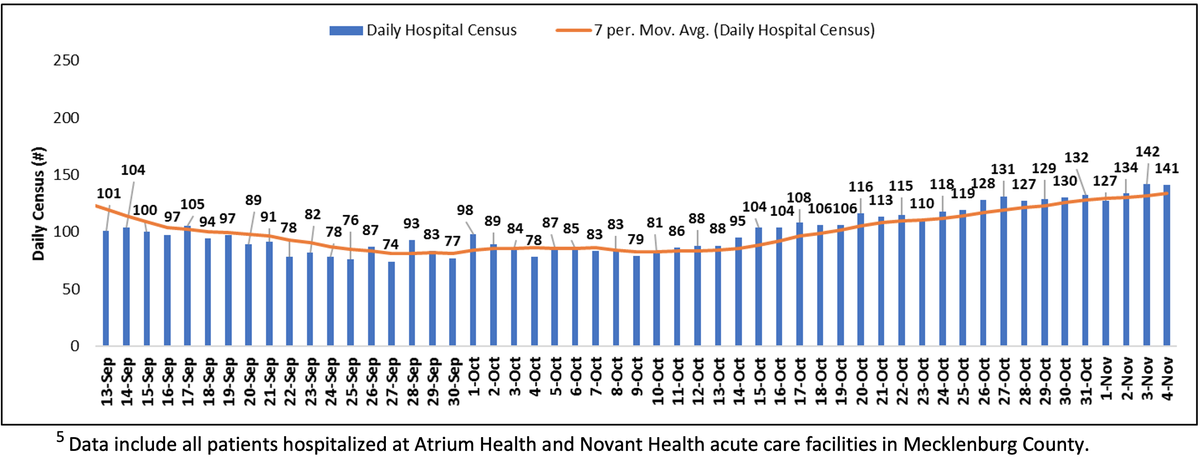
“Hospitalizations are holding steady,” Passaretti told the Observer in an interview Thursday. “Certainly, if we start to see the the kind of spread in Mecklenburg County that we’re seeing in other counties — Gaston, Lincoln and Cleveland — that puts us in a tricky position very quickly.”
Mecklenburg’s caseload remains lower than peak levels recorded in July, when more than 300 infections were added each day, Passaretti said. During that spike, more than 200 people needed hospital-level care, compared to around 130 in the last week.
Novant Health infectious disease specialist Dr. David Priest said it’s likely only a matter of time until soaring case tallies elsewhere in North Carolina cascade into rippling effects here. He said patients tend to have symptoms including fever, difficulty breathing, muscle aches, headaches and gastrointestinal issues.
“We can expect over the next few weeks to have increasing numbers of sick individuals with COVID-19 coming into our hospitals,” Priest said in an interview Friday. “We feel like we’re in a resurgence of viral activity currently.”
In Gaston County, the weekly total of confirmed COVID-19 cases hit an all-time high the week of Oct. 17 with 585, recent public health data show.
Daily COVID-19 cases in Cleveland County hit a first peak in early August. Since a low in September, those daily cases have been surging.
Lincoln County was reporting a second wave of COVID-19 cases by mid-September. Since October, Lincoln has reported five days tabulating higher daily case counts than the county’s single highest reporting day in July, according to the North Carolina Department of Health and Human Services.
“We know ultimately everyone who hasn’t had (COVID-19) is vulnerable,” said Michael Thompson, associate chair of the Public Health Sciences department at UNC Charlotte.
“All we’re trying to do is slow down the pathway and minimize the harm without overwhelming the hospital system. We haven’t gotten to an alarming rate locally yet.”
Threat of gatherings
The rise in cases should come as no surprise, Mecklenburg Public Health Director Gibbie Harris told county commissioners earlier this week. As businesses and schools slowly reopen, people found more opportunities to gather — and to be potentially exposed to infected individuals.
”We are seeing some significant spread in the community,” Harris said.
The county has recorded 35,845 cumulative infections since the start of the pandemic in March, N.C. DHHS reported Friday morning. That’s a rate of 323 cases for everyone 10,000 residents.
Mecklenburg’s positivity rate, which measures the percentage of COVID-19 tests that come back positive, signals the virus is circulating more. The metric was 7% in the past week, compared to around 4.4% last month. State leaders and the World Health Organization target a 5% benchmark when contemplating loosening coronavirus restrictions.
“It’s not exploding like it is in the Midwest — it’s not all doom and gloom in Charlotte,” said Dr. David Rubin, director of PolicyLab at Children’s Hospital of Philadelphia and lead investigator for a COVID-19 model that incorporates county-specific trends.
Mecklenburg’s “disease reservoir” is substantially elevated, though.
“There’s more and more people walking around and spreading it to each other,” Rubin said. “You’re going to see your testing positivity go up, but what we’re really alarmed by is ... the sheer number of people with increasing transmission.”
Charlotte last month reported its largest coronavirus outbreak to date. Convocation events at the United House of Prayer for All People on Beatties Ford Road led to at least eight deaths and 187 confirmed cases, Harris said Wednesday.
But Passaretti warned clusters can occur in any group setting — not just large gatherings with hundreds or thousands of attendees. An inside get-together with 10 to 20 people not wearing masks, for example, could have far-reaching consequences.
”You go to this event, you get infected and then you go to another event. It just spiders out very quickly,” Passaretti said. “There is a little bit of not recognizing the consequences of those actions and what implications that may have.”
Ahead of the next looming threat with this pandemic — Thanksgiving celebrations — officials are pleading with the public to follow basic coronavirus protocols. Harris recommends that people also get tested for COVID-19 before traveling to see friends and loved ones.
”Just because you’re tested does not mean that you’re fully in the clear, but it does give you an idea that you’re not exposing someone directly,” Harris said. “You still need to wear your mask, and you still need to social distance.”
Hannah Smoot contributed to reporting for this story.
This story was originally published November 6, 2020 at 3:04 PM.