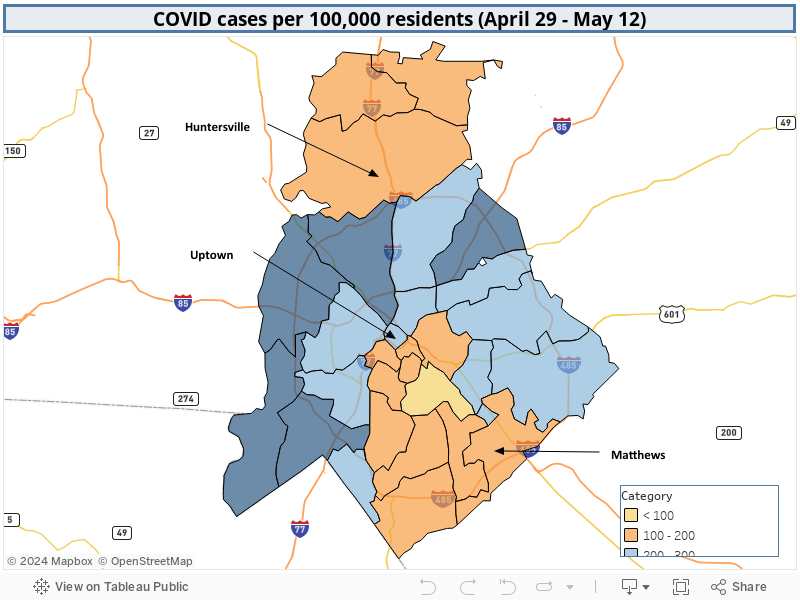
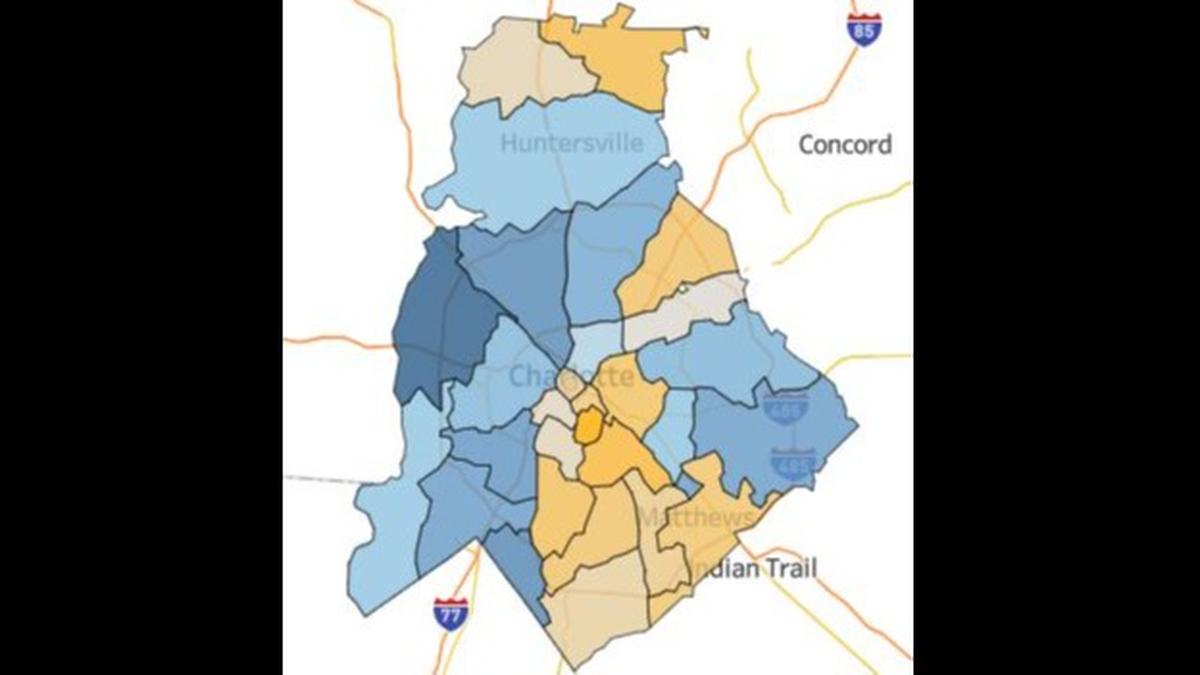
As North Carolina health leaders urge a more tailored, local response to “viral hotspots,” Mecklenburg this week released its own detailed data showing the ZIP codes in and around Charlotte with the highest positivity rate for COVID-19.
What it means: The positivity rate is derived from the percent of positive coronavirus tests. In Mecklenburg’s map, when someone is diagnosed, their positive test is included in the data for the ZIP code where they live. Looking at the rate rather than total number of cases offers clearer insights into how hard hit certain neighborhoods are, even as population and density in each ZIP code varies.
Higher positivity rates were observed in communities where adults work in front-line jobs, have limited access to health care and where children or adults have been exposed to the virus while living in multi-generational homes. In Charlotte, Black and Hispanic families have been disproportionately affected.
What it doesn’t mean: A neighborhood with a low positivity rate doesn’t mean there’s no threat of contracting the virus there, but the metric does indicate lower prevalence. Health experts stress that no geographic area is immune. Plus, ZIP codes aren’t necessarily aligned with centers of employment or social activities. Everyday movement — like shopping, going to work or seeing friends and family — means the virus is easily spread, and neighborhoods with low positivity rates are still at risk.
Countywide, Mecklenburg’s average positivity rate was 8.2% in the past week. (The World Health Organization and state officials have pointed to a 5% positivity rate as the threshold to use when considering easing coronavirus restrictions.)
The county has recorded 39,166 cases since the start of the pandemic, according to the North Carolina Department of Health and Human Services on Wednesday. The death toll reached 425 on Tuesday evening, local officials said.
The ZIP code data (map below) from the county health department shows accelerated spread of the virus near the South Carolina state line.
During the first half of November, the positivity rate fluctuated widely across neighborhoods, Mecklenburg Deputy Public Health Director Raynard Washington told county commissioners Tuesday evening. The highest rates were observed in the western and southwestern parts of Mecklenburg, he said.
“COVID-19 does not have any knowledge or awareness of the geographic boundaries that we create,” Washington said. “We have to be particularly vigilant not just in Mecklenburg County, but across this entire region and really across the entire state if we want to do our due diligence to keep the spread low.”
Only three ZIP codes recorded positivity rates below 5%. Meanwhile, 21 ZIP codes logged rates between 5 and 10%, and six ZIP codes were above 10%, according to a Charlotte Observer analysis.
The data reflects where infected people live, yet not necessarily where they contracted the virus. Mecklenburg Public Health Director Gibbie Harris has said the nuanced picture helps officials allocate resources, including deploying more mobile COVID-19 testing units.
”Very few people stay in their ZIP code — they’re moving around,” Harris previously told commissioners as she explained an earlier iteration of the map. “It doesn’t show you that they work in another part of the county, or that they went to a grocery store in another part of the county, or that they went to a bar or a restaurant in another part of the county.”
The bottom line, as Harris sees it, is that Mecklenburg has “widespread community involvement.” The sheer scope of cases makes it impossible for health officials to pinpoint the source of every individual infection, unlike the start of the pandemic when only a handful of infections were known in Mecklenburg.
N.C. DHHS Secretary Dr. Mandy Cohen emphasized Tuesday the entire state is grappling with community spread — though some regions are reeling more than others, based on case rates and hospitalizations.
Health experts say the virus spreads more rapidly in communities with high population density.
Poor communities and communities of color are far more likely to have longstanding health care disparities, leaving them vulnerable to severe complications if infected with COVID-19. In those communities, adults are also more likely to be essential workers, which increases the possibility of being exposed to the virus while on the job.
The positivity rate is derived from the percent of positive coronavirus tests. In Mecklenburg’s map, when someone is diagnosed, their positive test is included in the data for the ZIP code where they live. Gavin Off goff@charlotteobserver.com
Alison Kuznitz is a local government reporter for The Charlotte Observer, covering City Council and the Mecklenburg Board of County Commissioners. Since March, she has also reported on COVID-19 in North Carolina. She previously interned at The Boston Globe, The Hartford Courant and Hearst Connecticut Media Group, and is a Penn State graduate.Support my work with a digital subscription