COVID cases by Charlotte ZIP codes: Lowest rates in months. Here’s the map.
For the second week in a row, every ZIP code in Mecklenburg County saw a drop in COVID-19 case rates.
A steady decline in infections has brought every ZIP code in and around Charlotte to fewer than 900 new cases per 100,000 residents (average case rate over the last two weeks).
While the spread of the virus was considerably slower in the beginning of the pandemic and again last fall compared to now, the most-recent ZIP code data shows substantial improvement when compared to the last three months.
The case rate data by ZIP code — which Mecklenburg County Public Health releases at least twice per month — shows only the most recent, or active, infections detected by coronavirus testing, and takes into account population to show where cases are most concentrated.
The most-recent data is current through Feb. 17. Based on the information, the countywide 14-day average case rate was 483.8 new cases per 100,000 residents. That’s the lowest the county’s average case rate has been since late November, when public health officials began releasing ZIP code-level information.
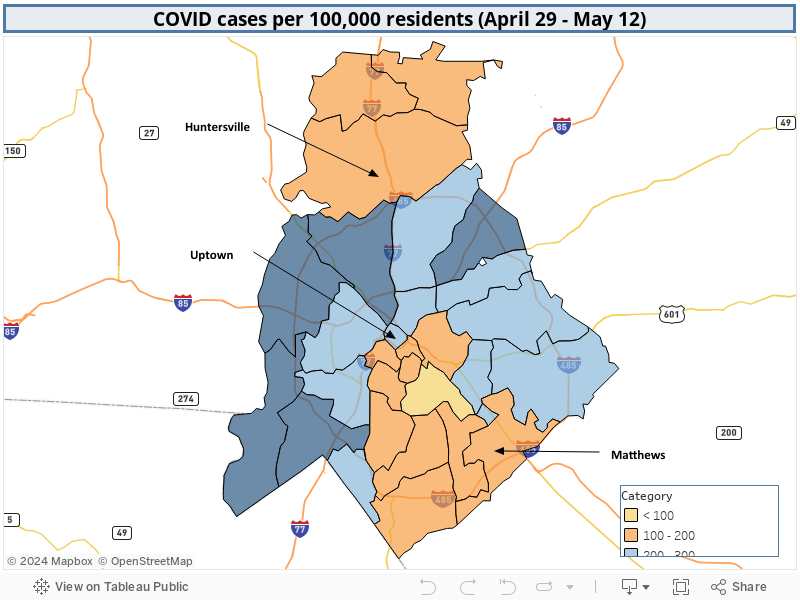
Tryon Hills and neighborhoods along North Graham and around Sugar Creek Road saw a significant decrease in case rate — residents of zip code 28206 saw their case rate decrease exponentially in a matter of weeks, going from the county’s highest rate of 1,660.6 per 100,000 residents during the last weeks of January to 575.5 in the past two weeks.
The highest concentration of infections remain in and around uptown Charlotte and parts of University City.
For the last two weeks, the highest case rate in Charlotte by far is in South End and Dilworth. Neighborhoods in ZIP code 28203 have seen a consistently high number of cases relative to population, according to data from the county going back to November. The 28203 ZIP code is the only area of Mecklenburg with a case rate higher than 700 during the past two weeks.
Following closely was the Steele Creek and Lake Wylie area near the South Carolina border. Case rate remains high in some northwest Charlotte neighborhoods.
Though the county’s positivity rate is going down, Health Director Gibbie Harris warned on President’s Day that it’s a “crucial time” for the county. The number of residents hospitalized is still much higher than during the previous summer’s peak, and the weekly coronavirus positivity rate (7.8%) remains elevated.
ZIP code data shows where infected residents live — not necessarily where they contracted the virus, such as at essential front-line jobs elsewhere.
Data released last week showed only 10 ZIP codes with case rates below 600. The most recent data covering the past two weeks show all but six ZIP codes with case rates below 600.
COVID-19 case rates by ZIP code
This data comes from Mecklenburg County Public Health and includes positive COVID-19 test results, based on a person’s home ZIP code, between Feb. 4 and Feb. 17.
Below 500 cases per 100,000 residents
- 28277: 330.1
- 28211: 347.9
- 28036: 373.3
- 28210: 386.3
- 28207: 407.1
- 28226: 418.7
- 28217: 418.8
- 28105: 423.1
- 28212: 453.1
- 28273: 456.8
- 28270: 457.0
- 28205: 489.6
- 28209: 492.0
Between 501-600 cases per 100,000
- 28227: 515.2
- 28078: 515.3
- 28031: 520.0
- 28208: 525.5
- 28215: 544.0
- 28269: 545.2
- 28134: 552.0
- 28206: 575.5
- 28262: 588.1
- 28216: 595.6
Between 601-800 cases per 100,000
- 28214: 615.8
- 28204: 632.7
- 28213: 650.6
- 28278: 683.5
- 28202: 686.3
Above 800 cases per 100,000
- 28203: 870.2
Gavin Off contributed to this report.
This story was originally published February 22, 2021 at 2:16 PM.