Nearly all Charlotte ZIP codes see a decrease in COVID numbers. Here’s the latest data.
Nearly all ZIP codes in and around Charlotte saw a decrease in COVID-19 case rates for the first time in months.
The latest data released by Mecklenburg County Public Health show that all ZIP codes have fewer than 400 new cases per 100,000 residents. Only two saw no change in case rate, and none showed increases.
The countywide average is 208.0 new cases per 100,000 residents, based on positive coronavirus test results from April 29 to May 12.
The case rate data by ZIP code shows only the most recent, or active, infections detected by coronavirus testing and takes into account population to show where cases are most concentrated. Mecklenburg Public Health typically releases ZIP code-level data weekly and the rate is based on a 14-day average.
The county’s highest concentration of COVID cases is in west Charlotte along Beatties Ford Road. Despite residents of ZIP code 28216 seeing a slight drop in cases since the county’s last data release from late April, consistent increases over the past couple of months have had lasting effects.
Other ZIP codes with high case rate concentrations are 28214 (north of the airport, along the Catawba River), 28262 (in and around University City), 28273 (on the South Carolina border near Carowinds) and 28278 (Steele Creek and along the South Carolina border near Lake Wylie).
Two ZIP codes saw no change in their case rates: 28036 (north Mecklenburg near Lake Norman) and 28212 (southeast Mecklenburg County, along Independence Boulevard and Idlewild Road).
The lowest concentration of COVID case rates is in south Charlotte along Providence Road, including Cotswold and parts of Myers Park (28211).
ZIP codes 28036 and 28207 (along Providence Road, including and around Queens University, respectively) have among the lowest numbers in the county.
Residents of ZIP codes 28203 (South End and parts of Dilworth) and 28204 (Cherry and Elizabeth) saw the biggest drops in case rates.
Latest coronavirus trends
Mecklenburg County’s COVID-19 trends are either stable or decreasing amid rising vaccination rates, Public Health Director Gibbie Harris said this week.
As long as the metrics continue to improve, Harris said she doesn’t expect to enact tougher rules than Gov. Roy Cooper, who on Friday relaxed most mask mandates, plus social distancing and mass gathering requirements.
“I’m hoping that people will use good common sense around this, and I’m hoping that we’re not going to see reckless behavior because of this,” Harris said of changing public health guidance.
The Centers for Disease Control offered guidance Thursday that fully vaccinated people no longer need to wear masks indoors or outdoors.
More than 402,000 Mecklenburg residents — about 36% of the county’s population — are fully vaccinated as of late Thursday, according to the North Carolina Department of Health and Human Services. The goal is to inoculate two-thirds of all residents, Harris and Cooper have said.
The county is adding about 130 new cases each day, according to an Observer analysis of state public health data. That’s a nearly 37% decrease over the last two weeks.
Mecklenburg has logged 112,120 coronavirus infections since the start of the pandemic, the state DHHS reported Friday.
The average positivity rate fell to 5% in the past week, according to the latest county health data. The rate, which hovered around 8% at this point last month, now aligns with the threshold state leaders use for relaxing coronavirus restrictions.
Average hospitalizations dropped to 150, a 15% decrease over the last two weeks.
Mecklenburg officials say 957 residents have died from coronavirus-related complications as of Friday morning.
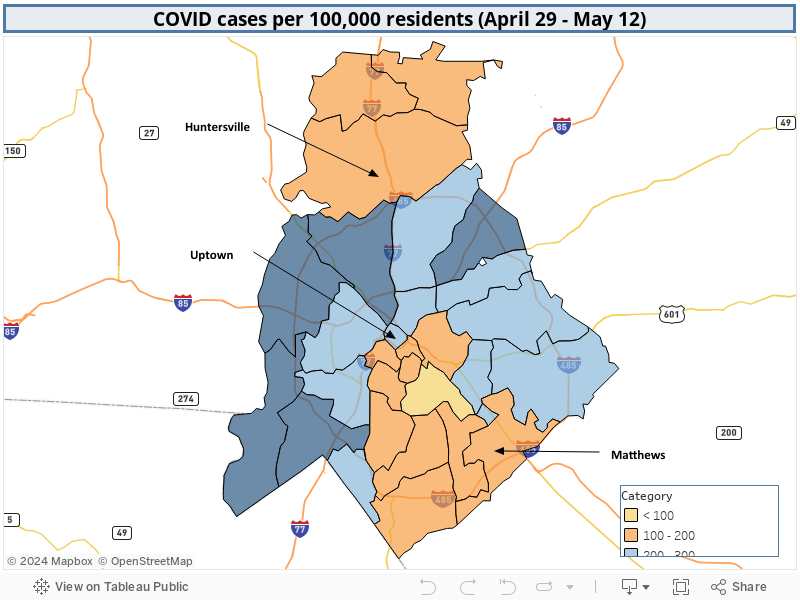
COVID-19 case rates by ZIP code
This data comes from Mecklenburg County Public Health and includes positive COVID-19 test results, based on a person’s home ZIP code, between April 29 and May 12.
Below 100 cases per 100,000 residents:
28211: 74.8
Between 100-200 cases:
28036: 109.1
28207: 125.3
28031: 140.1
28226: 140.4
28204: 146.0
28277: 147.3
28270: 149.4
28078: 154.3
28105: 158.7
28209: 170.0
28205: 181.7
28210: 183.9
28203: 195.6
Between 200-300 cases:
28134: 208.1
28217: 214.6
28212: 223.2
28227: 225.4
28269: 225.6
28206: 254.9
28202: 264.6
28215: 282.9
28208: 291.9
28213: 299.3
Above 300 cases:
28278: 303.8
28273: 310.7
28262: 317.9
28214: 340.4
28216: 341.8
Gavin Off contributed to this report.
This story was originally published May 17, 2021 at 6:00 AM.