
Dwayne Collins, political activist and former Charlotte NAACP president, dies at 51
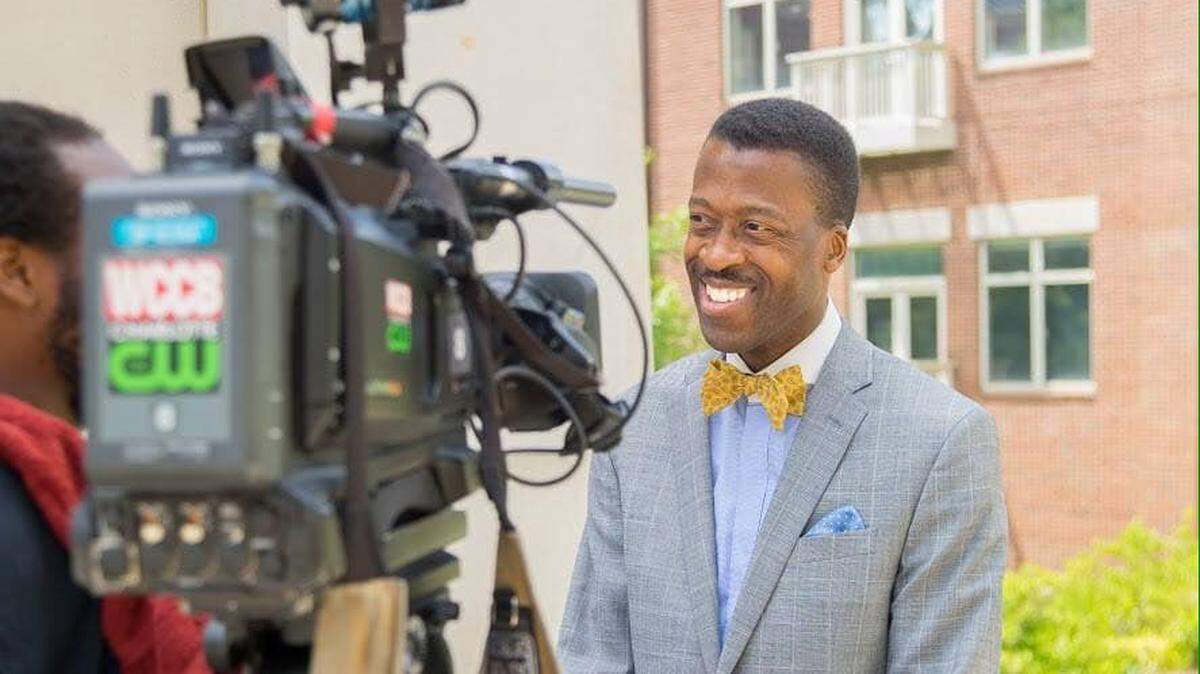
Dwayne Collins, an African American political leader who fought to preserve racial integration in Charlotte schools and pushed for police accountability, died late last month. He was 51.
The cause was multiple myeloma, a kind of blood cancer, said his son Omari.
A resident of Charlotte for nearly his entire life, Collins advocated fiercely for its black residents as the city grappled with issues of equity, segregation and racial injustice through the 1990s and 2000s — first, as a grassroots activist, and later, at the helm of some of the city’s most influential groups.
Collins first emerged on the citywide stage in the protests that followed the 1993 police killing of an unarmed black motorist, Windy Gail Thomson. He co-founded a group called Citizens for Justice, where he organized “Black Monday” events to unite the community.
In particular, he and others lobbied Peter Gilchrist, then the district attorney, to bring in an independent prosecutor to examine officer-involved shootings and to create and strengthen the Citizens Review Board, an independent body meant to hold the police accountable.
“He was always about action,” said Jay Ferguson III, a longtime friend and fellow activist. “When it came to community work, if you weren’t about action, you probably weren’t going to be able to keep up with him.”
Yet Collins is perhaps best known for a battle he waged within the legal system.
As one of two lead plaintiffs in a 1999 case about the racial makeup of Charlotte-Mecklenburg Schools, he sued to preserve court-ordered busing in the district, following a successful suit from some white parents that put an end to the practice.
His efforts failed after the Supreme Court declined to hear the case. So did Collins’ 2005 bid for a seat on the Charlotte-Mecklenburg school board. Nonetheless, he was long a fixture in debates on education policy, including on changes to the Myers Park magnet program and the school district’s student assignment plan.
More than anything else, Ferguson said, Collins was known for his consistent involvement. He was elected as president of the city’s NAACP in 1999, heralded as a new, fresh face for black leadership.
He took the helm of Charlotte’s influential Black Political Caucus from 2006 to 2009, and in recent years, pushed for black fathers to get involved in schools and organized town halls between police and young black men. Even a month before his death, he still attended Tuesday Morning Breakfast, the weekly gathering of the city’s black politicos.
In many ways, the issues he advocated for reflect struggles that carry to the present day: Accountability of police involvement after a fatal shootings. Racial equity within the school system. Environmental justice.
But Ferguson pointed to one of Collins’ most common refrains: “It’s not a sprint, it’s a marathon,” he said, “and he really lived that out.”
Dwayne Lavone Collins was born in Fayetteville on Sept. 27, 1967.
A graduate of Garinger High School and Johnson C. Smith University, he grew up in a family of educators and entered the fray of political activism early in life. While pursuing his English degree in college, he founded the Messengers of Truth, which taught black history and culture on the streets as a way to combat crime and drugs.
Besides his pursuit of racial justice, Collins also had a sartorial bent: He was rarely seen in public without a pocket square in his tailored suit and an elegant fedora or straw boater hat atop his head.
After working as a minister and for retailers along the likes of Saks Fifth Avenue and Ralph Lauren, he founded a wardrobe consultation service for men and often designed suits for customers himself.
Omari Collins remembers waking up before dawn to see his father shining his shoes or ironing his clothes, he said, while discussing strategies over the phone in advance of a meeting with the mayor or a county commissioner.
The family often had to disconnect their land phone, he said, because his father would get inundated with calls from concerned residents about all matter of issues.
“He was fearless but compassionate. He could hang with anyone,” he said. “A lot of people can’t speak to someone from the hood to Hollywood, and he was able to do both.”
Later in life, Collins hosted “The Gotham Sophisticate,” a syndicated talk show on men’s clothing, and served as a fashion columnist in three regional publications.
That passion also served him well in meetings with powerful city officials, friends said, where Collins relied on his seersucker and pinstripe suits as much as he did on his rhetoric.
“His attire was his armor,” Feguson said.
In addition to his son Omari, Collins is survived by another son, Salim Collins, also of Charlotte; a stepsister, Maisha Kelly Freeman, of Hoover, Ala.; his ex-wife, Patrina K. Peebles; an uncle, Rev. Eugene Collins Sr. of Charleston, S.C.; and two aunts, Louise M. Pittman of Washington, D.C. and Diane Collins of Camden, S.C.
This story was originally published September 4, 2019 at 4:44 PM.