He walked with King in the 60s. In Charlotte, he says ‘we shall overcome’ inequality
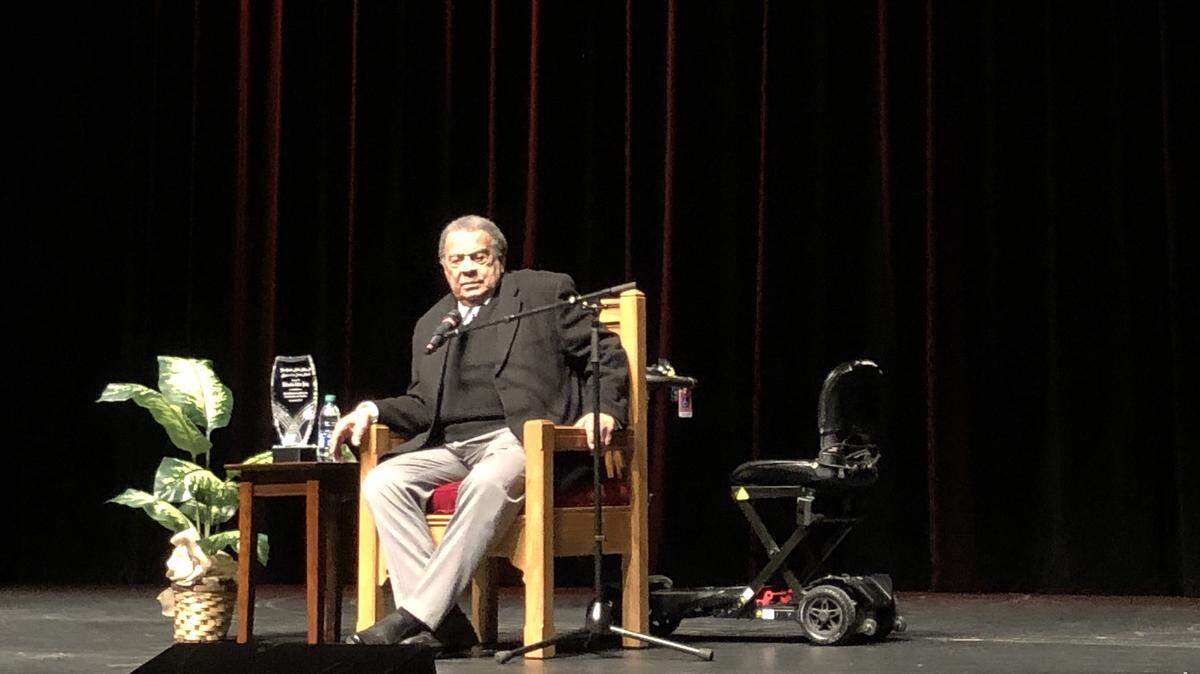
Decades after he was jailed for participating in demonstrations with Martin Luther King Jr., Andrew Young brought his message of nonviolent resistance to Charlotte.
The civil rights leader and former United Nations Ambassador and Atlanta mayor spoke at Central Piedmont Community College’s Central Campus as part of the city’s Martin Luther King Jr. Day event. He was presented with Charlotte’s “Keeper of the Dream Award,” which is given to those who epitomize King’s ideals.
Young told stories of his youth growing up in New Orleans, of his time working with King and his experience as a young minister. In the 1960s, Young served as executive director of the Southern Christian Leadership Conference and an advisor to King.
Young also revealed a personal connection to the Charlotte area: after he graduated college, he was traveling with his parents to a church conference. They stopped in Kings Mountain, and he went for a run up the mountain. When he reached the top, he looked down over the trees and fields.
He says the view made him realize that everything in life had a purpose.
“The reason I think I have been successful is that I followed what I thought was my purpose,” he said. “... And that’s how I got to work with Martin Luther King.”
Young recounted lessons he learned as a child, and during his involvement with the civil rights movement, that taught him nonviolent resistance.
When Young visited King and fellow civil rights activist Ralph Abernathy in jail in Albany, Ga., the desk sergeant didn’t look up at him, instead calling him a “little n-----.”
Young recalled the conversation and resisting the urge to anger.
Years later, at a fundraiser for his Congressional campaign in Maine, Young remembers, he ran into the police sergeant again. To his surprise, Young told the audience Monday, the sergeant thanked him.
“He said, ‘As soon as you and Dr. King left, I realized that did not want my children growing up that way,’” Young recalled. “... There have just been incidents like that throughout my life that are nonviolent that work far better than my getting angry.”
Reflections on today
Young contends that the country has made significant progress on race, but in an interview with the Observer, he said King would’ve “hoped that we would have gone further.”
He told the audience that by attending Monday’s celebration, they too were a part of King’s dream.
“We are overcoming, and we shall overcome,” he said.
A 2014 study from researchers at Harvard and UC Berkeley ranked Charlotte last of 50 large cities for economic mobility. Segregationist laws and policies that King fought to dismantle played a role in creating that gap, the 2017 Leading on Opportunity Report found.
The inequality persists despite the growth of Charlotte’s economy and population in recent years.
“We’re growing well, but we still haven’t figured out how to grow at the bottom of the barrel,” Young said before his speech Monday.