Q&A: Charlotte’s coronavirus peak moved again. Why does the date keep changing?
By Bruce Henderson and
Alison Kuznitz
Mecklenburg County officials have once again revised their projections for when a surge of local coronavirus cases could happen.
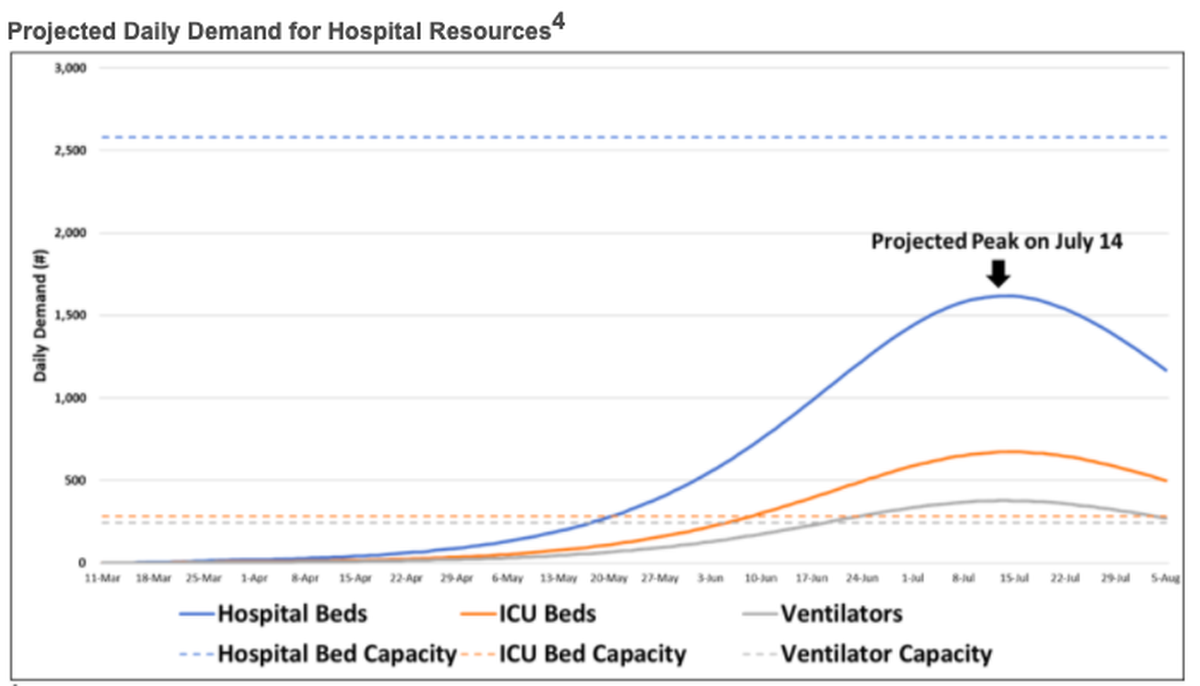
The most recent projections, released on May 5, show a probable peak of demand on health care providers on July 14. That’s a little more than two weeks later than had previously suggested the region could see its peak.
That would seem to only prolong the agony of the outbreak.
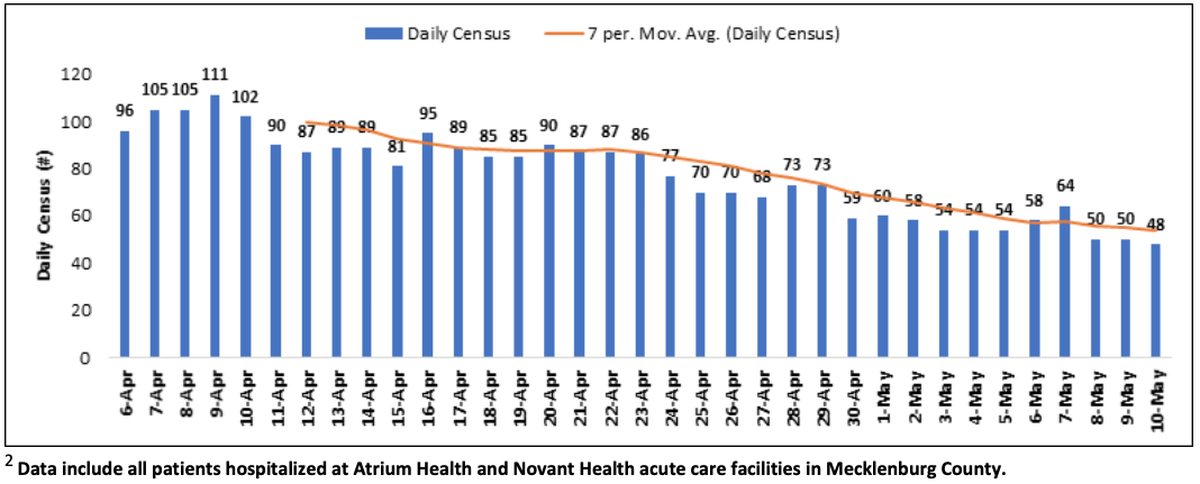
But health officials say the later dates mean social distancing enforced by county and state stay-at-home orders is working. Hospitalizations at the region’s acute care facilities have decreased in the last 14 days, and so has the average percentage of people testing positive for COVID-19, local officials said.
And, as The Charlotte Observer previously reported, the latest projection shows “peak” demand would require fewer intensive care unit beds and fewer ventilators than anticipated. Mecklenburg’s health director has said there’s currently no need to plan for a field hospital, based on local hospitals’ capacity to handle a possible surge in patients.
The “flattened curve,” in which infections are spread thinly over a longer period of time instead of coming in a sudden surge, means hospitals will be less likely to be overrun by an avalanche of sick people. The county might not see fewer COVID-19 cases in total, however.
The number of cases is expected to continue to rise as Mecklenburg expands coronavirus testing. Last week, Health Director Gibbie Harris said the county aims to reach an additional 50,000 Mecklenburg County residents in the next month.
Here’s more on what the projections are, how they’re calculated and what it means for Mecklenburg’s response.
Why do COVID projections vary so widely?
Models are used in science to explain and predict the behavior of events and processes. They’re based on observations and assumptions that can be further refined with new information, changing the results or projections.
In Mecklenburg’s case, the county observes case counts and the estimated amount of social distancing being practiced under North Carolina’s stay-at-home order. Then it makes assumptions about factors such as how many infected patients will need hospital and ICU care.
“These models are just like forecasting a hurricane,” officials have said. “Expect to see new ‘forecasts’ as we learn more about how COVID-19 is impacting our community.”
The COVID-19 projections are “quite volatile,” local officials say.
Mecklenburg Deputy Health Director Raynard Washington told reporters that while officials monitor COVID-19 models on a daily basis, those estimates are not “the only source of information” consulted when making decisions — such as asking residents to wear masks or the timeline of stay-at-home orders.
“(Models) essentially allow us to be able to understand better what might happen in the future based on what we know currently,” Washington said. “We expect that they will continue to change.”
Officials acknowledge they’re missing crucial information, which could affect the models’ margin of error. Because of limited testing capacity and symptom criteria for who will get tested, officials revealed that local cases “may be as little as 5-10% of actual infections.”
And questions have been raised about whether the University of Pennsylvania’s coronavirus model is still relevant for projections in Charlotte. The projections are intended to help officials anticipate a surge in cases at the start of an epidemic — not when there’s a plateau or decline, which appears to be the case in Mecklenburg, a Penn Medicine data scientist who help created the model told WFAE.
While the University of Washington’s coronavirus model appears to accurately project state conditions, it is not available for counties, Mecklenburg officials say.
Harris told Mecklenburg County commissioners in April that Washington’s model was too “optimistic” and showed “more favorable outcomes.”
By contrast, Harris said, the University of Pennsylvania’s model provides “middle-of-the road” projections for when hospitals could see the greatest strain on resources.
It’s also unclear how well the state projections line up with county conditions. Mecklenburg has twice as many coronavirus cases as any other N.C. county.
What about surrounding counties?
The local projections reflect “expected hospital resource demand for the entire region.”
Mecklenburg County’s hospitals deliver the majority of emergency and acute health care for people living in eight counties, including York and Lancaster in South Carolina. The county’s facilities serve about 2.3 million people from surrounding counties.
But as South Carolina reopens restaurants and other businesses more rapidly than North Carolina, Harris told reporters that could interfere with Mecklenburg’s stricter social distancing guidelines. And in neighboring Gaston County, some elected officials have encouraged businesses to defy North Carolina’s stay-at-home order, prompting the leaders of 12 cities and towns to push back.
“We’re right on the border, and if they loosen things in those communities, we expect to see some effect on our county,” Harris said in response to South Carolina’s reopening. “We’re just not sure what that will be at this time.”
Mecklenburg County
How does social distancing play in?
UPenn’s analysis — formally known as the COVID-19 Hospital Impact Model for Epidemics — incorporates information on how susceptible people are to the coronavirus, as well the number of individuals who are infected and recovered.
The model has several key parameters, including what’s known as a basic reproduction number, according to Penn Medicine. That variable calculates how many people could become infected with the coronavirus, after being exposed to someone who has tested positive for COVID-19.
But social distancing could dramatically reduce how long it takes for coronavirus cases to double and consequently lower the model’s reproduction rate.
As of May 5, positive cases were doubling in Mecklenburg about every 21 days, according to Rebecca Carter, a county spokesperson. By comparison, earlier doubling rates were every 2.85 days — and later, every 6 days under the stay-at-home order.
That means plans to erect a field hospital to accommodate a possible surge in cases are “on the back-burner right now,” Harris has said. Leaders from Atrium Health and Novant Health in April previously requested the county’s help in setting up a 600-bed field hospital at the Charlotte Convention.
The UPenn model predicts expected demand on the county’s health care network based on assumptions of the degree of social distancing that’s observed: declines in people moving around of 30%, 45% or 60%. Google Mobility metrics shows there’s been a “slight” decrease in social distancing, though it remains “significantly higher” than before the stay-at-home order took effect.
Mecklenburg’s projected July 14 peak is based on 45% “sustained” social distancing. Unlike previous models, the county did not say how scenarios of more or less social distancing could impact this new peak.
What’s supposed to happen on July 14?
A surge in coronavirus cases could start to overwhelm hospitals in and around Charlotte that day, based on the most recent modeling with 45% social distancing.
The county projects a demand for 1,615 hospital beds on that day — down from more than 2,000 beds predicted when the peak was expected June 27. The greater Charlotte region would need 672 ICU beds and 377 ventilators on July 14, based on county data, the Observer has previously reported.
There are only 283 critical-care beds and 243 ventilators in the county, Mecklenburg officials said last month. But Harris has said those figures don’t account for surge capacity at Atrium Health and Novant Health, which she described as “pretty significant” without offering specific numbers.
There were an average of 57 coronavirus patients hospitalized in the the county’s acute care facilities in the past week. Harris said fewer patients have required ventilators, and that there “a lot” of ventilators still available.
The greater Charlotte region is not expected to reach its coronavirus peak until mid-July, according to the latest projection from Mecklenburg County officials released on May 5, 2020. Mecklenburg County
Could the peak occur even later?
It’s unclear how North Carolina’s approach to gradually reopen businesses — and expand testing to capture a greater extent of the COVID-19 outbreak — could impact Mecklenburg’s peak. The state’s stay-at-home order remains in effect until at least May 22, though Mecklenburg’s stricter proclamation expired on April 29.
Harris has said that Mecklenburg County residents have continued to “flatten the curve” by following social distancing guidelines.
“The peak dates will continue to be pushed out further,” Harris previously said. “Hopefully, we won’t all get infected at the same time and basically overwhelm our healthcare system.”
Every new data entry will affect the projected peak — and so will changes to the model’s underlying assumptions as more information becomes available on the spread of the novel coronavirus.
Mecklenburg County’s coronavirus outbreak is unlike any other North Carolina county, with experts attributing the steep volume of cases to population density and socioeconomic factors that have led to disproportionate infections in Charlotte’s minority communities.
Charlotte is also home to the country’s sixth busiest airport, which could have spurred earlier coronavirus outbreaks compared to rest of the state.
Officials said that the University of Washington’s modeling approach “is not widely available at the county or regional level.” That means it is unclear “how state-level trajectories align with local trajectories.”
But UPenn’s model can be “more helpful” for local decision makers, said Michael Thompson, an associate professor of public health sciences at UNC Charlotte.
“It’s more intuitive,” Thompson told the Observer in April. “You’re inputting things like (case) doubling rates, and death rates, and the known infectious periods you’re measuring locally.”
As of Friday afternoon, Gov. Roy Cooper relaxed certain aspects of his stay-at-home order, outlining more activities and businesses that are allowed under his phased approach to restart the economy while mitigating the spread of COVID-19.
But at least until late May, North Carolina residents are still encouraged to stay home as much as possible. Harris emphasized this phased reopening should not be considered “business as usual,” urging people to wear cloth face covering and to stand at least 6 feet apart in public settings.
The health director said her biggest concern is that Mecklenburg residents will not take the continued stay-at-home order seriously.
“People have been cooped up for a long time and its really easy for people to see the restrictions loosening and think that it’s back to what was normal before … I’m not sure at what point we’ll be back to what was normal before,” Harris said.
Bruce Henderson writes about transportation, emerging issues and interesting people for The Charlotte Observer. His reporting background is in covering energy, environment and state news.